Hiking in Maine can be an activity that is Social, but Distancing

With the temporary closure of schools and businesses, the uncertainty in the air, and the moratorium on group activities in many places, the universal mood seems to be a somber one, at best. But, with care, resolve, and education (try this article on social distancing), a more sanguine view can prevail. What is a healthy thing to do that requires relative isolation – six feet of separation with non-family members, and no direct contact with surfaces that might contain lingering viruses?

Six feet of separation is easy to maintain on a trail.

Hiking, in its many forms, needs no more cheerleading for its holistic wellness benefits. But getting outside for mental health has never been more important. Here in Portland, Maine, schools will be closed until at least the end of April, a stay-at-home order has been issued, and non-essential businesses are temporarily closing. These actions, and others, can all have degenerative ripple effects on time, and on physical and mental health, if we let them.
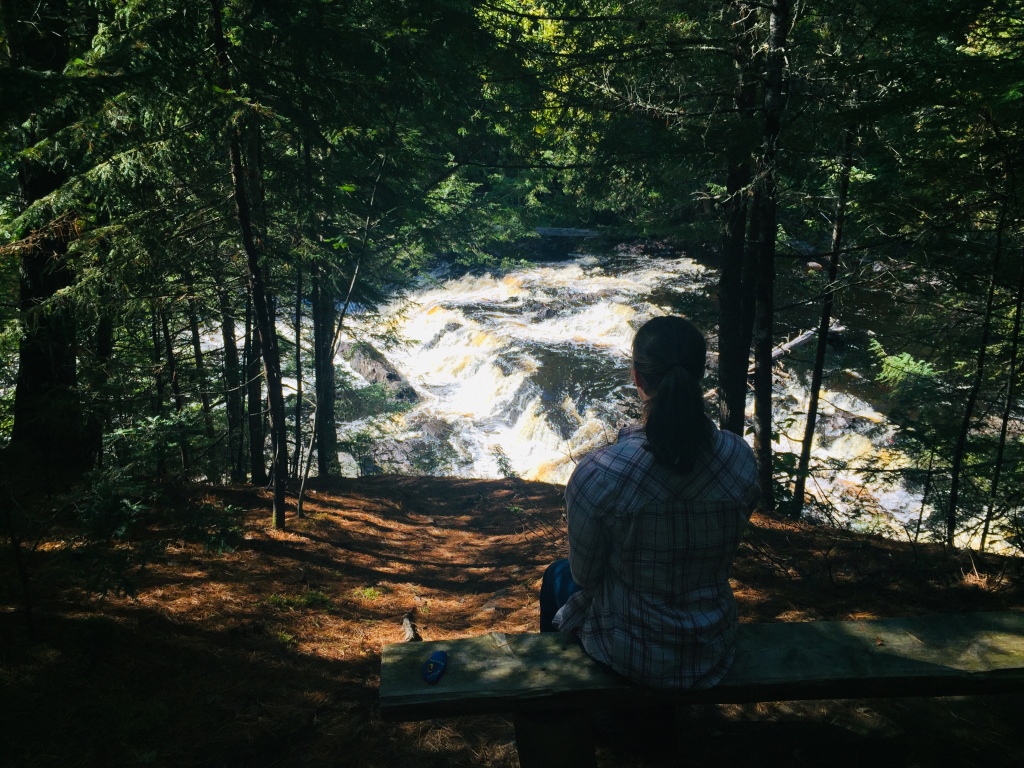
Observation bench, Mariaville Falls Preserve, ME

First, breathe. We were fortunate to be born in a country with the infrastructure and prosperity to get through this. Here in Maine, we are less-densely populated than most other places, surrounded by an embarrassment of natural riches in the form of the coast, lakes, and mountains.

Second, prioritize. Number one is the safety of you and your family, and others in the community at large. Follow directives of the Maine CDC. The National Recreation and Park Association has issued a helpful statement, with guidelines on social distancing while using parks and open space. And be ready to turn around. Ironically, outdoor spaces have become more crowded. As of March 26, York had closed down its beaches after a crush of people showed up, and Maine closed selected coastal state parks until April 8 due to overcrowding. Acadia National Park has closed facilities indefinitely to discourage out-of-state visitors. The Appalachian Trail Conservancy has requested that all hikers stay off the trail for at least two weeks, due to unprecedented crowding that is “the opposite of social distancing.”

Got all the spacing, sanitizing, and trail closures down? Great. Now pick your hike. Stay local. Try this article by Carey Kish on a Dozen Great Hikes to Celebrate Maine’s Bicentennial. Use Portland Trails’ great online maps to grab something closer to Portland. Try AllTrails, MaineByFoot or MaineTrailFinder. Find a land trust in Maine. Or look at our interactive map and trail guide.

Top Five Easy Nature Fixes within about an hour of Portland?

Cliff Walk at Prout’s Neck (Scarborough) (As of March 26, 2020, this appears to be closed due to COVID-19)

Morse Mountain/Seawall Beach (Phippsburg) (As of March 29, 2020, this is closed to the public due to COVID-19)

Burnt Meadow Mountain (Brownfield)

Fore River Sanctuary (Portland)

Mill Brook Preserve (Westbrook)

Remember- these are close, and popular, and may be crowded. The Portland Press Herald also just published a list of wild lands for exploration during this strange time.
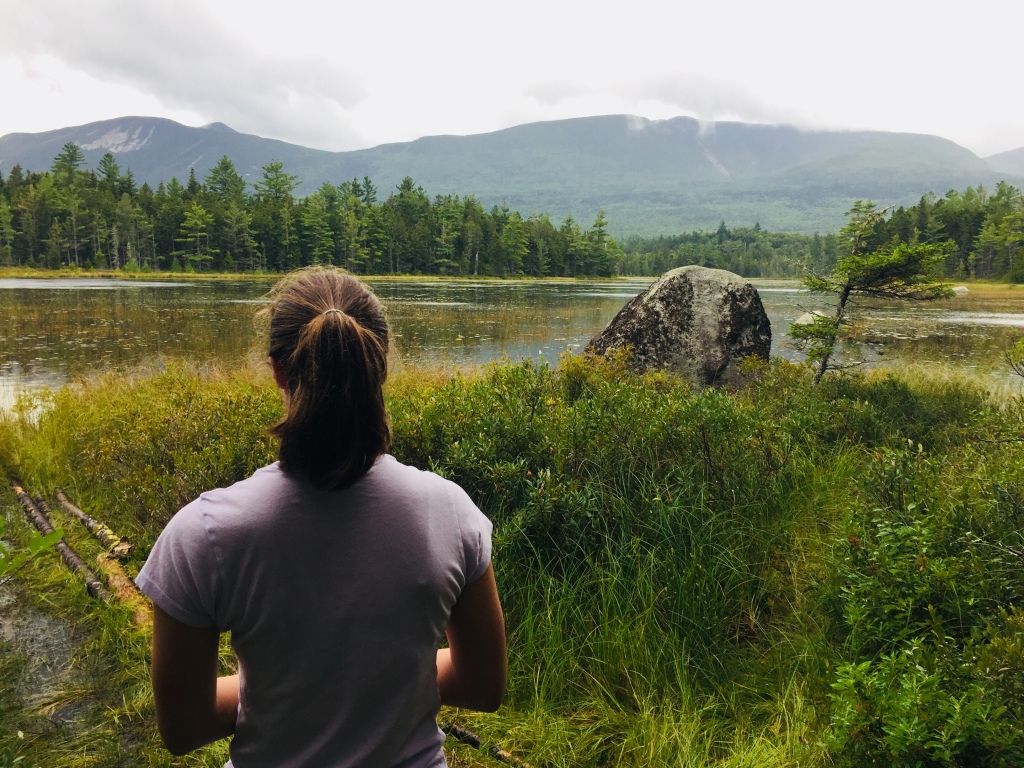
Looking across Elbow Pond to Mt O-J-I and Barren Mountain, Baxter State Park

Again, check state and local guidelines on the trails or parks you are using. Some may be closed due to COVID-19, some may just be closed to protect trails during mud season. The best source of information is the maintainer of the trails, whether that be a government agency, a municipality, a land trust, or a non-profit.

The point is not some Instagram-worthy photo opportunity, it’s fresh air and time in nature, so don’t sweat the surroundings. Baxter Woods or Evergreen Cemetery are great places to walk. If you can’t make it way out onto remote trails, there are other outdoor options. Last weekend, dad and daughter took advantage of the sunny weather, using Portland Trails and the East Coast Greenway to safely walk ten-plus miles to Wainwright Fields in South Portland.

Check out this Press Herald article on what to do when your plans are cancelled due to virus restrictions. Look at this Bangor Daily News feature on educational outdoor family activities. And if you are looking for educational opportunities outdoors for children during closures, try Learning on the Trails, a “pop-up virtual, trail-based education initiative” by filling out this form for Portland Trails.
This is not meant to be a flippant article, but suggestions specific to getting outdoors in the Portland area. People are deeply affected by this pandemic. Post-hike, consider getting takeout or delivery from a local restaurant – Portland’s Old Port has an updated list of businesses where this is available, as does Portland Food Map. The best place to look for where to help is at your friends and neighbors, but donations of money or time to places like Preble Street or national charities like the Salvation Army or Meals on Wheels can help those less fortunate.

The Portland Press Herald also recently featured a list of ways to help in your community during the pandemic.

So see you on the trail. We won’t get closer than six feet, but we will wave and say hi, and we’ll get through this together.

(Note: we will be updating this post as new opportunities develop)

Mill Brook Preserve South (Westbrook, ME)

Mill Brook Preserve South, a 32-acre annex/extension of the Mill Brook Preserve, opened its trails in October 2019, and has a 1.5 mile easy lollipop loop for hiking, running, snowshoeing, and cross-country skiing, ending in a short spur trail with the opportunity to view the annual migration of the alewives in late May and June. As with the Mill Brook Preserve, the best information and trail map can be found at the website of the Presumpscot Regional Land Trust, which holds this land, and coordinates the 28-mile Sebago to the Sea Trail.

Kiosk at Mill Brook Preserve South trailhead, Millbrook Estates, Westbrook, Maine

The Mill Brook Preserve South trailhead is located next to well-marked parking spaces in the Millbrook Estates (300 E. Bridge St, Westbrook). We hiked the loop and the spur a couple times in February 2020, an easy hike of about forty minutes. The trail was packed snow, with softer snow on the margins, and I would suggest traction devices (Yaktrax or microspikes) to avoid slipping and sliding.

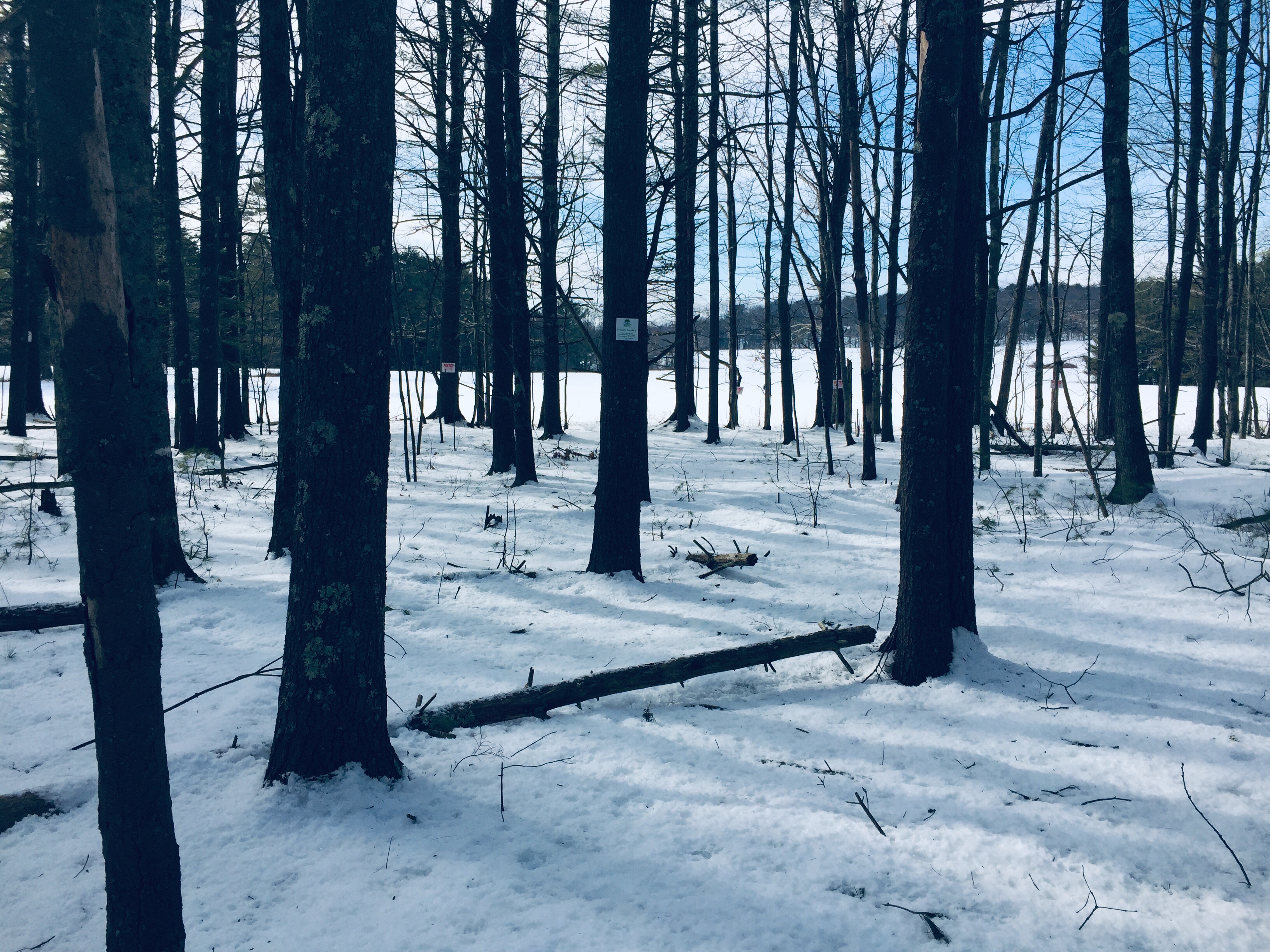
Edge of forest at southwest end of Mill Brook Preserve South adjoining cattle farm, Westbrook, Maine

We saw woodpeckers and red squirrels, as well as the tracks of deer. Dogs are allowed on the trail, but must be leashed, especially in the portion next to the working cattle farm (you will see signs). The beginning of the trail is next to a horse farm, so children may enjoy seeing these domesticated animals, if you strike out with woodland creatures.

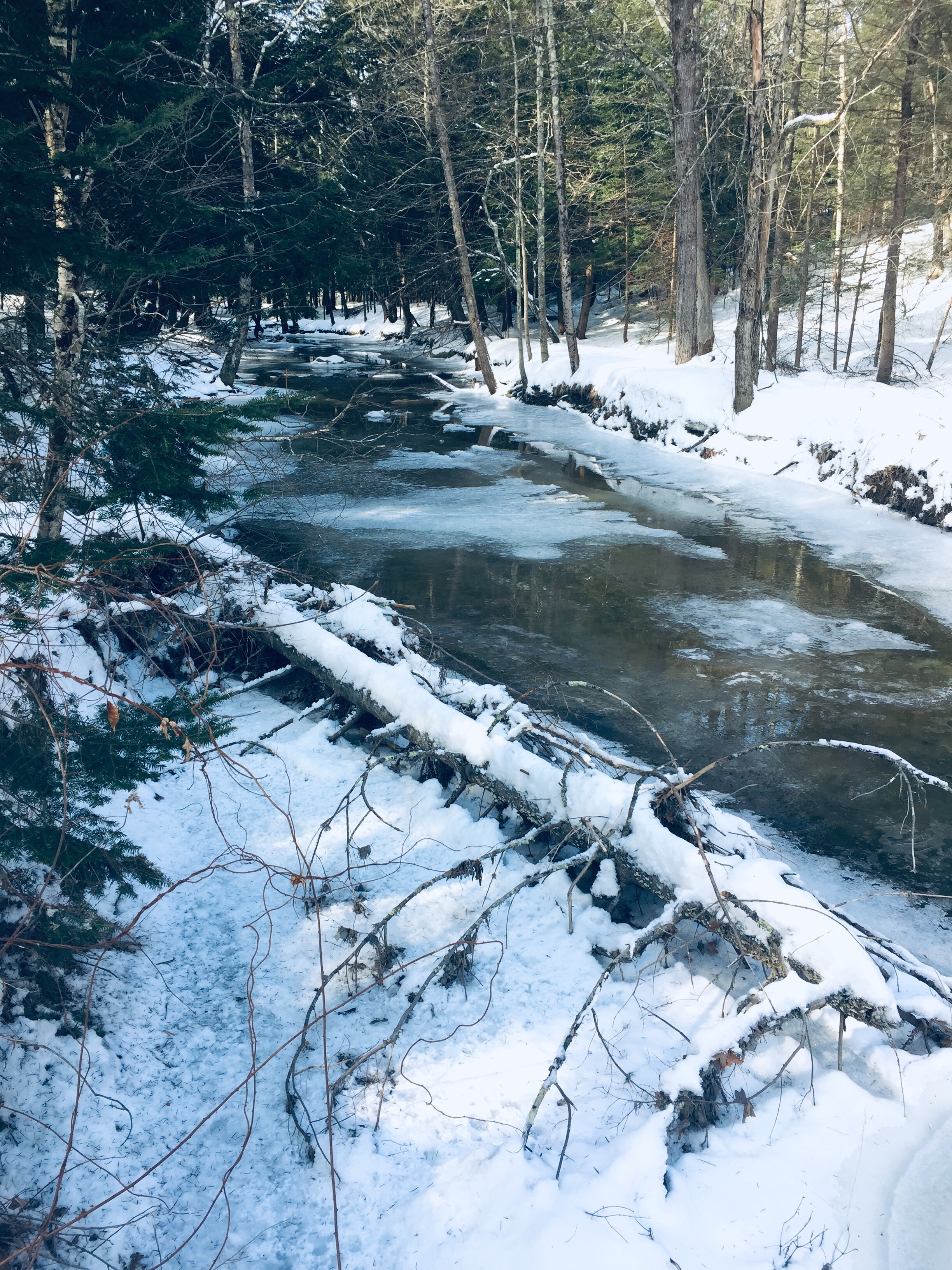
Mill Brook in winter, Mill Brook Preserve South, Westbrook, Maine

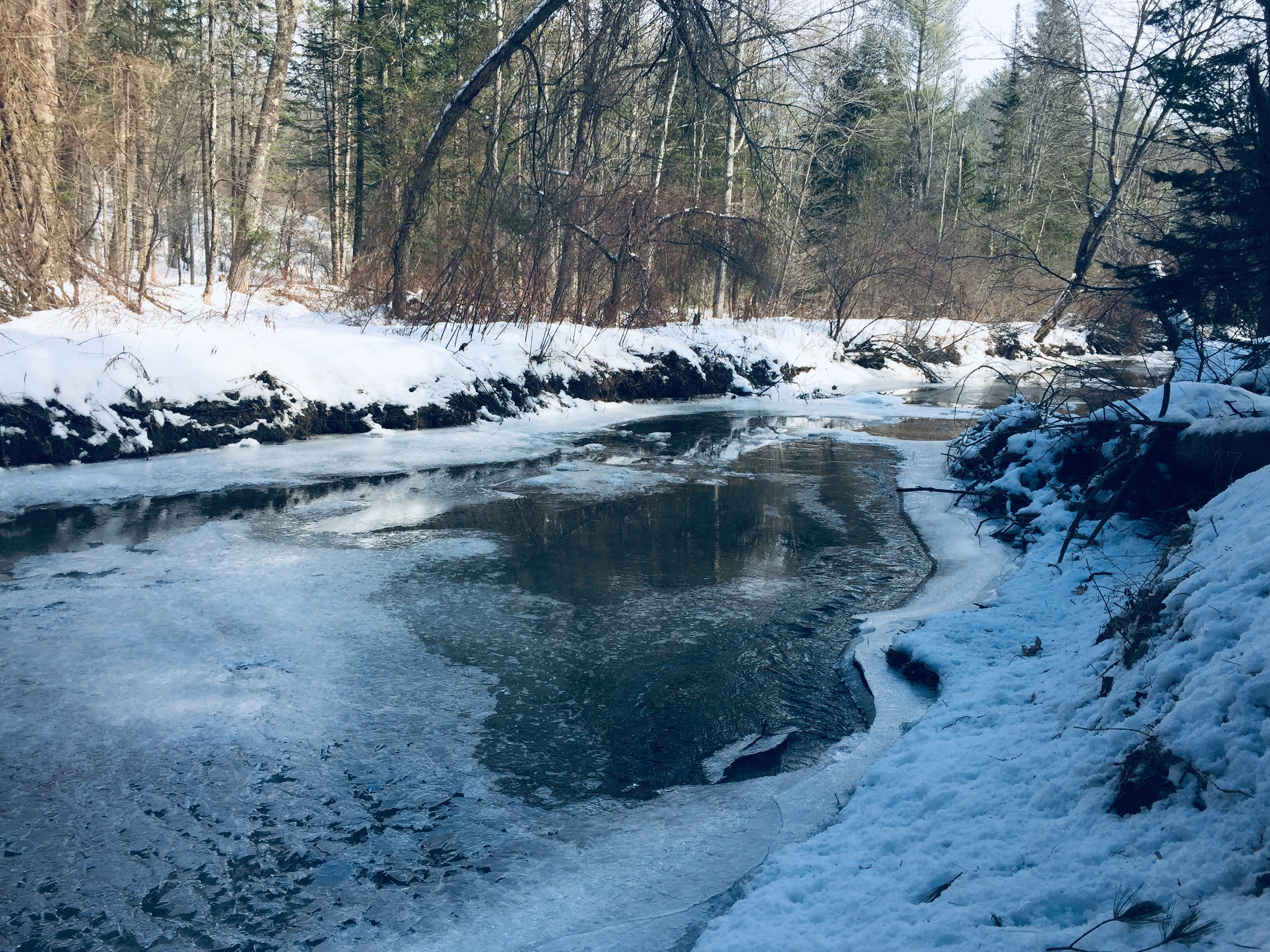
The spur trail midway through the loop leads downhill to Mill Brook, and on this winter visit, the flow was mostly under a sheet of ice, with an open area close to the near bank. In early summer, this area can be a great spot to watch the alewives run (and a midway picnic stop with smaller kids).

Mill Brook in winter, Mill Brook Preserve South, Westbrook, Maine

As in its northern sister preserve, navigation along the trails is forgiving and self-correcting, with maps posted at critical intersections throughout the Preserve.

5 Best Hiking and Outdoor Podcast Episodes of February 2020

Back in 2018, we ranked our top ten hiking and outdoors podcasts of 2018.  In 2019, we changed the format, listing our five favorite hiking and outdoors individual podcast episodes of 2019.  We consume a lot of podcasts, and those focused on being outdoors seem to have proliferated exponentially since we started listening.  That’s why, in 2020, we are trying something new.  This year, we will attempt to pick out the five best hiking and outdoors podcast episodes each month (or at least our favorites).

The best podcasts we heard in February focused on mindfulness – bringing wildlife to the forefront through art, to living purposefully, without technological input, to mental training and using the outdoor spaces we have.  Below are the five best hiking and outdoors podcast episodes we listened to in February 2020, with a brief description of each podcast.

A warning – playing podcasts or music on external speakers while hiking is basically a capital offense.  Playing podcasts or music through headphones/earbuds while hiking is somewhere in the spectrum of inadvisable to mortally dangerous.  Just from a common sense standpoint, why would you want to have your hearing and attention somewhere else if you want to maximize the benefits of being immersed in the outdoors (or, more basically, fail to hear the bear you just startled)?  All that being said, hike your own hike.

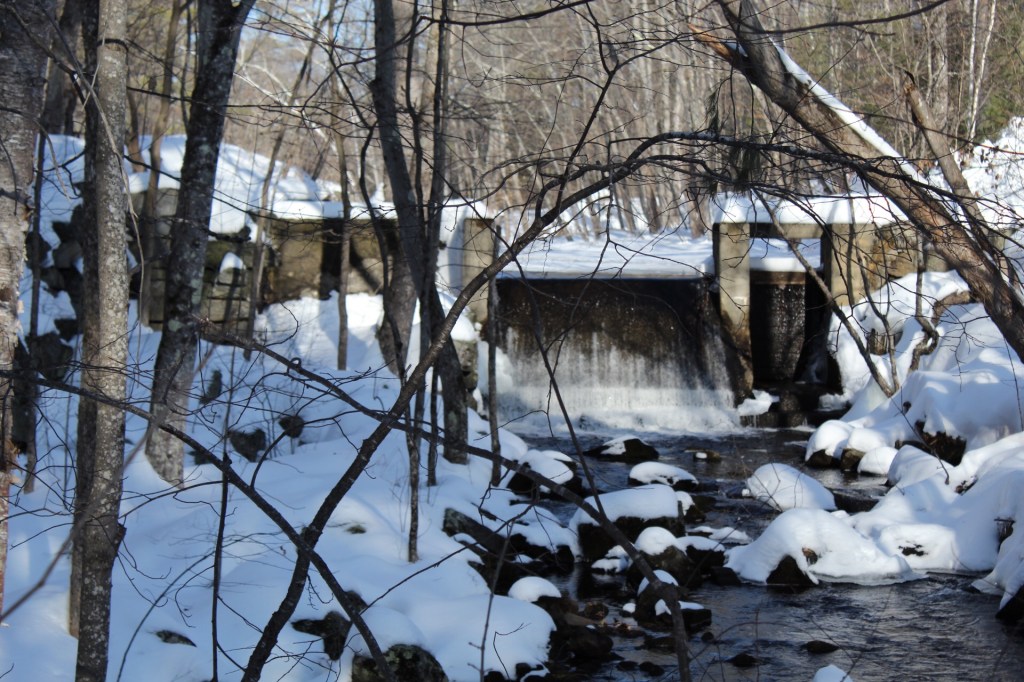
Icy mill dam outlet of Heald Pond, Lovell, ME


outside1. A Long-Shot Bid to Save the Monarch Butterfly (February 5, 2020) from Outside Podcast

Driving by Californa billboards, artist Jane Kim was inspired to begin creating large-scale public murals of animals along the migration routes they share with humans.  This idea, beginning with Sierra Nevada Bighorn Sheep along California highway 395, has recently culminated in a painting that includes a 50-foot-tall monarch butterfly, on a 13-story building in San Francisco’s Tenderloin district.

This public art helps the viewer realize what is possible, places the animal in the conscious mind, and draws attention to the potential shared environment for these creatures in urban green spaces (37 minutes).

Apple Podcast link: A Long-Shot Bid to Save the Monarch Butterfly


Outside In2. Nature Has Done Her Part (February 6, 2020) from Outside/In Podcast

The title of this episode is drawn from a Milton quote favored by conservationist and author Guy Waterman: “Accuse not Nature, she hath done her part; do thou but thine.”  Guy suffered from depression, and died of exposure on Franconia Ridge in 2000.  Guy’s widow, Laura Waterman, tells her story in this episode.  Both Guy and Laura escaped office jobs, turning to the mountains of Vermont and a subsistence life in the woods.

At their home, they meticulously documented and recorded everything, from rainfall to temperature, to maple syrup, to the top-producing blueberry bushes, an accounting of nature’s minutiae that led to a heightened awareness.  The books Guy and Laura wrote, including Backwoods Ethics, explored timely issues like the capacity of natural places for human use, and Laura explains the progression of these ideas over time.

Apple Podcast link: Nature Has Done Her Part


OutThere_logo-variations-13

3. Brain on Nature (February 6, 2020) from Out There Podcast

In 2015, Australian journalist Sarah Allely suffered a mild traumatic brain injury after being hit by a car while riding her bike, and struggled to regain her former brain function. Allely documented her recovery in a documentary podcast series called Brain on Nature.  Allely began to notice the recuperative effect of nature, starting by spending time in her garden.

Allely interviewed experts, and found the results made sense –  mindful time in nature is the opposite of looking at screens, and can be stimulating to the brain, but also restful and restorative.  The overload on the prefrontal cortex can sometimes be alleviated by something as simple as a walk in nature (42 mins).

Apple Podcast link: Brain on Nature


Training for Trekking

4. Preparing For Uneven Terrain (February 3, 2020) from The Training for Trekking Podcast

This concise weekly podcast by Australian trainer Rowan Smith focuses on practical tips to train for hiking and mountaineering.  In this February episode, Smith relays specific advice for preparing to tackle hikes over uneven and rough terrain.  According to Smith, the best preparation is (obviously) hiking, followed by strength training.  Smith recommends single-leg strength and proprioreception training to promote stability and injury prevention.

Following this strength advice, Smith pivots to belly breathing and a focus technique as an inoculation against stress.  The physical and mental strategies outlined in this short episode can be used to prepare your body for jumping over actual rocks and roots, or the more metaphorical uneven path we all traverse (15 minutes).

Apple Podcast link: Preparing For Uneven Terrain


Wild Ideas Worth Living5. Shanti Hodges: Getting Kids Outside from Wild Ideas Worth Living

In this episode, Shelby Stanger checks in with Shanti Hodges, who created Hike It Baby, which has become a nationwide network of parents and children hiking together and creating support groups through a shared activity.  Hodges, a new mother in Portland, Oregon, grew frustrated with the limited activities for mothers and babies, and built her own community from the ground up.

Hodges discusses the challenges of parenthood, and the benefits (and limits) of the outdoors.  Hodges then details her pivot from being consumed by Hike It Baby to her now spending more time with her son, and guiding and running womens’ retreats, while keeping involved with Hike It Baby.  Stanger and Hodges then close with a helpful discussion of the best tips and gear for hiking with very small children (39 minutes).

Apple Podcast link: Shanti Hodges: Getting Kids Outside


Disagree?  Have suggestions?  Leave a comment or Contact us.