



(Note: no pets or bikes are allowed on the trail)
(Note: no pets or bikes are allowed on the trail)
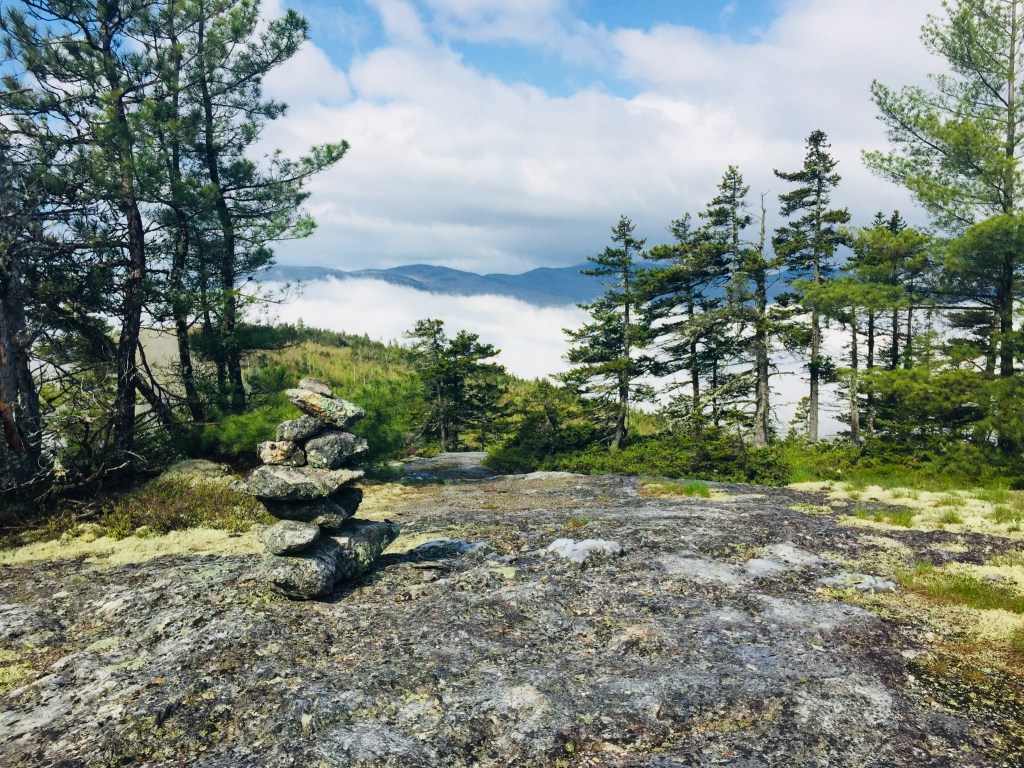
Rumford Whitecap Mountain (2,214 ft) in Rumford is accessible through trails maintained by the Mahoosuc Land Trust (MLT), for a 5.4 mile out/back to the summit on the Orange Trail (or slightly longer using the Starr and Orange Trails), or a longer traverse over Black Mountain via the Black/White Trail (requires spotting a car). MLT’s website advertises Rumford Whitecap as a four-season destination for hiking, snowshoeing, and back country skiing, with blueberries in the summer.

I have ascended via the Connector to the Starr Trail (marked with yellow blazes and flagging tape), and returned via the Orange Trail, and would suggest this route (or its reverse) for the views, rather than just the Orange Trail. I used the guidebooks Maine Mountain Guide and Maine Hikes Off the Beaten Path for detailed trail maps and descriptions. You can also find a map on the AllTrails app or Maine Trailfinder (link at the MLT website above).

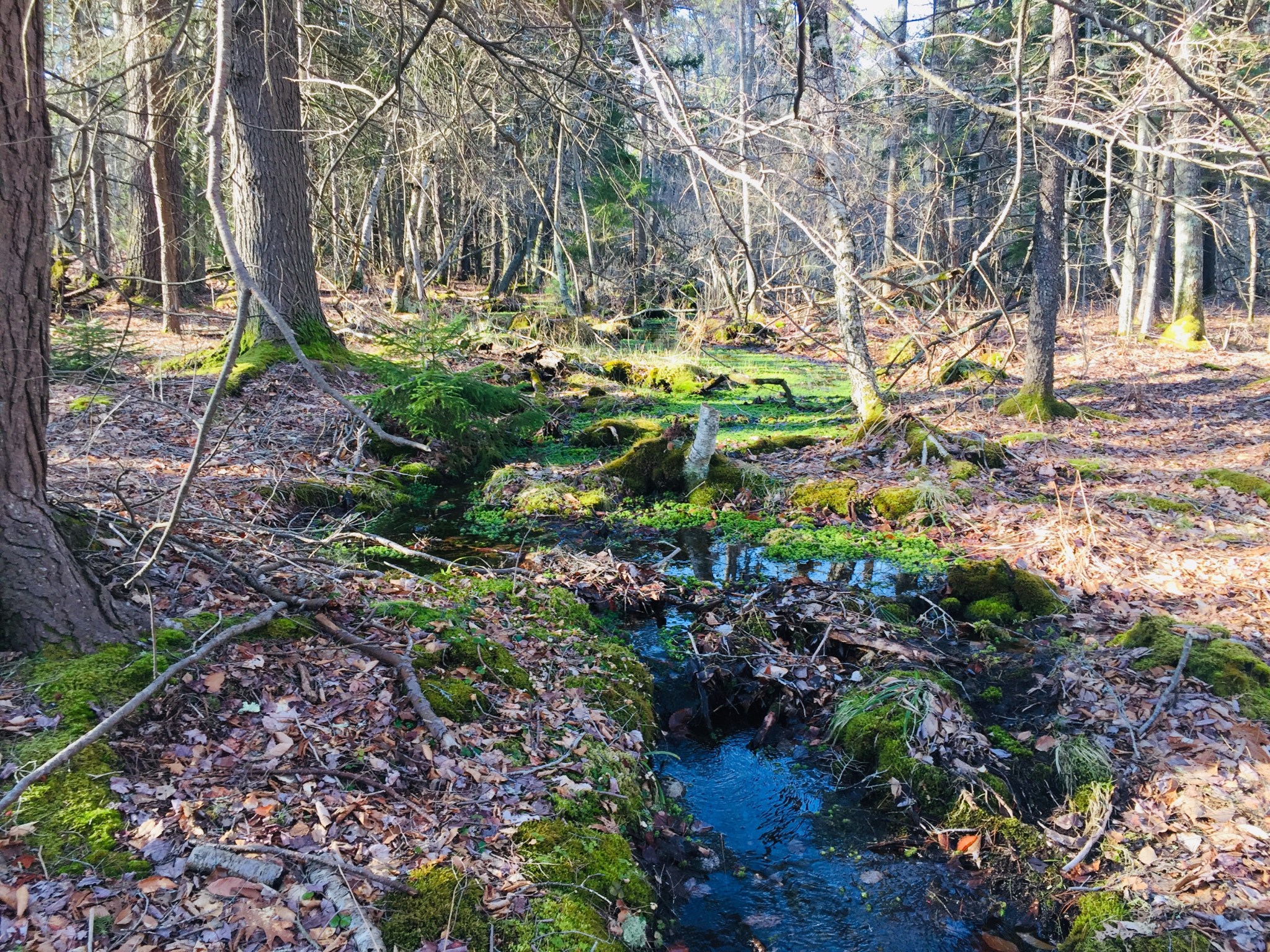
Both trails, divided by a pleasantly running brook in a valley between them, were muddy, but well-maintained. The Connector crossed the brook, with spring runoff created small waterfalls along the way. Rains can create a morning fog, but also spur the growth of a variety of May wildflowers from the trailhead to the summit.

The Starr Trail transitions from a grassy woods road to a winding climb, becoming more strenuous as the deciduous forest changes to a more sparse, rocky pine forest, and opens up on ledges with spectacular views of the Mahoosucs and White Mountains.

After the junction with the Orange Trail, the summit is only about another .5 miles, hopping over small cool rivulets of water running down the exposed rock face. Close to the summit last May, there was what appeared to be a large deposit of bear poop, but a quick look around didn’t disclose any prints. The summit itself is open in all directions, and a great spot for a picnic.
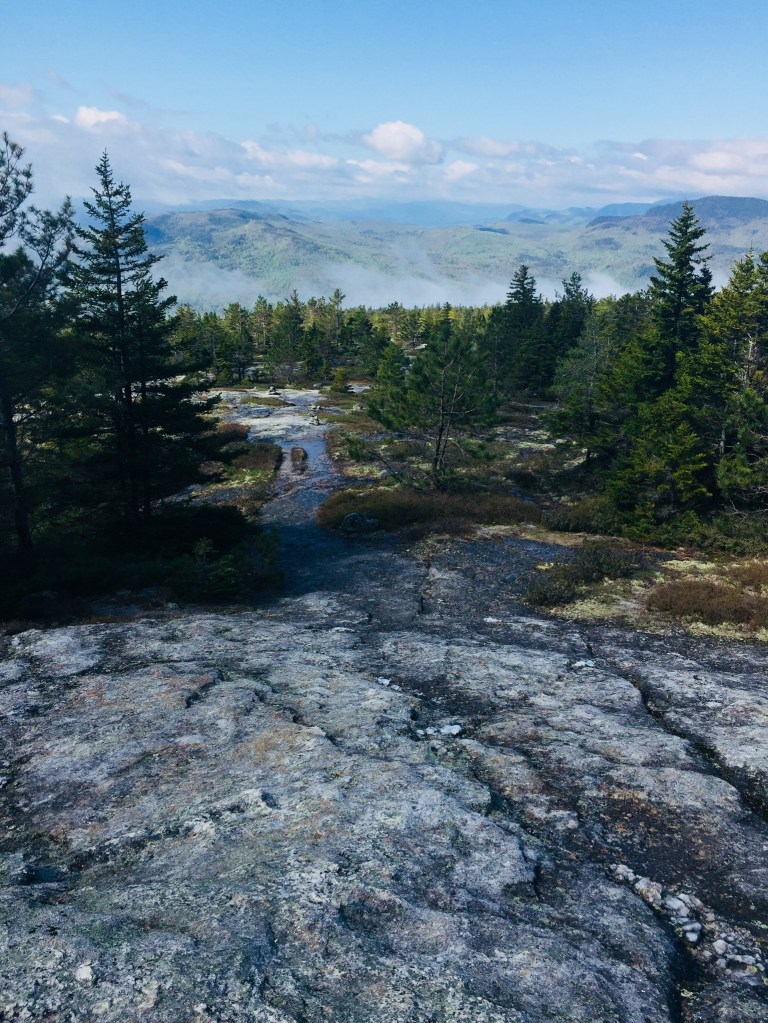
After a brief rest at the summit to enjoy the view and chew on some jerky, I headed back down the Orange Trail. The trail ran like a creek in places, with the spring rains, and remains diverted for a section. The hike can take about two to two and-a-half hours, with plenty of stops to listen to birdsong, inspect wildflowers, watch bumblebees at work, and pick up and inspect pieces of quartz.
(Disclaimer: This post contains affiliate links, and as an Amazon Associate Hiking in Maine blog earns from qualifying purchases.)
Back in 2018, we ranked our top ten hiking and outdoors podcasts of 2018. In 2019, we changed the format, listing our five favorite hiking and outdoors individual podcast episodes of 2019. We consume a lot of podcasts, and those focused on being outdoors seem to have proliferated exponentially since we started listening. That’s why, in 2020, we are trying something new. This year, we will attempt to pick out the five best hiking and outdoors podcast episodes each month (or at least our favorites).
March 2020 saw a seismic shift in what we knew to be normal, with all conversations dominated by a global pandemic. The outdoors became an escape, and then, in some cases, an impossibility, due to localized rules. This “best of” list took awhile (yes, it’s almost mid-April), due to the disruption of routines. But podcasts can help us process all these changes and share ideas, or simply let us escape for a few minutes. Hopefully, we struck a good balance between useful advice and outdoor escapism (and humor). Below are the five best hiking and outdoors podcast episodes we listened to in March 2020, with a brief description of each podcast.
A warning – playing podcasts or music on external speakers while hiking is basically a capital offense. Playing podcasts or music through headphones/earbuds while hiking is somewhere in the spectrum of inadvisable to mortally dangerous. Just from a common sense standpoint, why would you want to have your hearing and attention somewhere else if you want to maximize the benefits of being immersed in the outdoors (or, more basically, fail to hear the bear you just startled)? All that being said, hike your own hike.
 1. Lessons Learned and Empathy Earned (March 5, 2020) from Rich Roll Podcast
Rich Roll’s prolific, wide-ranging podcast explores the outdoors and the inner self, and Roll generated a podcast episode a week for seven straight years without a vacation. Roll then took his own advice, and took December 2019 off, prior to appearing on the cover of Outside Magazine in January 2020. This episode contains audio from Outside’s interview of Roll, in which Roll tells the story of his journey.
Rich Roll, a competitive high school swimmer, was first introduced to alcohol during college recruiting trips. Roll describes how his relationship to alcohol stunted his growth as a college athlete, then an attorney. A 100 day stay in rehab began Roll’s journey, giving him the tools he would eventually use in recovery. But Roll’s realization of his own poor health then resulted in big changes, as he overhauled his diet and returned to swimming and running. One day, a planned, routine 5-6 mile run kept going, and Roll, trusting a faint but life-altering whisper, found his calling as an ultra-endurance athlete. This episode contains great insights and anecdotes about Roll’s journey to self-actualization, and the help he received along the way (53 minutes).
Apple Podcast link: Lessons Learned & Empathy Earned: The Story Behind The Story
 2. Denali with Chris Lang (March 4, 2020) from Foot Stuff Podcast
Each Foot Stuff Podcast episode begins with the phrase, “A comedic deep dive into . . . ” In this case, the crew begins with a review of their own outdoor activities since last podcast, consisting of running, skiing, and ice fishing in and around the Adirondacks. A funny discussion of lesser-known collective nouns (“prickle of porcupines, raft of ducks, parliament of owls”) then precedes detailed advice on navigating a slide in winter, including training, equipment, and going as a group.
The meat of the podcast is a discussion of Denali, North America’s tallest summit, as climbed by podcast guest Chris Lang. Lang describes his introduction to winter mountaineering, starting with a winter ascent of New Hampshire’s Mount Washington, and quickly accelerating to a twenty day guided trip with Alpine Ascents to Denali’s summit. The comedic deep dive includes both the soaring highlights and the less glamorous parts of this adventure, including a (shared) (disappearing) poop bucket, in-tent smells, extreme weather, heavy gear, substantial expense, and rigorous training. “Dave,” a fellow traveler, is the big loser in this story, based upon numerous unforced errors and violations of unspoken outdoor ethics (“Suck it, Dave”). This story about what it takes to summit Denali, and the entire light-hearted podcast, may be just what you need right now (1 hr 33 mins).
Apple Podcast link: Denali with Chris Lang
Rudy Giecek’s hiking and backpacking interview show covers much more than just the Cascades. In this episode, Rudy interviews Kindra Ramos of the Washington Trails Association (WTA), for a timely discussion of how to help people get outside safely. Ramos focuses on social distancing as common sense – staying closer to home, not putting a strain on rural communities or first responders, and exploring lesser-known trails.
This description of trail management in Washington, from an area that took a heavy initial hit from the COVID-19 pandemic, is a good analog for Maine and the Northeast, with positive, practical advice – pick trails with less trail reports/activity. Stay with existing family/household members. If you are in the backcountry, take extra precautions, and be fully prepared. Busy trailhead? Have a second plan, and move on. Ramos closes with a point that will affect all of us – how can we help build sustainable trails for the future, and what role can the people now getting outside play in being future advocates for the outdoors (18 mins)?
Apple Podcast link: Socially Distant
 4. In It Together (March 29, 2020) from The Firn Line
Evan Phillips’ Alaska-based podcast explores the lives of mountain climbers. This listener-centered episode is a check-in with The Firn Line community during the Covid-19 pandemic, featuring interviews and clips gathered from March 22 to March 28, 2020 in Canada, Scotland, and the US.
People, particularly those used to the freedom of the outdoors, respond in different ways to isolation. There are ideas here for connection with family, for donations, for community service, for exercise, for “play.” Topics include gratitude, getting to know neighbors, and how communities are supporting each other in different places. Listeners also discuss self-care and lowering expectations for productivity, while maintaining connection during isolation, including a comparison to Alaska’s winter darkness, and resultant cabin fever (48 minutes).
Apple Podcast link: In It Together
Australian trainer Rowan Smith’s podcast normally focuses on practical tips to train for hiking and mountaineering. In this episode, Smith presents ideas for staying motivated and moving forward across a variety of circumstances and pandemic-imposed limitations. Smith’s great introduction draws on his childhood and his imagination to provide an example on how to immerse yourself in an activity, even when there are barriers.
Smith explores the ‘micro-adventure’ – doing what you can. He recommends books to keep adventure in mind if you cannot be outside (I would wholeheartedly endorse his suggestion of “Breath” by Tim Winton), as well as movies. Smith closes with two more ideas for keeping the adventure alive – use the time to refresh or find new skills like navigation or first aid, and/or plan and research your next big adventure in depth, to be ready when this strange time is over (15 minutes).
Apple Podcast link: Keeping The Adventure Alive
Disagree? Have suggestions? Leave a comment or Contact us.
With the temporary closure of schools and businesses, the uncertainty in the air, and the moratorium on group activities in many places, the universal mood seems to be a somber one, at best. But, with care, resolve, and education (try this article on social distancing), a more sanguine view can prevail. What is a healthy thing to do that requires relative isolation – six feet of separation with non-family members, and no direct contact with surfaces that might contain lingering viruses?

Hiking, in its many forms, needs no more cheerleading for its holistic wellness benefits. But getting outside for mental health has never been more important. Here in Portland, Maine, schools will be closed until at least the end of April, a stay-at-home order has been issued, and non-essential businesses are temporarily closing. These actions, and others, can all have degenerative ripple effects on time, and on physical and mental health, if we let them.
First, breathe. We were fortunate to be born in a country with the infrastructure and prosperity to get through this. Here in Maine, we are less-densely populated than most other places, surrounded by an embarrassment of natural riches in the form of the coast, lakes, and mountains.
Second, prioritize. Number one is the safety of you and your family, and others in the community at large. Follow directives of the Maine CDC. The National Recreation and Park Association has issued a helpful statement, with guidelines on social distancing while using parks and open space. And be ready to turn around. Ironically, outdoor spaces have become more crowded. As of March 26, York had closed down its beaches after a crush of people showed up, and Maine closed selected coastal state parks until April 8 due to overcrowding. Acadia National Park has closed facilities indefinitely to discourage out-of-state visitors. The Appalachian Trail Conservancy has requested that all hikers stay off the trail for at least two weeks, due to unprecedented crowding that is “the opposite of social distancing.”
Got all the spacing, sanitizing, and trail closures down? Great. Now pick your hike. Stay local. Try this article by Carey Kish on a Dozen Great Hikes to Celebrate Maine’s Bicentennial. Use Portland Trails’ great online maps to grab something closer to Portland. Try AllTrails, MaineByFoot or MaineTrailFinder. Find a land trust in Maine. Or look at our interactive map and trail guide.

Top Five Easy Nature Fixes within about an hour of Portland?
Cliff Walk at Prout’s Neck (Scarborough) (As of March 26, 2020, this appears to be closed due to COVID-19)
Morse Mountain/Seawall Beach (Phippsburg) (As of March 29, 2020, this is closed to the public due to COVID-19)
Burnt Meadow Mountain (Brownfield)
Fore River Sanctuary (Portland)
Mill Brook Preserve (Westbrook)
Remember- these are close, and popular, and may be crowded. The Portland Press Herald also just published a list of wild lands for exploration during this strange time.
Again, check state and local guidelines on the trails or parks you are using. Some may be closed due to COVID-19, some may just be closed to protect trails during mud season. The best source of information is the maintainer of the trails, whether that be a government agency, a municipality, a land trust, or a non-profit.
The point is not some Instagram-worthy photo opportunity, it’s fresh air and time in nature, so don’t sweat the surroundings. Baxter Woods or Evergreen Cemetery are great places to walk. If you can’t make it way out onto remote trails, there are other outdoor options. Last weekend, dad and daughter took advantage of the sunny weather, using Portland Trails and the East Coast Greenway to safely walk ten-plus miles to Wainwright Fields in South Portland.
Check out this Press Herald article on what to do when your plans are cancelled due to virus restrictions. Look at this Bangor Daily News feature on educational outdoor family activities. And if you are looking for educational opportunities outdoors for children during closures, try Learning on the Trails, a “pop-up virtual, trail-based education initiative” by filling out this form for Portland Trails.
This is not meant to be a flippant article, but suggestions specific to getting outdoors in the Portland area. People are deeply affected by this pandemic. Post-hike, consider getting takeout or delivery from a local restaurant – Portland’s Old Port has an updated list of businesses where this is available, as does Portland Food Map. The best place to look for where to help is at your friends and neighbors, but donations of money or time to places like Preble Street or national charities like the Salvation Army or Meals on Wheels can help those less fortunate.
The Portland Press Herald also recently featured a list of ways to help in your community during the pandemic.
So see you on the trail. We won’t get closer than six feet, but we will wave and say hi, and we’ll get through this together.
(Note: we will be updating this post as new opportunities develop)
Mill Brook Preserve South, a 32-acre annex/extension of the Mill Brook Preserve, opened its trails in October 2019, and has a 1.5 mile easy lollipop loop for hiking, running, snowshoeing, and cross-country skiing, ending in a short spur trail with the opportunity to view the annual migration of the alewives in late May and June. As with the Mill Brook Preserve, the best information and trail map can be found at the website of the Presumpscot Regional Land Trust, which holds this land, and coordinates the 28-mile Sebago to the Sea Trail.

The Mill Brook Preserve South trailhead is located next to well-marked parking spaces in the Millbrook Estates (300 E. Bridge St, Westbrook). We hiked the loop and the spur a couple times in February 2020, an easy hike of about forty minutes. The trail was packed snow, with softer snow on the margins, and I would suggest traction devices (Yaktrax or microspikes) to avoid slipping and sliding.
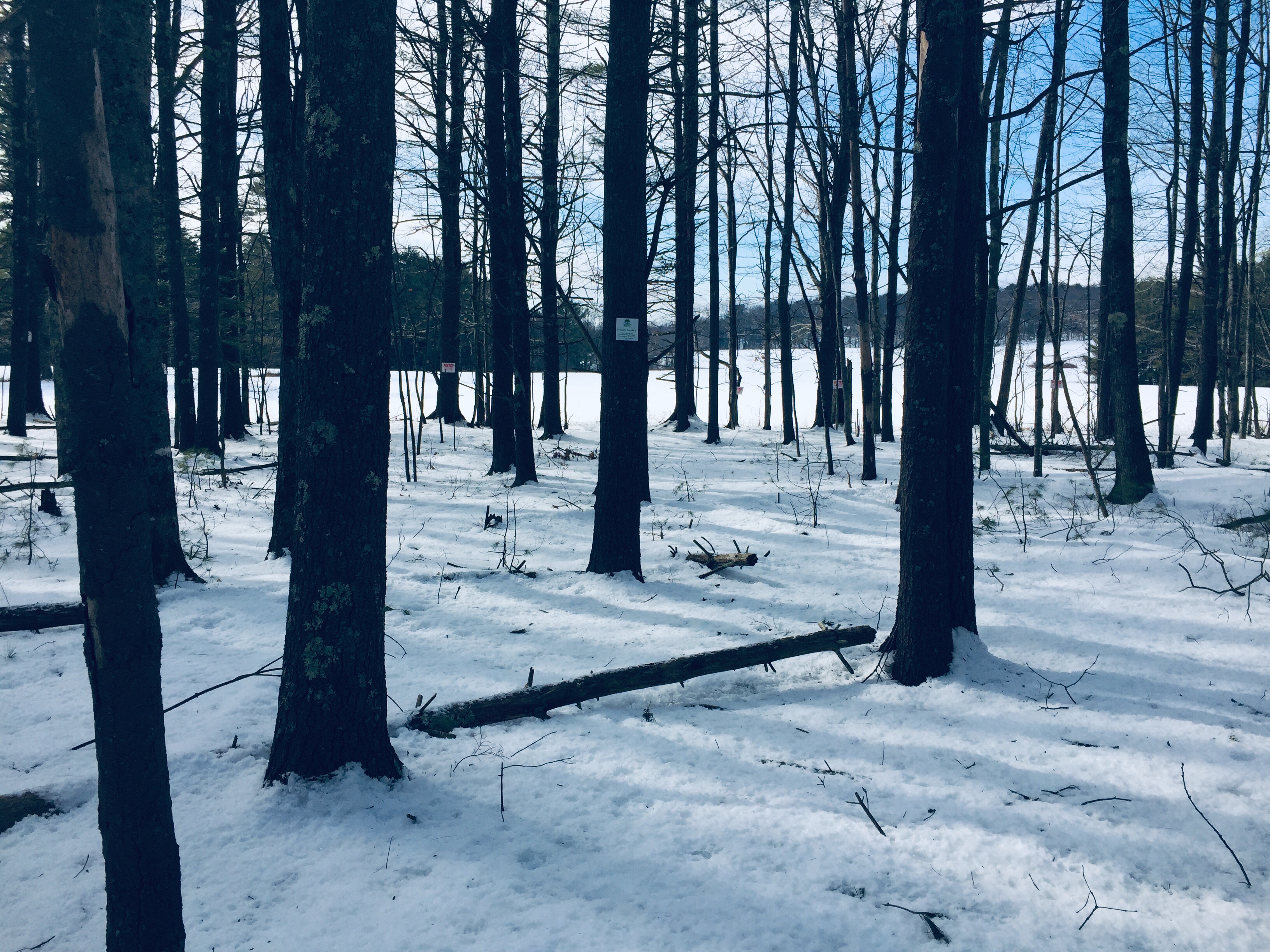
We saw woodpeckers and red squirrels, as well as the tracks of deer. Dogs are allowed on the trail, but must be leashed, especially in the portion next to the working cattle farm (you will see signs). The beginning of the trail is next to a horse farm, so children may enjoy seeing these domesticated animals, if you strike out with woodland creatures.
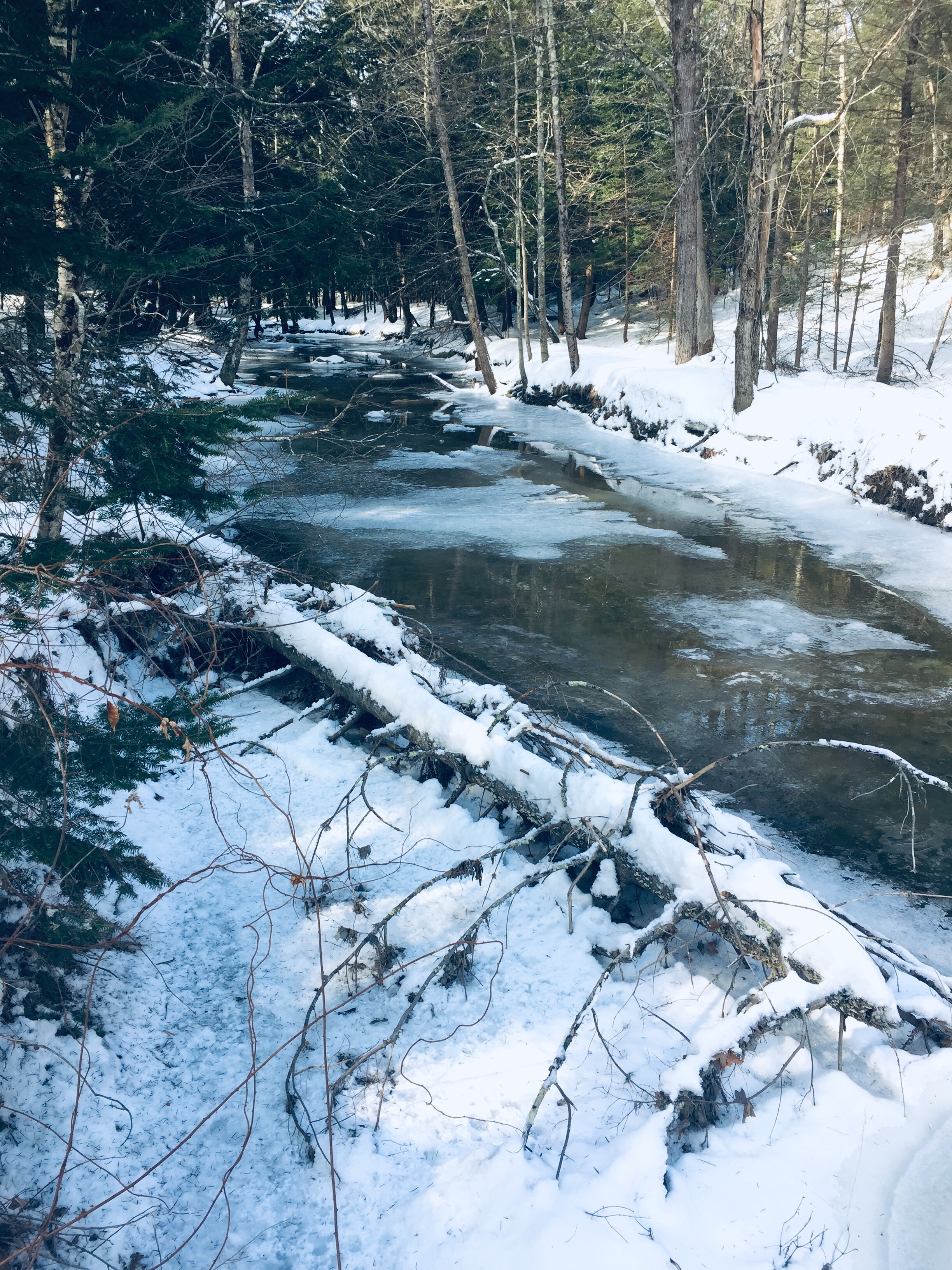
The spur trail midway through the loop leads downhill to Mill Brook, and on this winter visit, the flow was mostly under a sheet of ice, with an open area close to the near bank. In early summer, this area can be a great spot to watch the alewives run (and a midway picnic stop with smaller kids).
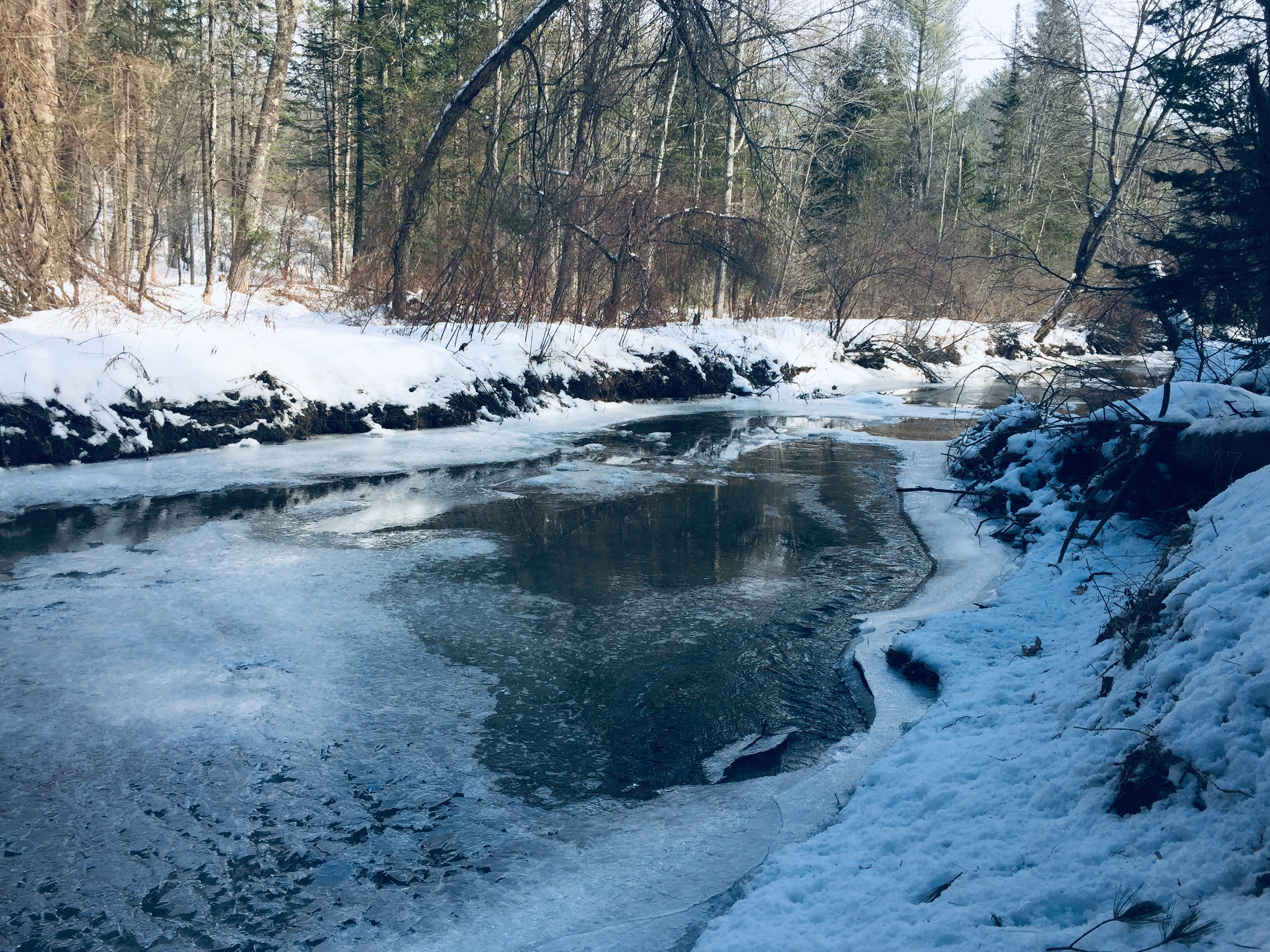
As in its northern sister preserve, navigation along the trails is forgiving and self-correcting, with maps posted at critical intersections throughout the Preserve.

Back in 2018, we ranked our top ten hiking and outdoors podcasts of 2018. In 2019, we changed the format, listing our five favorite hiking and outdoors individual podcast episodes of 2019. We consume a lot of podcasts, and those focused on being outdoors seem to have proliferated exponentially since we started listening. That’s why, in 2020, we are trying something new. This year, we will attempt to pick out the five best hiking and outdoors podcast episodes each month (or at least our favorites).
The best podcasts we heard in February focused on mindfulness – bringing wildlife to the forefront through art, to living purposefully, without technological input, to mental training and using the outdoor spaces we have. Below are the five best hiking and outdoors podcast episodes we listened to in February 2020, with a brief description of each podcast.
A warning – playing podcasts or music on external speakers while hiking is basically a capital offense. Playing podcasts or music through headphones/earbuds while hiking is somewhere in the spectrum of inadvisable to mortally dangerous. Just from a common sense standpoint, why would you want to have your hearing and attention somewhere else if you want to maximize the benefits of being immersed in the outdoors (or, more basically, fail to hear the bear you just startled)? All that being said, hike your own hike.
 1. A Long-Shot Bid to Save the Monarch Butterfly (February 5, 2020) from Outside Podcast
Driving by Californa billboards, artist Jane Kim was inspired to begin creating large-scale public murals of animals along the migration routes they share with humans. This idea, beginning with Sierra Nevada Bighorn Sheep along California highway 395, has recently culminated in a painting that includes a 50-foot-tall monarch butterfly, on a 13-story building in San Francisco’s Tenderloin district.
This public art helps the viewer realize what is possible, places the animal in the conscious mind, and draws attention to the potential shared environment for these creatures in urban green spaces (37 minutes).
Apple Podcast link: A Long-Shot Bid to Save the Monarch Butterfly
 2. Nature Has Done Her Part (February 6, 2020) from Outside/In Podcast
The title of this episode is drawn from a Milton quote favored by conservationist and author Guy Waterman: “Accuse not Nature, she hath done her part; do thou but thine.” Guy suffered from depression, and died of exposure on Franconia Ridge in 2000. Guy’s widow, Laura Waterman, tells her story in this episode. Both Guy and Laura escaped office jobs, turning to the mountains of Vermont and a subsistence life in the woods.
At their home, they meticulously documented and recorded everything, from rainfall to temperature, to maple syrup, to the top-producing blueberry bushes, an accounting of nature’s minutiae that led to a heightened awareness. The books Guy and Laura wrote, including Backwoods Ethics, explored timely issues like the capacity of natural places for human use, and Laura explains the progression of these ideas over time.
Apple Podcast link: Nature Has Done Her Part

In 2015, Australian journalist Sarah Allely suffered a mild traumatic brain injury after being hit by a car while riding her bike, and struggled to regain her former brain function. Allely documented her recovery in a documentary podcast series called Brain on Nature. Allely began to notice the recuperative effect of nature, starting by spending time in her garden.
Allely interviewed experts, and found the results made sense – mindful time in nature is the opposite of looking at screens, and can be stimulating to the brain, but also restful and restorative. The overload on the prefrontal cortex can sometimes be alleviated by something as simple as a walk in nature (42 mins).
Apple Podcast link: Brain on Nature
This concise weekly podcast by Australian trainer Rowan Smith focuses on practical tips to train for hiking and mountaineering. In this February episode, Smith relays specific advice for preparing to tackle hikes over uneven and rough terrain. According to Smith, the best preparation is (obviously) hiking, followed by strength training. Smith recommends single-leg strength and proprioreception training to promote stability and injury prevention.
Following this strength advice, Smith pivots to belly breathing and a focus technique as an inoculation against stress. The physical and mental strategies outlined in this short episode can be used to prepare your body for jumping over actual rocks and roots, or the more metaphorical uneven path we all traverse (15 minutes).
Apple Podcast link: Preparing For Uneven Terrain
 5. Shanti Hodges: Getting Kids Outside from Wild Ideas Worth Living
In this episode, Shelby Stanger checks in with Shanti Hodges, who created Hike It Baby, which has become a nationwide network of parents and children hiking together and creating support groups through a shared activity. Hodges, a new mother in Portland, Oregon, grew frustrated with the limited activities for mothers and babies, and built her own community from the ground up.
Hodges discusses the challenges of parenthood, and the benefits (and limits) of the outdoors. Hodges then details her pivot from being consumed by Hike It Baby to her now spending more time with her son, and guiding and running womens’ retreats, while keeping involved with Hike It Baby. Stanger and Hodges then close with a helpful discussion of the best tips and gear for hiking with very small children (39 minutes).
Apple Podcast link: Shanti Hodges: Getting Kids Outside
Disagree? Have suggestions? Leave a comment or Contact us.
The Heald and Bradley Ponds Reserve consists of over 800 acres in Lovell, Maine, preserved and maintained for public use by the Greater Lovell Land Trust (GLLT) – see GLLT map here. A detailed description of trails is also available in the AMC Maine Mountain Guide. While snowmobiles are allowed in winter on marked trails, I didn’t see any on the sunny February Sunday I visited. I followed an easy to moderate (double, triple?) lollipop loop for about 4.6 miles (appx 2 hours, 886 feet of elevation gain), summiting Amos Mountain (955 ft) and Whiting Hill (801 ft) via the Blue, Orange, Yellow and Red trails.

From the (well-plowed) parking lot on Slab City Road, it is a short downhill walk to the Blue Trail, past the southern outlet of Heald Pond. Informational kiosks are at the parking area and at the beginning of the Blue Trail, additionally, small placards at trail intersections, each with a laminated trail map, make navigation self-correcting (“You Are Here” is difficult to screw up).
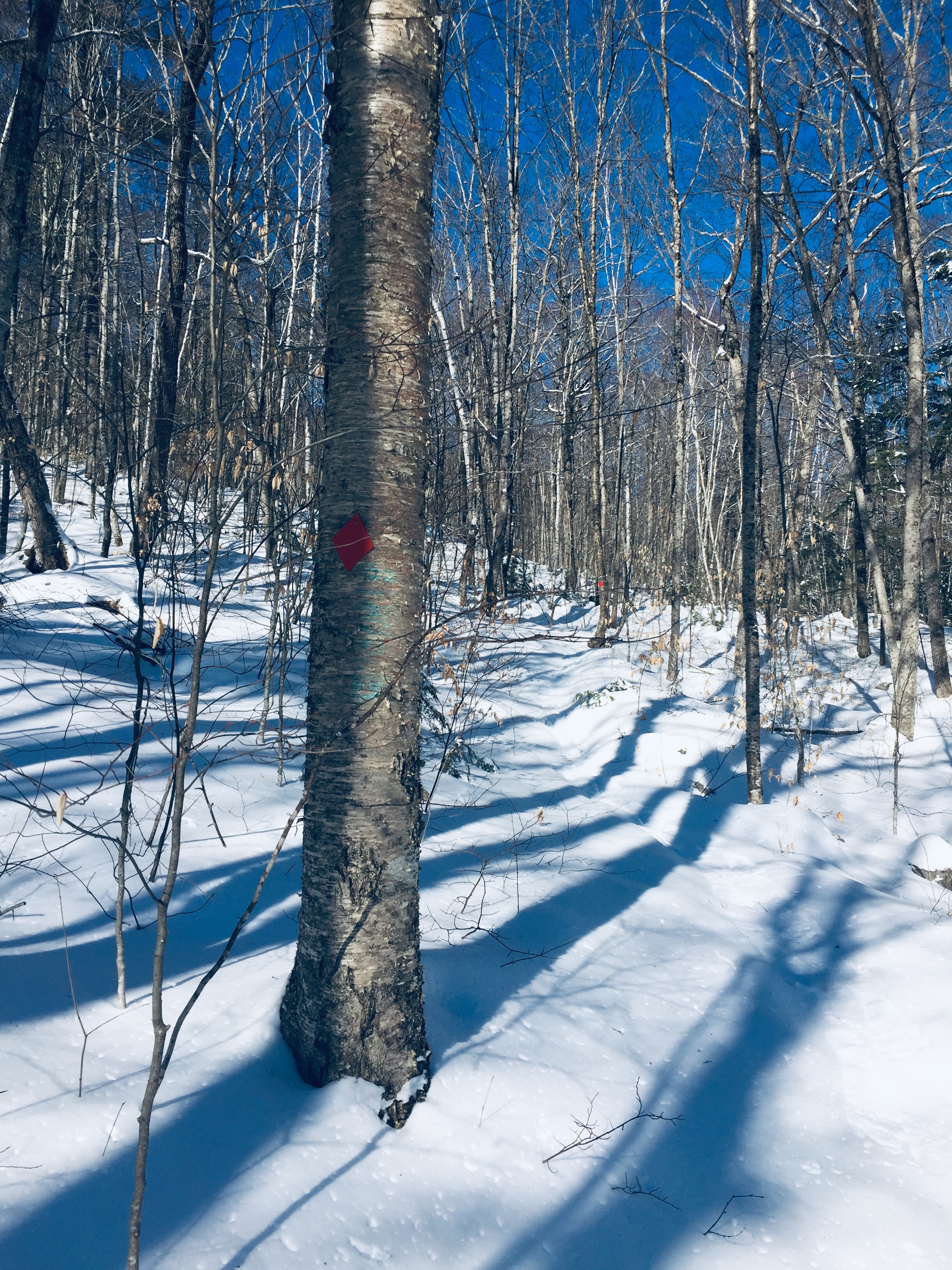
I wore snowshoes the entire route, and once off the snowmobile trail, was breaking trail through the deep, crusty snow. While the snowshoes made for enhanced mobility, the rasp and stomp of my steps eliminated my chances of seeing much wildlife. I was lucky enough to see a large pileated woodpecker, and the signs in the snow of others – the soft tread of foxes, the larger, circling tread of coyotes, the bouncing tread of deer, and the deeper, larger crescents left by moose.

I bypassed Whiting Hill on the way out, sticking to the west shore of Heald Pond on the Red Dot Trail, and clambering down the Otter Rocks Spur briefly to look at the frozen lake, and the sole visible ice fishing shack. As I was solo, wearing snowshoes, and shoreline ice is often the most treacherous, I didn’t venture out on the frozen pond. Continuing gradually uphill, I reached the intersection with the Chestnut Trail (blue blazes), and turned left, towards the Heritage Loop Trail (orange blazes), and a broad circle of the summit of Amos Mountain.
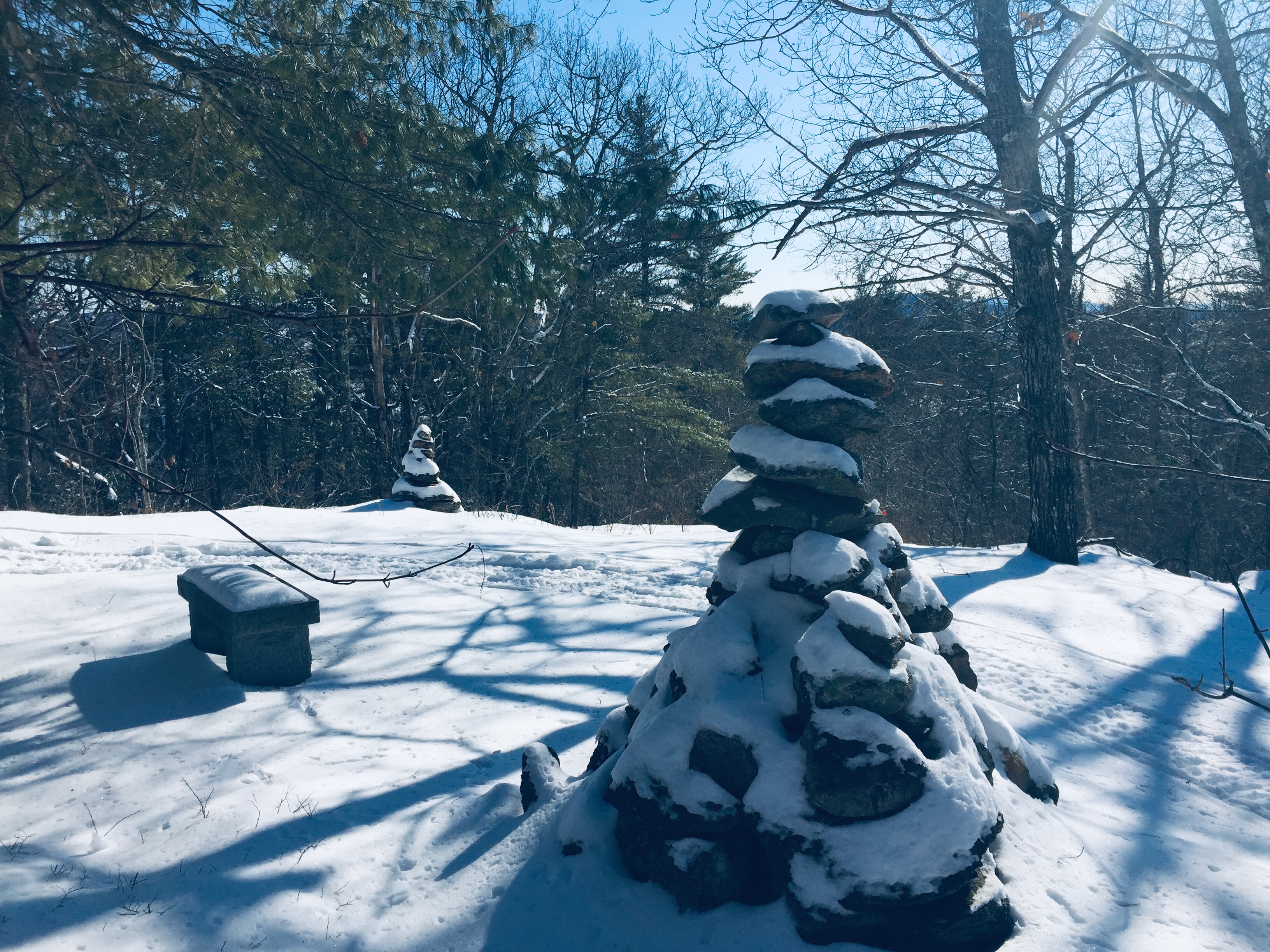
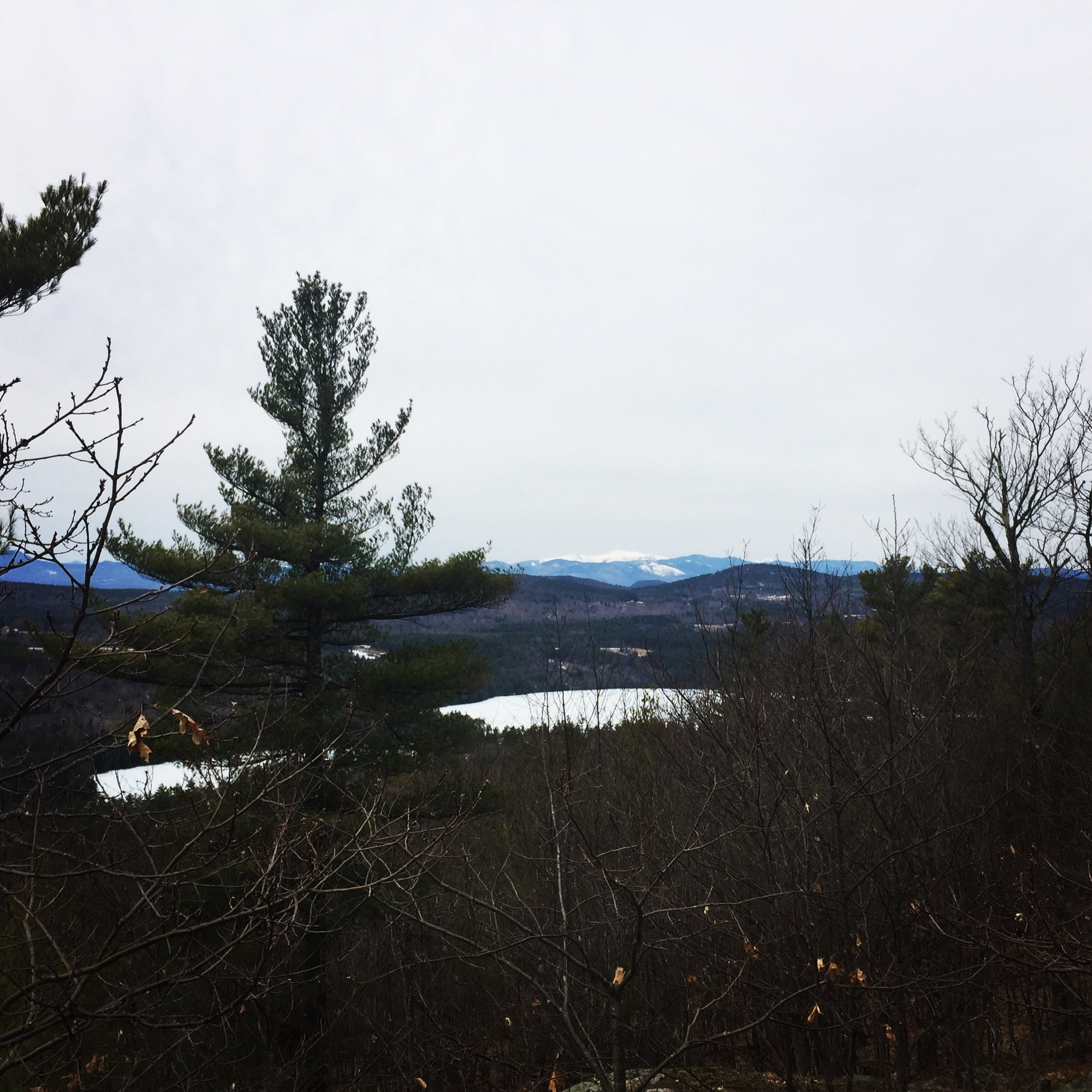
To the west of the summit is a viewpoint, just short of the Rogers Family Trail (blue blazes), with views of the Whites, with Mt. Washington as a centerpiece. The wooded summit of Amos Mountain contains rock cairns and a bench, with views to the southwest.
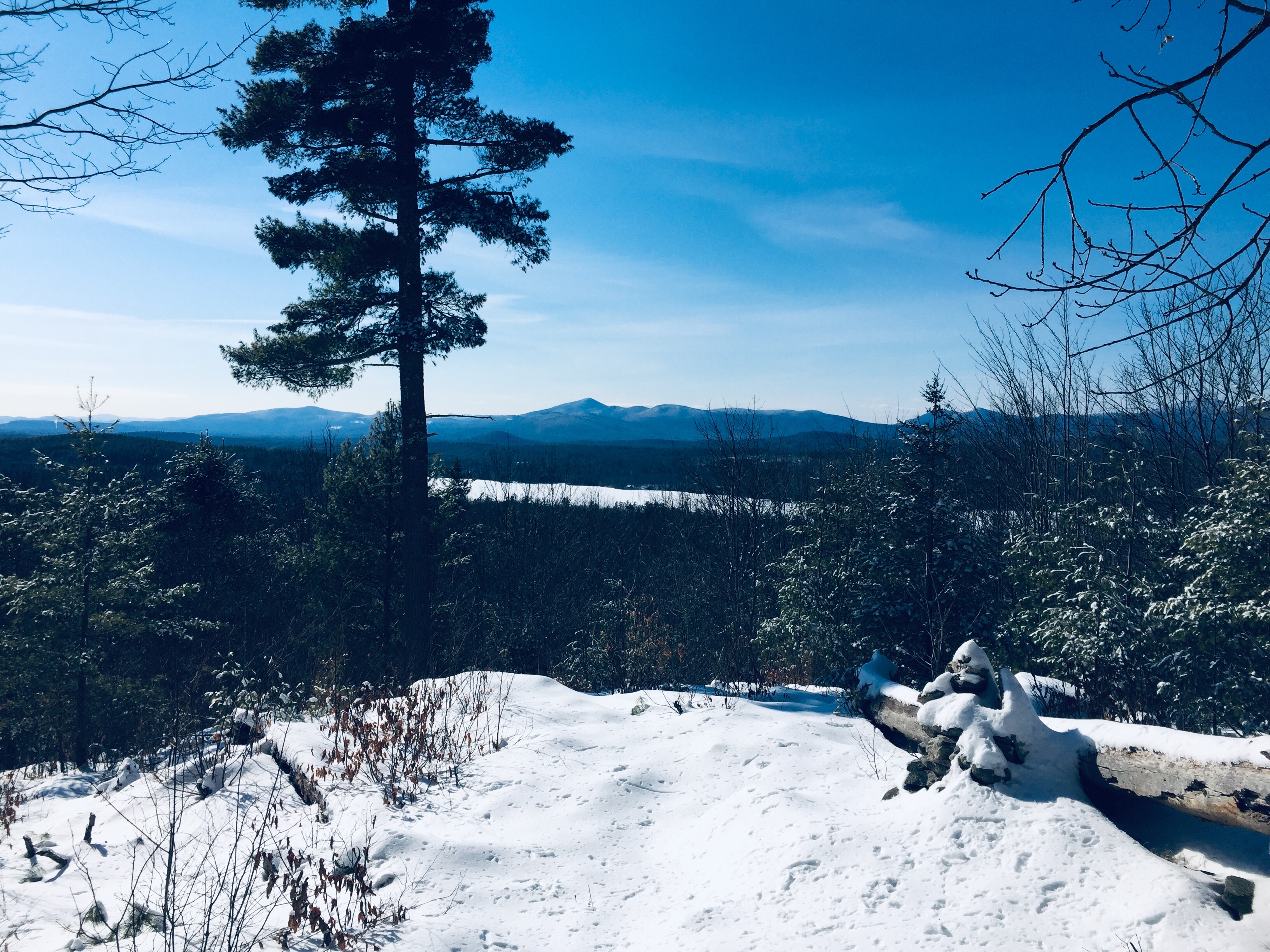
I descended Amos Mountain to the Hemlock Loop Trail, and a small picnic area, then headed towards Whiting Hill and its loop back to the start of the trail and the parking area. Whiting Hall has a more open summit, with views to the West of Kezar Lake and the White Mountains beyond, and an easy downhill walk ended at Slab City Road.
This would also be a beautiful fall hike, but I enjoyed having the place mostly to myself in the snow. Parking areas on Route 5 and Heald Pond Road can also be used to shorten the hike for children or the less mobile – see the GLLT map for locations. This Reserve is not far from Sabattus Mountain, and the post-hike stops available in Lovell are the same – the Center Lovell Market, for picnic supplies and a restaurant, and (after checking seasonal hours) Ebenezer’s Pub for food and Belgian beer.
Back in 2018, we ranked our top ten hiking and outdoors podcasts of 2018. In 2019, we changed the format, listing our five favorite hiking and outdoors individual podcast episodes of 2019. We consume a lot of podcasts, and those focused on being outdoors seem to have proliferated exponentially since we started listening. That’s why, in 2020, we are trying something new. This year, we will attempt to pick out the five best hiking and outdoors podcast episodes each month (or at least our favorites).
January is a month when we reflect upon the past year, and look forward to the new one. It is a time tailor-made for introspection, and we listened to a variety of great podcasts focused on new beginnings, winter reflections, and renewal through the outdoors. Below are the five best hiking and outdoors podcast episodes we listened to in January 2020, with a brief description of each podcast.
A warning – playing podcasts or music on external speakers while hiking is basically a capital offense. Playing podcasts or music through headphones/earbuds while hiking is somewhere in the spectrum of inadvisable to mortally dangerous. Just from a common sense standpoint, why would you want to have your hearing and attention somewhere else if you want to maximize the benefits of being immersed in the outdoors (or, more basically, fail to hear the bear you just startled)? All that being said, hike your own hike.
 1. Mr. Hodges (January 24, 2020) from The Dirtbag Diaries
Can a schoolteacher have a generational impact? Fitz Cahall and Cordelia Zars start by reminiscing about their favorite teachers, and memories of being trapped in school, when so much occurs outside the classroom. Thus begins a fantastic oral history, recounting an epic summer break bike trip from the Alaska line down to southern California led by a unique teacher with 22 students in 1975. The account, told by the nostalgic participants (including the surprisingly lively Mr. Hodges), is full of laughs, lessons, and misadventures, and reveals the lasting impact one unconventional role model can have for the rest of students’ lives (37 minutes).
Apple Podcast link: Mr. Hodges
 2. Nature is Good For You (January 4, 2020) by Scotland Outdoors
This podcast by BBC Radio, hosted by Mark Stephen and Euan McIlwraith, was new to us, and we were hooked from the very beginning. From a roaring fire beside a Scottish river, Stephen and McIlwraith (“portly woodland elf”) oversee a variety of discussions and topics, focused on appreciating nature in the New Year, getting outside and active after “two weeks of waddlesome sloth.” They introduce segments from contributors about medicinal and edible plants, planting and understanding trees, nature as a tool for PTSD, music inspired by the outdoors, and unlikely explorations. The sounds of the crackling fire and the rolling burr of their voices create an intimate environment for storytelling (1 hr, 25 min).
Apple Podcast link: Nature is Good For You
Get Outside’s Jason Milligan hosts a wide-ranging roundtable discussion by team Chick-a-Boom – Cyndi Wyatt, Marilee Valkass, and Saveria Tilden to discuss fears and misconceptions about the outdoors, and the benefits of working through these issues through education and perseverance. This is a compelling and empowering examination of escaping the stresses and limitations of society through building a relationship with nature. Throughout the podcast, the group provides tools and advice for all levels of outdoors exploration by using personal examples. My favorite portion was a light-hearted discussion of risk management around dangerous animals, with the conclusion, “animals don’t have hospitals,” explaining the intrinsic decision-making conducted by predators (i.e. – it’s usually not worth attacking a human), and the importance of education. The roundtable’s advice and common sense conclusions are the perfect way to begin the year with inspiration (1 hr, 6 min).
Apple Podcast link: G.O. 092 – Roundtable: Embrace Your Discomfort Zone

Dr. Ann Jones presents a timely story inspired by a social media post by Adrian Murgo, who noticed that the leaves of the gum trees on his property turned red and fell to the ground prior to the incursion of Australian wildfires. This podcast takes the observations of a layperson, and attempts to explain it through the expertise of Professor Peter Vesk, a University of Melbourne ecologist, Professor Adrian Franklin, a University of South Australia sociologist and Oliver Costello, of Firesticks Alliance, an indigenous corporation, punctuated by the sounds of the Australian outback. Do gum trees have awareness of fire, and are they built to burn? How have indigenous peoples lived with gum trees, and acted as stewards of these “ancestor trees?” Dr. Jones avoids easy conclusions or soundbites, and tells a powerful and insightful story about the Australian landscape (25 minutes).
Apple Podcast link: The burning bush is talking

We heard about this podcast directly from the presenters, and were instantly hooked. Matt Baer, Tyler Socash, Wade Bastian, and Jeremy Utz host an “Outdoor Recreation Comedy” which irreverently meanders through outdoor topics, stories, interviews, headlines, and advice from the Adirondacks. In January 2019 on this blog, we reviewed Where You’ll Find Me, a book by Ty Gagne about a deadly trip to the White Mountains. So we were thrilled to find this shorter “Blue Blaze” episode (a nod to the Appalachian Trail’s side trails), in which the Foot Stuff crew reviews the book, providing insight and humor. They discuss everything from the actual tactile feeling of the physical book itself to the historical context of the Whites, to the decisions made by Kate Matrosova in her ill-fated traverse. The in-depth discussion is appropriately respectful of the mortal nature of this tale, but punctuated by the jokes and anecdotes that make this podcast great (47 minutes).
Apple Podcast link: FSP 091 – Where You’ll Find Me
Disagree? Have suggestions? Leave a comment or Contact us.
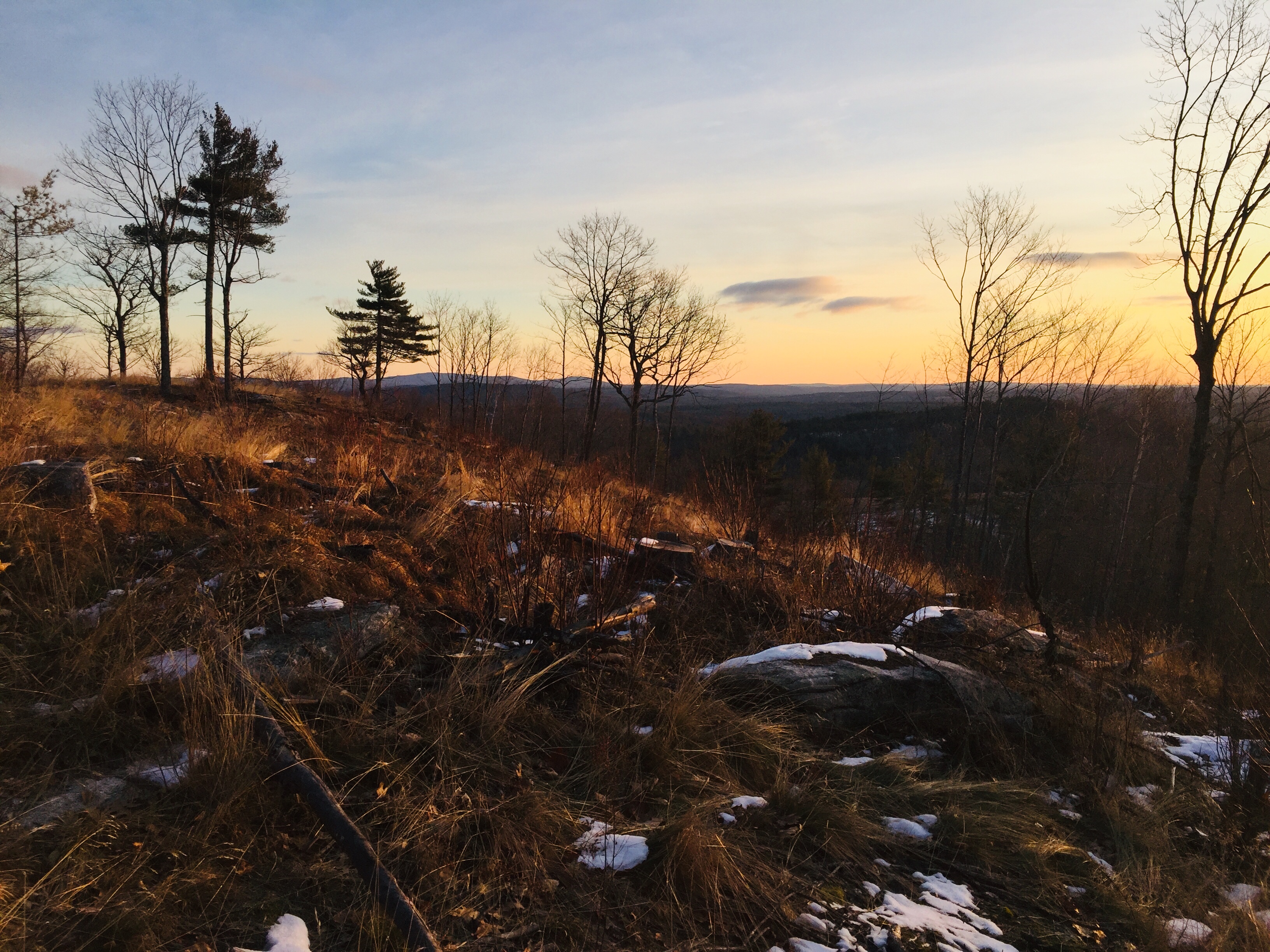
In January 2020, I hiked Mount Tom (1,073 ft) via the West Ridge Trail, an approximately 3.5 mile out-and-back from the parking lot for Mount Tom Preserve at Menotomy Road in Fryeburg, which took about an hour and fifteen minutes. Like Hawk Mountain and Mount Tire’m, which I did earlier the same day, this is a short but rewarding Oxford Hills hike. This can also be done as an approximately 4-mile loop hike by continuing after the summit to the Mount Tom Trail, then returning south on Menotomy Road, which is usually relatively quiet, to the start point.
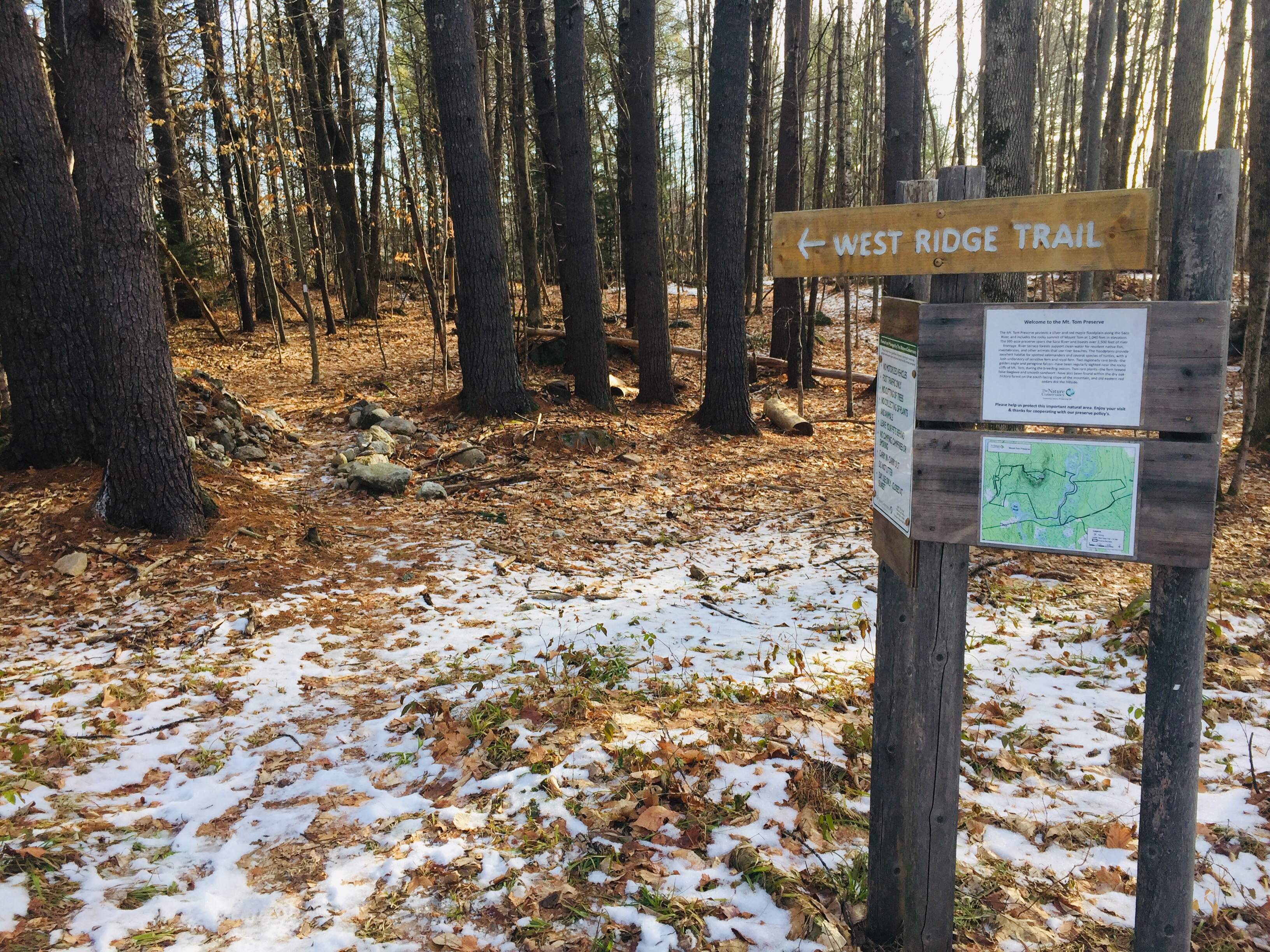
This parking lot, and the Preserve, which includes the summit, are maintained by The Nature Conservancy (TNC). TNC’s excellent description of the Preserve follows:
Mt. Tom Preserve protects a silver and red maple floodplain along the Saco River, and includes the rocky summit of Mount Tom at 1,040 feet in elevation. The 995-acre preserve spans the Saco River and boasts over 3,500 feet of river frontage. Several day-use hiking trails provide recreational opportunities, as does as a 1.14 mile seasonal snowmobile trail that is part of a larger network maintained by the Interstate Sno-goers. Visitors can summit Mt. Tom, canoe along the Saco River, or just walk through the beautiful forests!
River terrace forests support clean water for resident native fish, invertebrates, and other animals that use river beaches. The floodplains provide excellent habitat for spotted salamanders and several species of turtles, with a lush understory of sensitive fern and royal fern. Two regionally rare birds–the golden eagle and peregrine falcon–have been regularly sighted near the rocky cliffs of Mt. Tom, during the breeding season. Two rare plants–the fern-leaved false foxglove and smooth sandwort–have also been found within the dry oak-hickory forest on the south facing slope of the mountain, and old eastern red cedars dot the hillside.

The West Ridge Trail, marked by white blazes and small TNC emblems, rolls across that floodplain, crossing small brooks, passing ghostly birches and large rock formations, until becoming steep about a mile in.
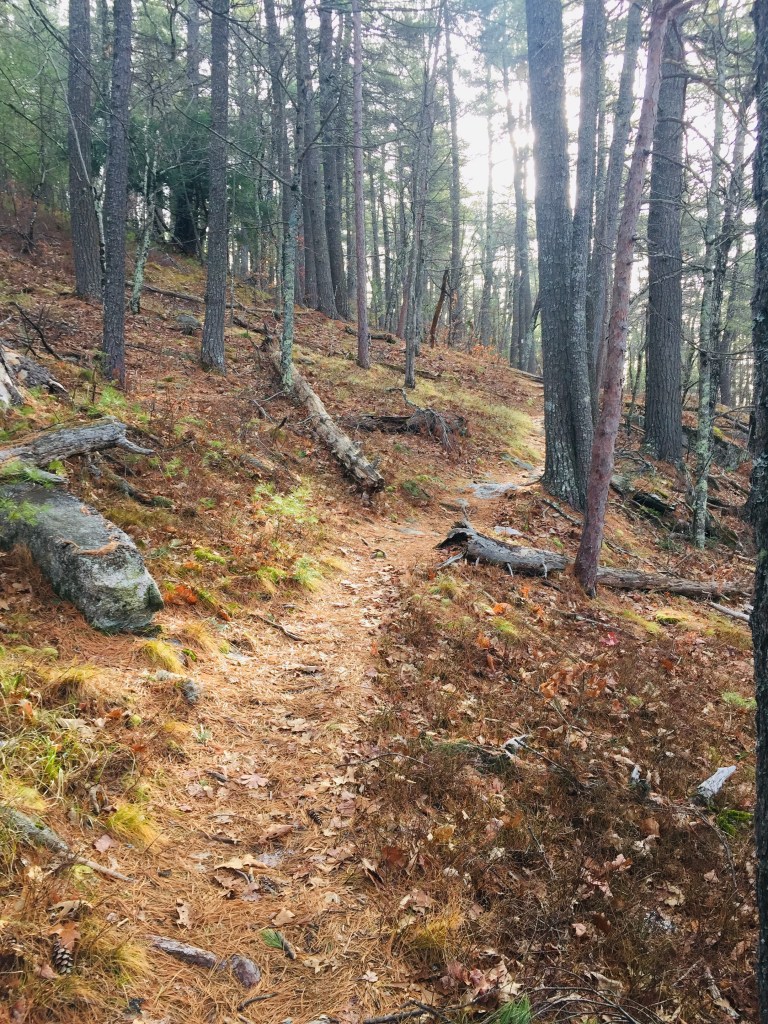
The trail ascends the ridge, with frequent views through clearings in the trees, to meet the Mount Tom Trail, at which point, it turns right, and shortly thereafter, reaches the summit and its rocky ledges and views.

The descent in winter was easy, with microspikes, and I saw several other groups, all with dogs, ascending the trail on my way back. An added benefit in winter was the lack of bugs, which would be omnipresent in the late spring and early summer in the first portion of the trail. This hike may be challenging for very young or out-of-condition hikers, but presents an easy to moderate walk in the woods, with views to the south of the Saco River Valley.
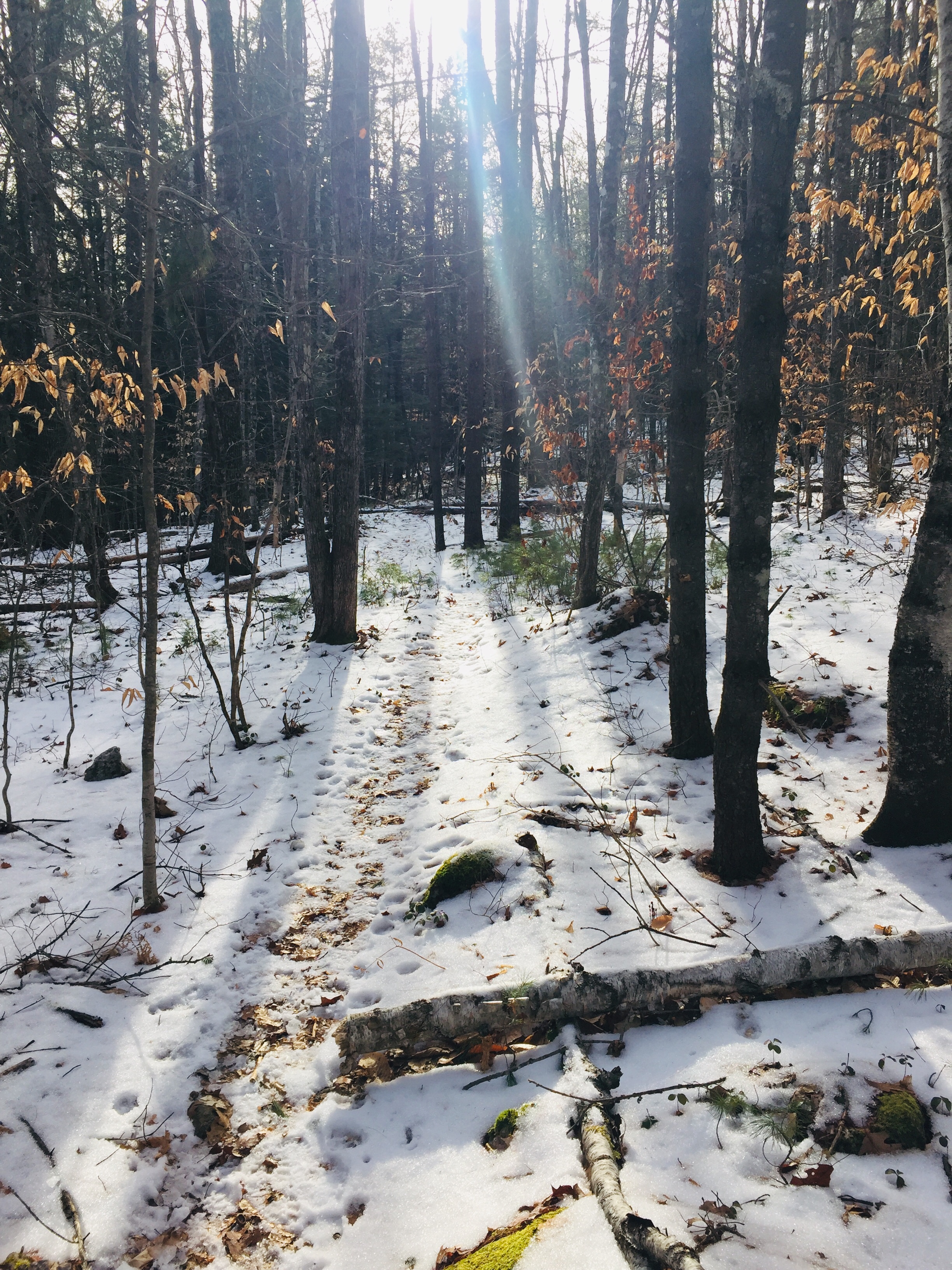
Mount Tire’m (1,104 ft) is a short (1.3 miles, appx. 35 minutes) out-and-back hike via the Daniel Brown Trail, right in the village of Waterford. I hiked it recently in the winter, but this is an all-season hike, presenting a brief, but moderately steep climb. A story, too convenient to be anything but apocryphal, has the name coming from the Pequawket tribe near Fryeburg saying the climb would “tire um out.”
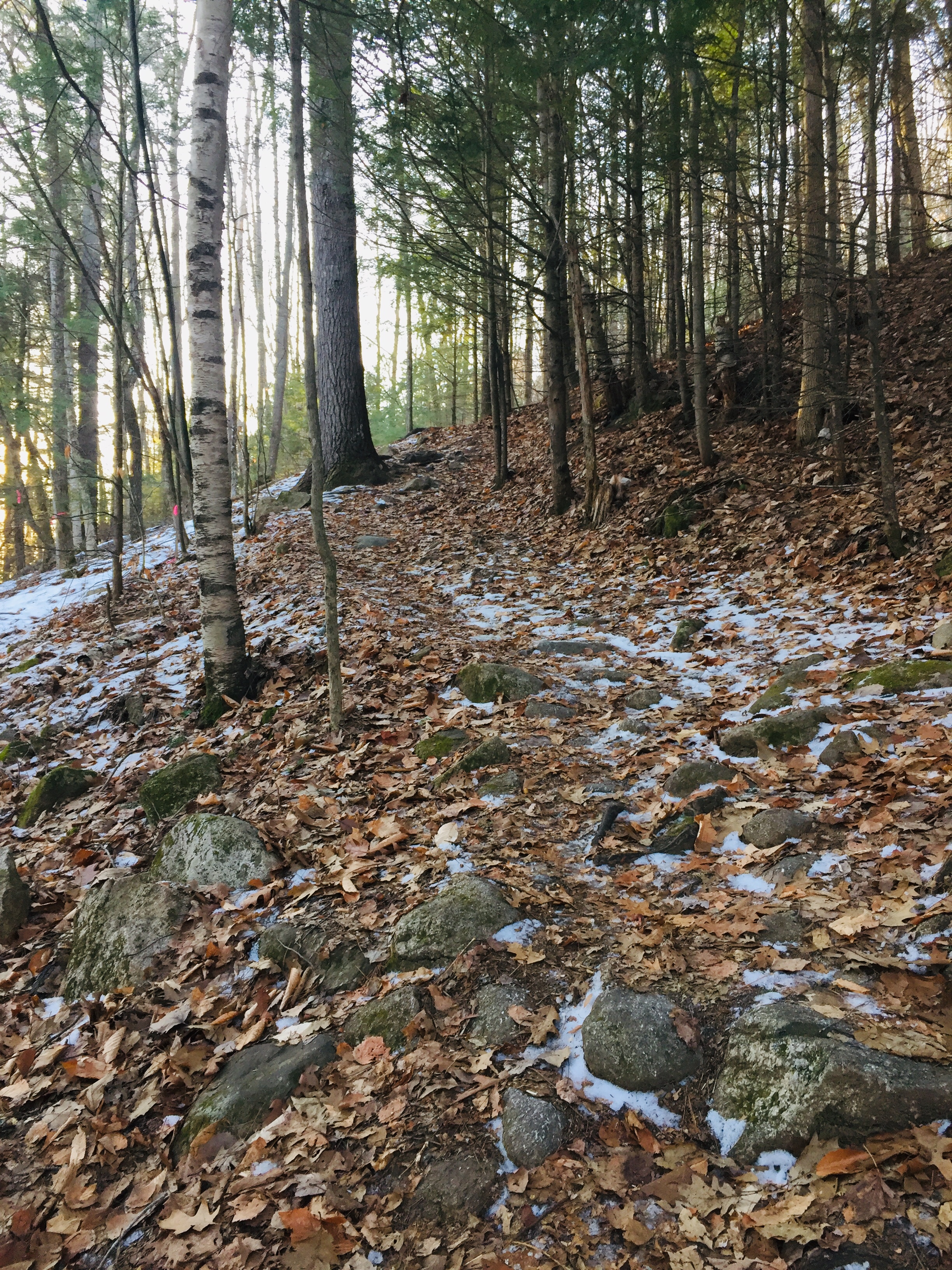
The trailhead is located just uphill from the Waterford Congregational Church on Plummer Hill Road, with parking on the shoulder. While there wasn’t much snow, the grade of the climb and the ice had me pulling on micro-spikes fairly early.
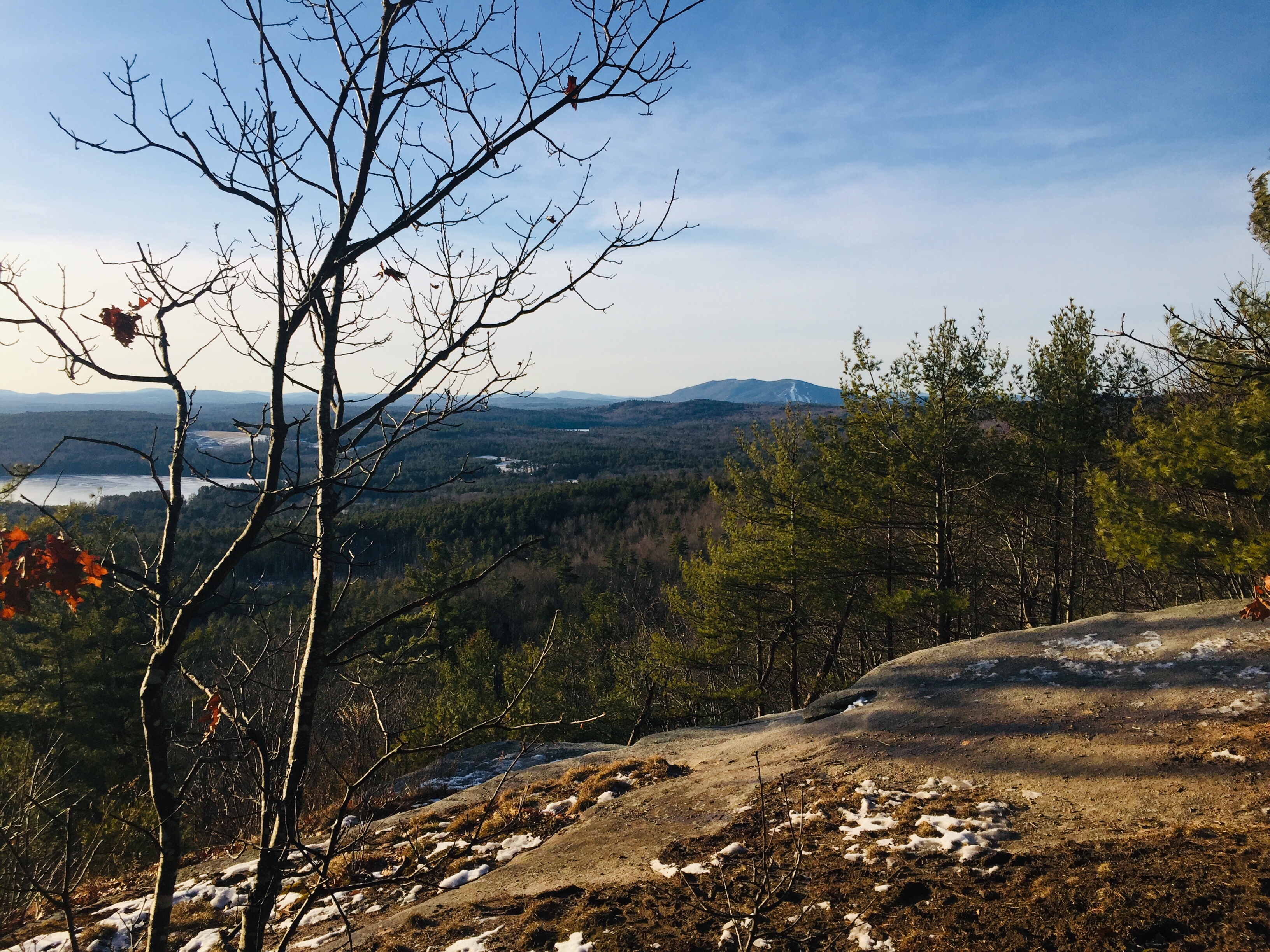
The summit area includes some rock formations and a “cave,” a glacial erratic, which is popular with children, as well as summer blueberries. The sparse winter vegetation and abundant sun allowed for more light through the trees, and views throughout of nearby Keoka Lake, to the east.
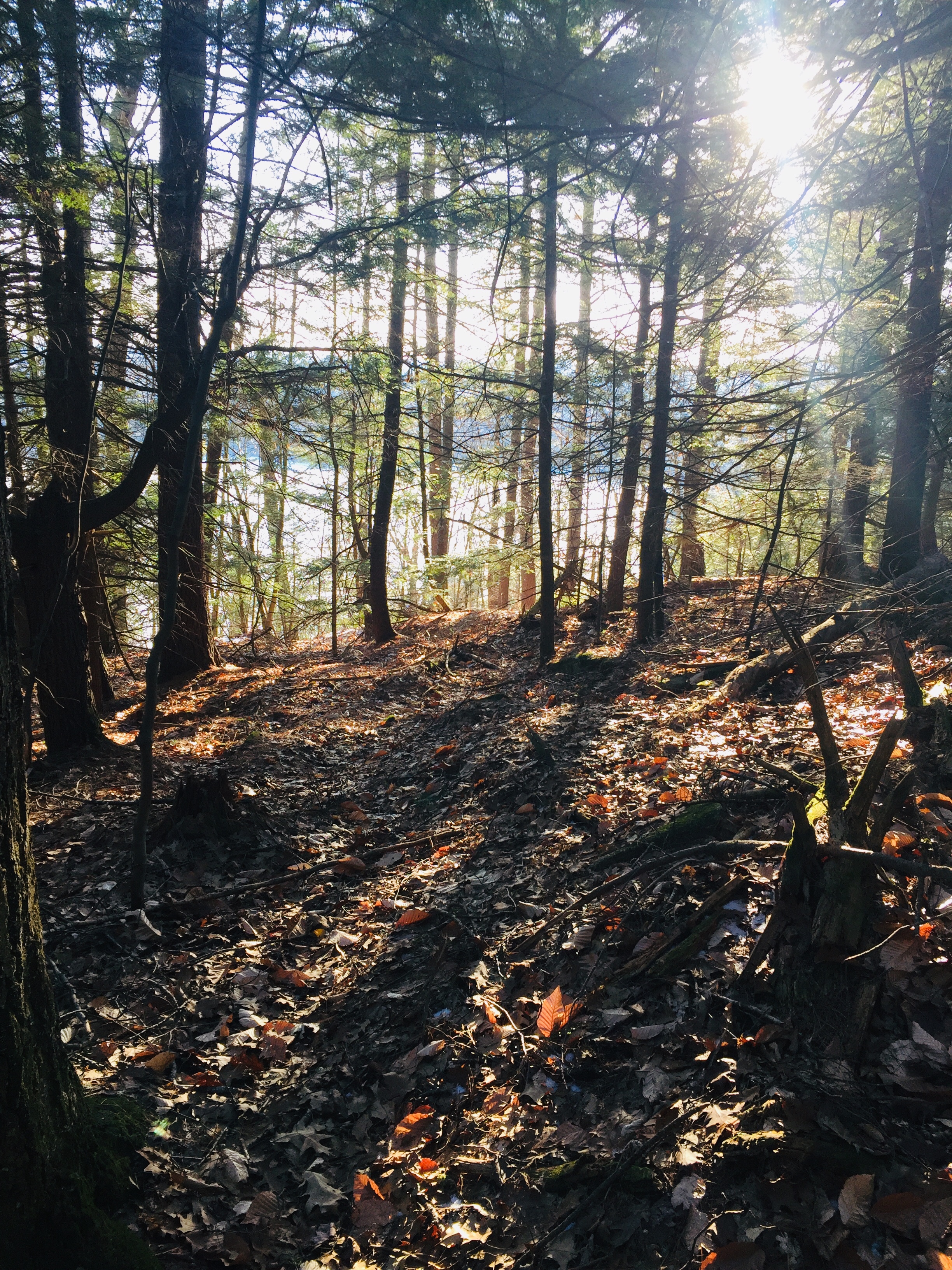
This well-packed and frequently used trail was relatively empty on this winter weekend morning, with only two other hikers, a fit older couple with a dog. In this quiet, I could hear the wind rattling and rustling through the winter forest’s dried leaves, the distinctive squawking of crows and intermittent chickadee songs.