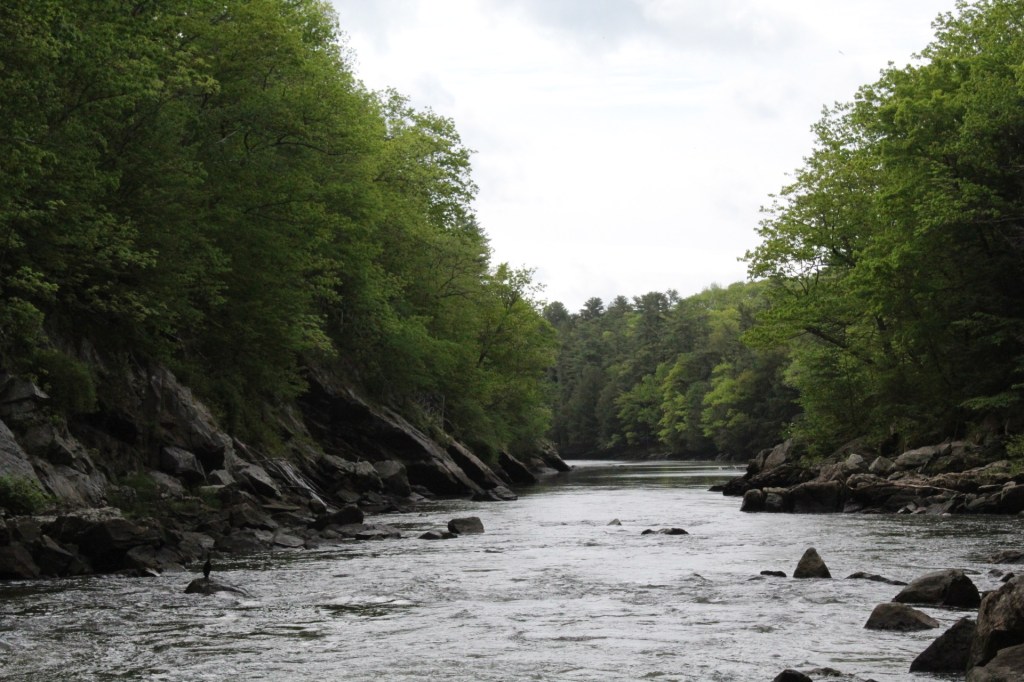
Calmer water and a cormorant, past Presumpscot Falls, Portland, ME
The Presumpscot River Preserve, with trails maintained by Portland Trails, consists of 48 acres along the Presumpscot River, which flows from Sebago Lake to Casco Bay, owned collaboratively between the City of Portland, City of Falmouth, Portland Trails and private landowners. This Preserve is accessible from trailheads at Oat Nuts Park on Summit, Hope Lane, Overset Rd, and the west side of Rte 100 at the bridge over the Presumpscot (Portland/Falmouth line).
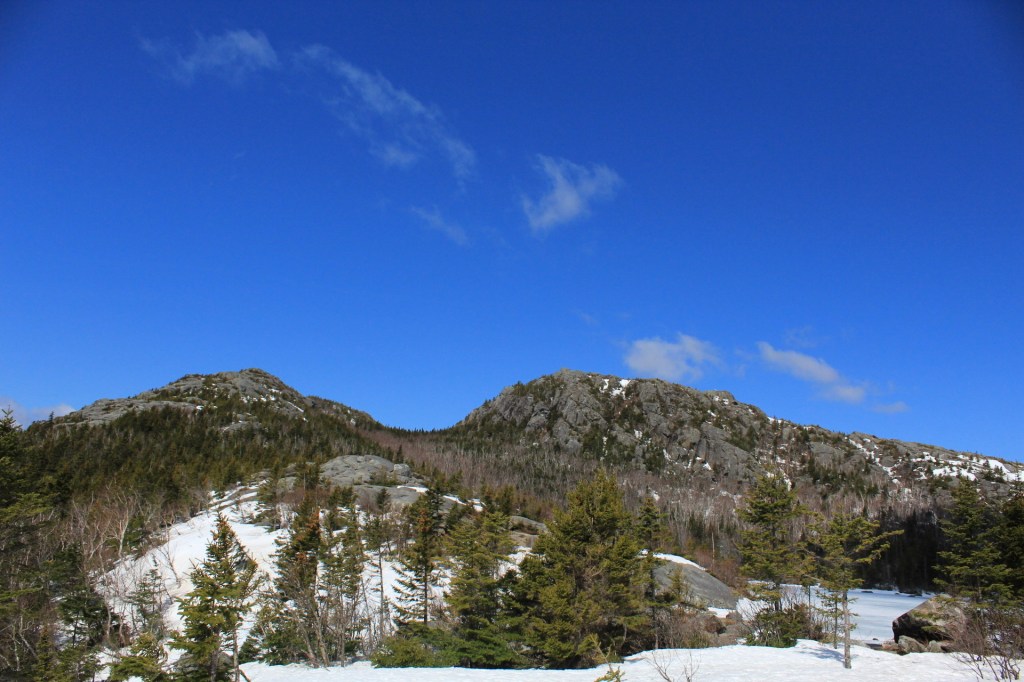
View of Tumbledown peaks from Tumbledown Pond, Weld, ME
Tumbledown Mountain (3,068 ft) in Weld, Maine, is a beloved hike to many Mainers, due to its accessibility and the unique nature of Tumbledown Pond near the summit (this pond is a geological feature called a “tarn”). Normally, taking a break to swim or fly fish at the top of a mountain is just a daydream. We first hiked this in April 2017 during our 100-Mile Wilderness training, and again more recently in May 2020, so neither of these warm weather activities were available at elevation.
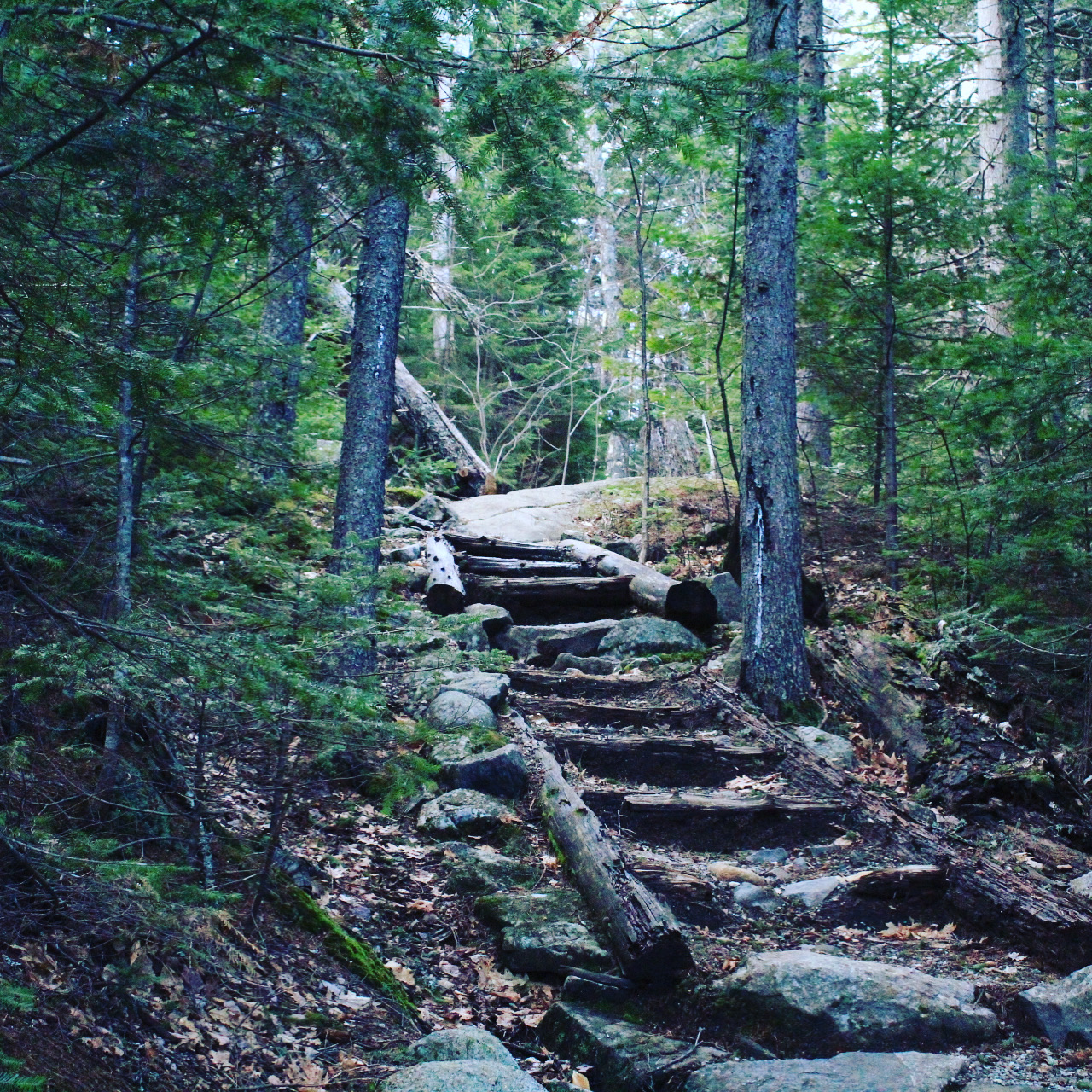
Ascending the Loop Trail on Tumbledown Mountain, Weld, ME.Continue reading →
The Center Hill Nature Trail is a short (half-mile) loop located on Center Hill (1,658 ft), inside Mount Blue State Park, off Center Hill Road (unpaved) in Weld, Maine. This trail begins and ends at the parking area for the Center Hill picnic area, and includes excellent views of Mount Blue, Tumbledown Mountain, Webb Lake, and the surrounding lakes and mountains.
Center Hill Nature Trail, Mount Blue State Park, Weld, MaineThe steep, winding access road from Center Hill Road to the summit is paved, but not plowed in winter. There are snowshoe trails accessible to hikers from the base of the hill, or from the winter trailhead at park headquarters at 299 Center Hill Road, Weld, Maine. The best guide is Mount Blue State Park’s map and brochure.View of (right to left) West, Old Blue, Tumbledown, Little Jackson, and Jackson Mountains from Center Hill Nature Trail, Mount Blue State Park, Weld, Maine.We visited in May, before the summit road was open, and navigated the icy road to the summit on foot, then walked the Center Hill Nature Trail counter-clockwise, stopping at each viewpoint. The trail was wet, but easily navigable, and snow was only present in shaded areas.Viewpoint from Center Hill Nature Trail, Mount Blue State Park, Weld, MaineThis short trail is perfect for families, with picturesque spots to take photos and picnic tables with beautiful views, and brochures are available (in summer) for a self-guided natural history hike through numbered stations. In the summer, swimming is available a short drive away at Mount Blue State Park’s Webb Beach and Campground on the opposite side of Webb Lake.View of Mount Blue’s trademark conical summit from Center Hill Nature Trail, Mount Blue State Park, Weld, MaineFor those doing more challenging hikes in the area of Tumbledown, Mount Blue, or other peaks, this ring is a nice break, and the viewpoints and benches are an easy way to get the lay of the land of the Mount Blue area.View through the trees of Tumbledown, Little Jackson, and Jackson Mountains from Center Hill Nature Trail, Mount Blue State Park, Weld, Maine.
If March was a time to process, April 2020 was hopefully a time for solutions. Last month’s list included thoughts and feelings on the pandemic, and while the podcasts we listened to in April 2020 were indelibly influenced by the world around them, the podcasts we selected this month as our top five were overwhelmingly positive and hopeful. These episodes and stories from around the world focus more on using the limitations we are under as bumpers or guardrails, and finding a way forward. They are filled with video links, birdsong, and hopeful human stories that transcend separation. Below are the five best hiking and outdoors podcast episodes we listened to in April 2020, with a brief description of each podcast.
A warning – playing podcasts or music on external speakers while hiking is basically a capital offense. Playing podcasts or music through headphones/earbuds while hiking is somewhere in the spectrum of inadvisable to mortally dangerous. Just from a common sense standpoint, why would you want to have your hearing and attention somewhere else if you want to maximize the benefits of being immersed in the outdoors (or, more basically, fail to hear the bear you just startled)? All that being said, hike your own hike.
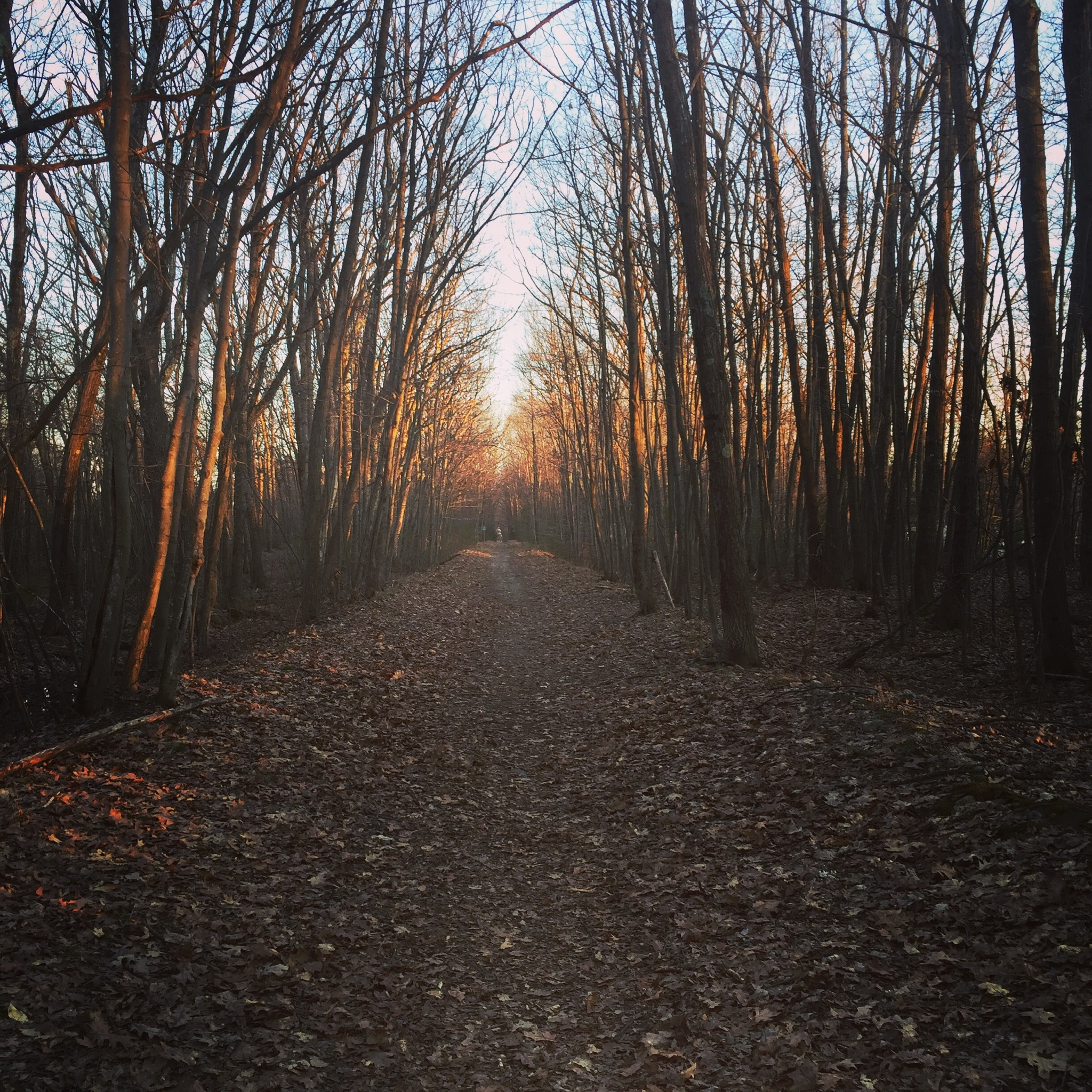
Forest City Trail at sunset, Portland Trails, April 2020
Mike Flanigan is the “most optimistic person” Scott Guinn knows. The two men met several years ago in San Diego, and quickly became friends and climbing partners. Through descriptions and interviews, Dirtbag Diaries hosts Fitz Cahall and Cordelia Zars recount the growth of Mike and Scott’s friendship, and the mischievous fun and connection they find in climbing and outdoor adventure. While their relationship was lighthearted, and built on shared “shenanigans,” vulnerability and trust created a layered friendship that survived the distance between San Diego and Colorado.
After Scott left climbing gear at Mike’s place, Mike mailed these items back to Scott, along with a written challenge. While the stakes were low (pride and a six-pack of beer), this ignited a series of counter-challenges and accompanying trash-talking correspondence. The story is full of relatable details like unanticipated obstacles, productive suffering, and the unexpected difficulty of catching a thrown beer can from atop a rock face.
The challenges gave both men “an excuse” to get outdoors and accomplish things they would not have attempted otherwise. The Dirtbag Diaries consistently finds the human element in nature, and provides topical, insightful stories of ordinary people finding extraordinary adventures and truths in the outdoors. This simple story of friendship provides relatable lessons on connection and vulnerability, despite the challenges of separation and time (38 minutes).
This short episode featuring Taylor Quimby (and his young son) and Sam Evans-Brown explores the possibilities of watching birds from a window or a backyard with suggestions from Bridget Butler (Vermont, “The Bird Diva” ), J. Drew Lanham, Ph.D (Clemson ornithologist), and Karen Purcell (Cornell, Project Director, “Celebrate Urban Birds”) on how to enjoy the spaces that are available to us.
Rather than a worldwide scavenger hunt to fill a notebook with birds seen, this episode looks at backyard birding as a mindfulness practice. “Birding by ear” is prominently featured, and birdsong records are present throughout the podcast. The Merlin application, from the Cornell Lab of Ornithology, is a citizen science project that allows backyard birders to contribute to our understanding of birds, and Celebrate Urban Birds, another Cornell project, salutes the more common birds that survive alongside us. As spring arrives in the Northeast, this simple activity allows us to recognize what we have. As Dr. Lanham says, a “warbler that ends up in your yard is your link to a tropical rainforest,” and “stitches the world together with feathers.” (25 mins).
Broadcast from lockdown, after a hiatus due to Australian bushfires and the pandemic, this brilliant comeback from the Hike or Die podcast wasn’t recorded in the outdoors, but remotely by Tom Griffin and Craig Brinin from a studio (and a desk underneath a bunk bed). Unlike the others on this list, this is not a standalone audio experience. This is a multi-media presentation from Down Under, best enjoyed by listening to the podcast while following along on the show page with links to videos and photos.
After an acknowledgement of the serious of the situation, and the need to be safe and responsible, Tom and Craig curate and comment on lighthearted and positive news stories touching on the outdoors – 4×4’s in lakes, feeding animals, dinosaur trees, helicopter evacuations, walking sharks, insane races caught on video, and amazing trail cam videos. The wide-ranging discussions include gear talk about K-Bar tactical sporks, using bush stoves vs. outdoor fire danger, irreverent listener emails, bushcraft, and great book recommendations. This is a two-hour great escape outdoors for a rainy day (1 hr 59 minutes).
In October 2010, Pam Bales, a volunteer member of the Pemigewasset Valley Search and Rescue Team, was on a hike up the Jewell Trail, headed for New Hampshire’s Mount Washington, thinking about turning around due to deteriorating conditions, when she found a barely unconscious man (“John”) off a side trail. Pam was confused about “John’s” situation, as he was so clearly unequipped for a fall hike in the treacherous Presidential Range, would not provide his name, and seemed completely unmotivated to rescue himself. Pam tried to get “John” warm with the food, gear, and clothing she had brought with her.
Pam pushed, motivated, and cajoled “John” during the descent down the mountain. “John” departed in his car after thawing out, and Pam was left wondering, “What the F just happened?” We won’t spoil the ending, but an anonymous letter postmarked from Portland, Maine, shed a shocking light on the circumstances in which Pam found “John.” This is a great story about reaching out and helping others, even if they seem unwilling to help themselves (27 minutes).
Off Track is always full of high-quality sounds of nature, and never more so than in this episode that begins with Australian whipbirds (“whippys”). The Earworms from Planet Earth series are crowd-sourced, composed of sounds submitted from the podcast’s audience. Host Ann Jones introduces the whipbird sounds, and with the assistance of experts, provides background and explanation, including pulling individual calls from whipbirds (and many other birds) from a cacophony of rainforest sounds.
The curated audio then transitions to other wild sounds, including the growling and pecking of the crane-like brolga, and a mystery sound/call from the Sidney area. You can hear the sounds of an island off Tasmania, seabirds from another Australian island, and many other places, animals, and birds (25 minutes).
Back in 2018, we ranked our top ten hiking and outdoors podcasts of 2018. In 2019, we changed the format, listing our five favorite hiking and outdoors individual podcast episodes of 2019. We consume a lot of podcasts, and those focused on being outdoors seem to have proliferated exponentially since we started listening. That’s why, in 2020, we are trying something new. This year, we will attempt to pick out the five best hiking and outdoors podcast episodes each month (or at least our favorites).
Disagree? Have suggestions? Leave a comment or Contact us.
Seam of green moss surrounding stream, Basin Preserve, Phippsburg, METhe Sprague Pond Loop Trail through the Basin Preserve in Phippsburg, ME, is a quiet hike through diverse coastal woodland. The Basin Preserve consists of over 1800 acres in Phippsburg, Maine, from land donated anonymously to The Nature Conservancy (TNC) in 2006, and adjoins the Sprague Pond Preserve, maintained by the Phippsburg Land Trust. Trail maps of this rolling hike, featuring ridges, mixed hardwood, coastal pitch pine woodland, shrub marsh, and a 10-acre spring-fed pond, are available for download on the TNC website.Ridge covered in sunlight and blueberry plants, Basin Preserve, Phippsburg, MEOn a warm spring day, we took the Loop Trail, from the Burnt Ledge Loop trailhead on Basin Road and a portion of the Meditation Trail along Sprague Pond for a 5.8 mile loop (appx 2.5 hrs). Basin Road is closed for winter maintenance until April 15th, and trails (open sunrise to sunset) can also be accessed from the Sprague Pond Preserve trailhead on Route 209.Spring runoff in wooded stream, Basin Preserve, Phippsburg, METake time at the Basin Road trailhead to read the sign next to the fenced-in area opposite the trail, where TNC and the Maine Chapter of the American Chestnut Foundation maintain a seed orchard, where they are attempting to a produce a blight-resistant chestnut adapted to Maine’s climate. The Sprague Pond Loop Trail is a lollipop loop that divides at Burnt Ledge, and we chose the counter-clockwise loop, heading first down the western side of the trail.Rocky terrain and mixed vegetation, Basin Preserve, Phippsburg, METhis well-marked path, covered in pine needles, winds up and down small ridges, which are covered in blueberry plants. Despite the recent rains and swollen streams due to snow melt, the trails were dry and well-maintained. A few fallen trees made for brief scrambles/detours, but this was the exception, rather than the rule.Canada geese, south end of Sprague Pond, Phippsburg, MEWe saw and heard songbirds and squirrels throughout the hike, but the animal life peaked at Sprague Pond, where we saw mallard ducks, a great blue heron, Canada geese, a circling bird of prey (unidentified), and a garter snake enjoying the sunny Meditation Trail. Shortly after the pond, a beaver dam and lodge were visible, and a spring torrent fed a rocky waterfall next to the trail.Waterfall near Sprague Pond, Phippsburg, MEAfter the waterfall, the eastern side of the loop was primarily a mixed hardwood forest, open and light-filled, with desiccated beech leaves rattling in the wind, chattering squirrels and silent birches awaiting spring. This serene coastal woodland preserve offers a nearly six mile uninterrupted walk through pines, moss, blueberries, and birdsong.
Rumford Whitecap Mountain (2,214 ft) in Rumford is accessible through trails maintained by the Mahoosuc Land Trust (MLT), for a 5.4 mile out/back to the summit on the Orange Trail (or slightly longer using the Starr and Orange Trails), or a longer traverse over Black Mountain via the Black/White Trail (requires spotting a car). MLT’s website advertises Rumford Whitecap as a four-season destination for hiking, snowshoeing, and back country skiing, with blueberries in the summer.
Forest “gateway” descending the Orange Trail, Rumford Whitecap Mountain, Maine.
I have ascended via the Connector to the Starr Trail (marked with yellow blazes and flagging tape), and returned via the Orange Trail, and would suggest this route (or its reverse) for the views, rather than just the Orange Trail. I used the guidebooks Maine Mountain Guide and Maine Hikes Off the Beaten Path for detailed trail maps and descriptions. You can also find a map on the AllTrails app or Maine Trailfinder (link at the MLT website above).
Spring waterfalls on the Connector between the Starr and Red/Orange Trails, Rumford Whitecap
Both trails, divided by a pleasantly running brook in a valley between them, were muddy, but well-maintained. The Connector crossed the brook, with spring runoff created small waterfalls along the way. Rains can create a morning fog, but also spur the growth of a variety of May wildflowers from the trailhead to the summit.
Spring wildflowers, Rumford Whitecap, Rumford, Maine
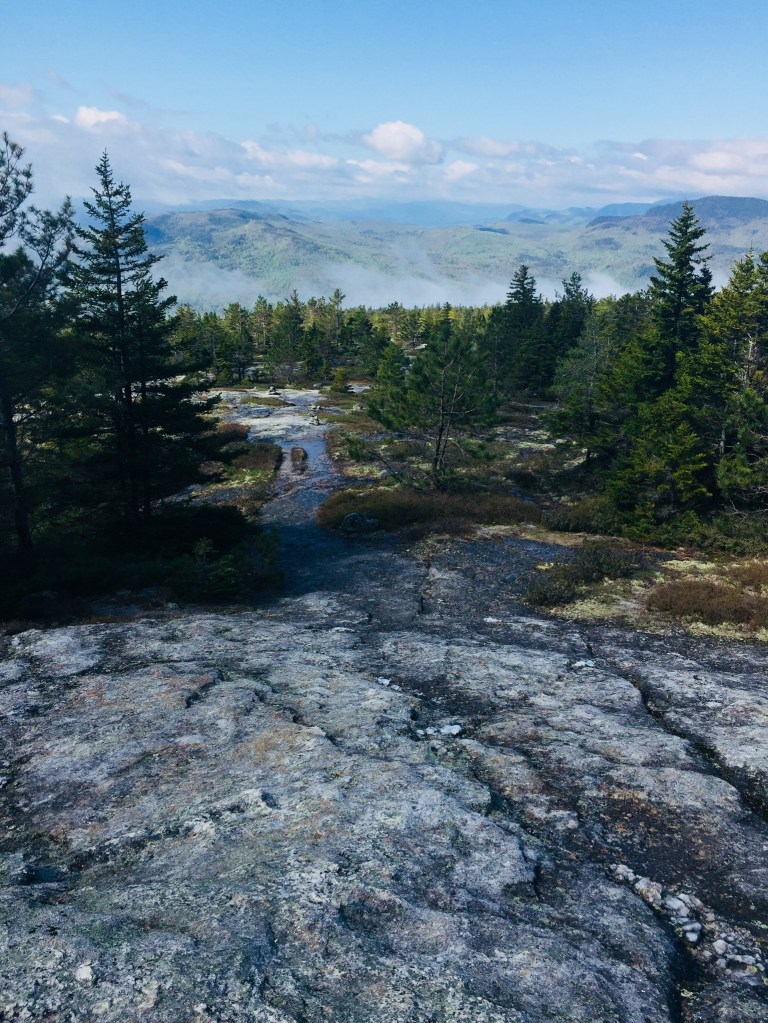
The Starr Trail transitions from a grassy woods road to a winding climb, becoming more strenuous as the deciduous forest changes to a more sparse, rocky pine forest, and opens up on ledges with spectacular views of the Mahoosucs and White Mountains.
Descent out of the woods into the clouds on the Starr Trail, Rumford Whitecap
After the junction with the Orange Trail, the summit is only about another .5 miles, hopping over small cool rivulets of water running down the exposed rock face. Close to the summit last May, there was what appeared to be a large deposit of bear poop, but a quick look around didn’t disclose any prints. The summit itself is open in all directions, and a great spot for a picnic.
The long summit ridge of Rumford Whitecap
After a brief rest at the summit to enjoy the view and chew on some jerky, I headed back down the Orange Trail. The trail ran like a creek in places, with the spring rains, and remains diverted for a section. The hike can take about two to two and-a-half hours, with plenty of stops to listen to birdsong, inspect wildflowers, watch bumblebees at work, and pick up and inspect pieces of quartz.
(Disclaimer: This post contains affiliate links, and as an Amazon Associate Hiking in Maine blog earns from qualifying purchases.)
Back in 2018, we ranked our top ten hiking and outdoors podcasts of 2018. In 2019, we changed the format, listing our five favorite hiking and outdoors individual podcast episodes of 2019. We consume a lot of podcasts, and those focused on being outdoors seem to have proliferated exponentially since we started listening. That’s why, in 2020, we are trying something new. This year, we will attempt to pick out the five best hiking and outdoors podcast episodes each month (or at least our favorites).
March 2020 saw a seismic shift in what we knew to be normal, with all conversations dominated by a global pandemic. The outdoors became an escape, and then, in some cases, an impossibility, due to localized rules. This “best of” list took awhile (yes, it’s almost mid-April), due to the disruption of routines. But podcasts can help us process all these changes and share ideas, or simply let us escape for a few minutes. Hopefully, we struck a good balance between useful advice and outdoor escapism (and humor). Below are the five best hiking and outdoors podcast episodes we listened to in March 2020, with a brief description of each podcast.
A warning – playing podcasts or music on external speakers while hiking is basically a capital offense. Playing podcasts or music through headphones/earbuds while hiking is somewhere in the spectrum of inadvisable to mortally dangerous. Just from a common sense standpoint, why would you want to have your hearing and attention somewhere else if you want to maximize the benefits of being immersed in the outdoors (or, more basically, fail to hear the bear you just startled)? All that being said, hike your own hike.
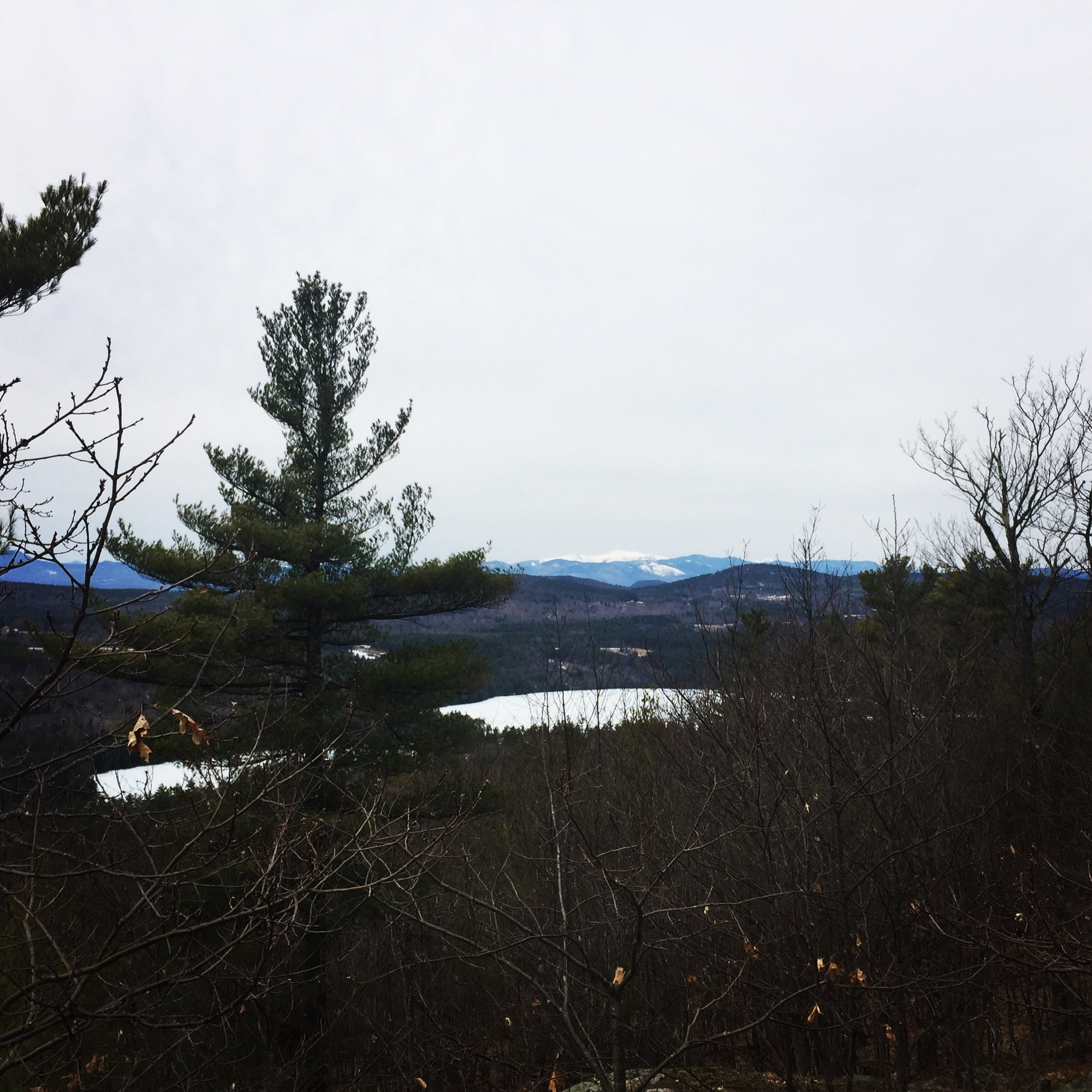
Mount Washington and the Whites from Hawk Mountain, Waterford, ME
Rich Roll’s prolific, wide-ranging podcast explores the outdoors and the inner self, and Roll generated a podcast episode a week for seven straight years without a vacation. Roll then took his own advice, and took December 2019 off, prior to appearing on the cover of Outside Magazine in January 2020. This episode contains audio from Outside’s interview of Roll, in which Roll tells the story of his journey.
Rich Roll, a competitive high school swimmer, was first introduced to alcohol during college recruiting trips. Roll describes how his relationship to alcohol stunted his growth as a college athlete, then an attorney. A 100 day stay in rehab began Roll’s journey, giving him the tools he would eventually use in recovery. But Roll’s realization of his own poor health then resulted in big changes, as he overhauled his diet and returned to swimming and running. One day, a planned, routine 5-6 mile run kept going, and Roll, trusting a faint but life-altering whisper, found his calling as an ultra-endurance athlete. This episode contains great insights and anecdotes about Roll’s journey to self-actualization, and the help he received along the way (53 minutes).
Each Foot Stuff Podcast episode begins with the phrase, “A comedic deep dive into . . . ” In this case, the crew begins with a review of their own outdoor activities since last podcast, consisting of running, skiing, and ice fishing in and around the Adirondacks. A funny discussion of lesser-known collective nouns (“prickle of porcupines, raft of ducks, parliament of owls”) then precedes detailed advice on navigating a slide in winter, including training, equipment, and going as a group.
The meat of the podcast is a discussion of Denali, North America’s tallest summit, as climbed by podcast guest Chris Lang. Lang describes his introduction to winter mountaineering, starting with a winter ascent of New Hampshire’s Mount Washington, and quickly accelerating to a twenty day guided trip with Alpine Ascents to Denali’s summit. The comedic deep dive includes both the soaring highlights and the less glamorous parts of this adventure, including a (shared) (disappearing) poop bucket, in-tent smells, extreme weather, heavy gear, substantial expense, and rigorous training. “Dave,” a fellow traveler, is the big loser in this story, based upon numerous unforced errors and violations of unspoken outdoor ethics (“Suck it, Dave”). This story about what it takes to summit Denali, and the entire light-hearted podcast, may be just what you need right now (1 hr 33 mins).
Rudy Giecek’s hiking and backpacking interview show covers much more than just the Cascades. In this episode, Rudy interviews Kindra Ramos of the Washington Trails Association (WTA), for a timely discussion of how to help people get outside safely. Ramos focuses on social distancing as common sense – staying closer to home, not putting a strain on rural communities or first responders, and exploring lesser-known trails.
This description of trail management in Washington, from an area that took a heavy initial hit from the COVID-19 pandemic, is a good analog for Maine and the Northeast, with positive, practical advice – pick trails with less trail reports/activity. Stay with existing family/household members. If you are in the backcountry, take extra precautions, and be fully prepared. Busy trailhead? Have a second plan, and move on. Ramos closes with a point that will affect all of us – how can we help build sustainable trails for the future, and what role can the people now getting outside play in being future advocates for the outdoors (18 mins)?
Evan Phillips’ Alaska-based podcast explores the lives of mountain climbers. This listener-centered episode is a check-in with The Firn Line community during the Covid-19 pandemic, featuring interviews and clips gathered from March 22 to March 28, 2020 in Canada, Scotland, and the US.
People, particularly those used to the freedom of the outdoors, respond in different ways to isolation. There are ideas here for connection with family, for donations, for community service, for exercise, for “play.” Topics include gratitude, getting to know neighbors, and how communities are supporting each other in different places. Listeners also discuss self-care and lowering expectations for productivity, while maintaining connection during isolation, including a comparison to Alaska’s winter darkness, and resultant cabin fever (48 minutes).
Australian trainer Rowan Smith’s podcast normally focuses on practical tips to train for hiking and mountaineering. In this episode, Smith presents ideas for staying motivated and moving forward across a variety of circumstances and pandemic-imposed limitations. Smith’s great introduction draws on his childhood and his imagination to provide an example on how to immerse yourself in an activity, even when there are barriers.
Smith explores the ‘micro-adventure’ – doing what you can. He recommends books to keep adventure in mind if you cannot be outside (I would wholeheartedly endorse his suggestion of “Breath” by Tim Winton), as well as movies. Smith closes with two more ideas for keeping the adventure alive – use the time to refresh or find new skills like navigation or first aid, and/or plan and research your next big adventure in depth, to be ready when this strange time is over (15 minutes).
With the temporary closure of schools and businesses, the uncertainty in the air, and the moratorium on group activities in many places, the universal mood seems to be a somber one, at best. But, with care, resolve, and education (try this article on social distancing), a more sanguine view can prevail. What is a healthy thing to do that requires relative isolation – six feet of separation with non-family members, and no direct contact with surfaces that might contain lingering viruses?
Six feet of separation is easy to maintain on a trail.
Hiking, in its many forms, needs no more cheerleading for its holistic wellness benefits. But getting outside for mental health has never been more important. Here in Portland, Maine, schools will be closed until at least the end of April, a stay-at-home order has been issued, and non-essential businesses are temporarily closing. These actions, and others, can all have degenerative ripple effects on time, and on physical and mental health, if we let them.
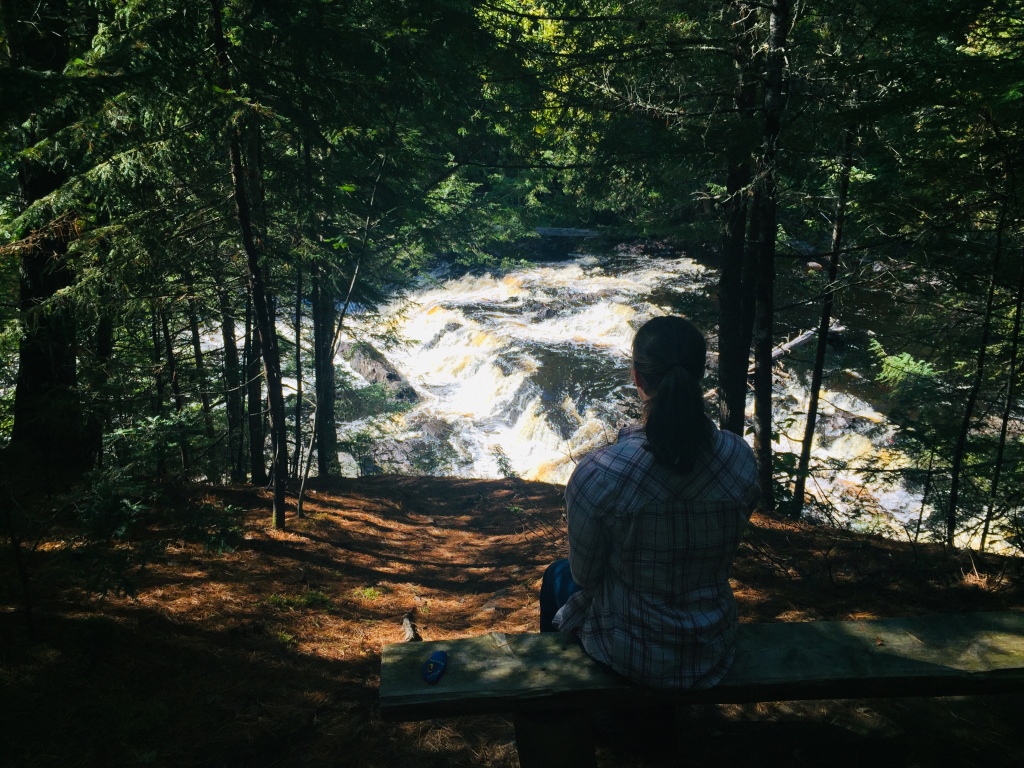
Observation bench, Mariaville Falls Preserve, ME
First, breathe. We were fortunate to be born in a country with the infrastructure and prosperity to get through this. Here in Maine, we are less-densely populated than most other places, surrounded by an embarrassment of natural riches in the form of the coast, lakes, and mountains.
Remember- these are close, and popular, and may be crowded. The Portland Press Herald also just published a list of wild lands for exploration during this strange time.
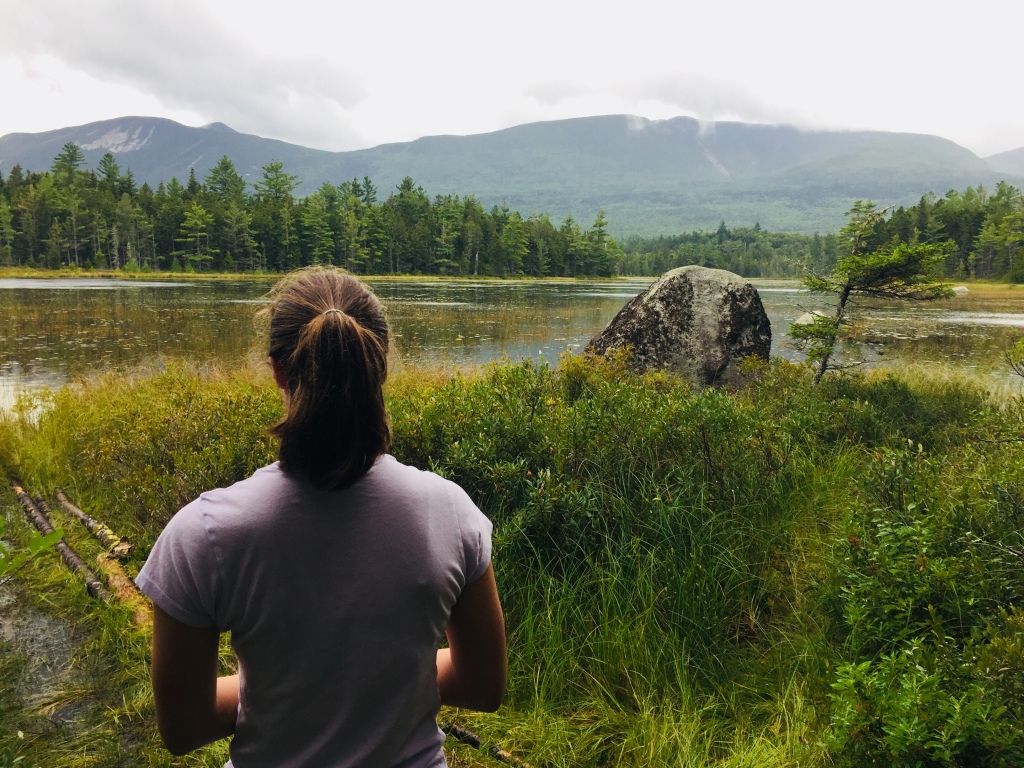
Looking across Elbow Pond to Mt O-J-I and Barren Mountain, Baxter State Park
Again, check state and local guidelines on the trails or parks you are using. Some may be closed due to COVID-19, some may just be closed to protect trails during mud season. The best source of information is the maintainer of the trails, whether that be a government agency, a municipality, a land trust, or a non-profit.
The point is not some Instagram-worthy photo opportunity, it’s fresh air and time in nature, so don’t sweat the surroundings. Baxter Woods or Evergreen Cemetery are great places to walk. If you can’t make it way out onto remote trails, there are other outdoor options. Last weekend, dad and daughter took advantage of the sunny weather, using Portland Trails and the East Coast Greenway to safely walk ten-plus miles to Wainwright Fields in South Portland.
This is not meant to be a flippant article, but suggestions specific to getting outdoors in the Portland area. People are deeply affected by this pandemic. Post-hike, consider getting takeout or delivery from a local restaurant – Portland’s Old Port has an updated list of businesses where this is available, as does Portland Food Map. The best place to look for where to help is at your friends and neighbors, but donations of money or time to places like Preble Street or national charities like the Salvation Army or Meals on Wheels can help those less fortunate.
Mill Brook Preserve South, a 32-acre annex/extension of the Mill Brook Preserve, opened its trails in October 2019, and has a 1.5 mile easy lollipop loop for hiking, running, snowshoeing, and cross-country skiing, ending in a short spur trail with the opportunity to view the annual migration of the alewives in late May and June. As with the Mill Brook Preserve, the best information and trail map can be found at the website of the Presumpscot Regional Land Trust, which holds this land, and coordinates the 28-mile Sebago to the Sea Trail.
Kiosk at Mill Brook Preserve South trailhead, Millbrook Estates, Westbrook, Maine
The Mill Brook Preserve South trailhead is located next to well-marked parking spaces in the Millbrook Estates (300 E. Bridge St, Westbrook). We hiked the loop and the spur a couple times in February 2020, an easy hike of about forty minutes. The trail was packed snow, with softer snow on the margins, and I would suggest traction devices (Yaktrax or microspikes) to avoid slipping and sliding.
Edge of forest at southwest end of Mill Brook Preserve South adjoining cattle farm, Westbrook, Maine
We saw woodpeckers and red squirrels, as well as the tracks of deer. Dogs are allowed on the trail, but must be leashed, especially in the portion next to the working cattle farm (you will see signs). The beginning of the trail is next to a horse farm, so children may enjoy seeing these domesticated animals, if you strike out with woodland creatures.
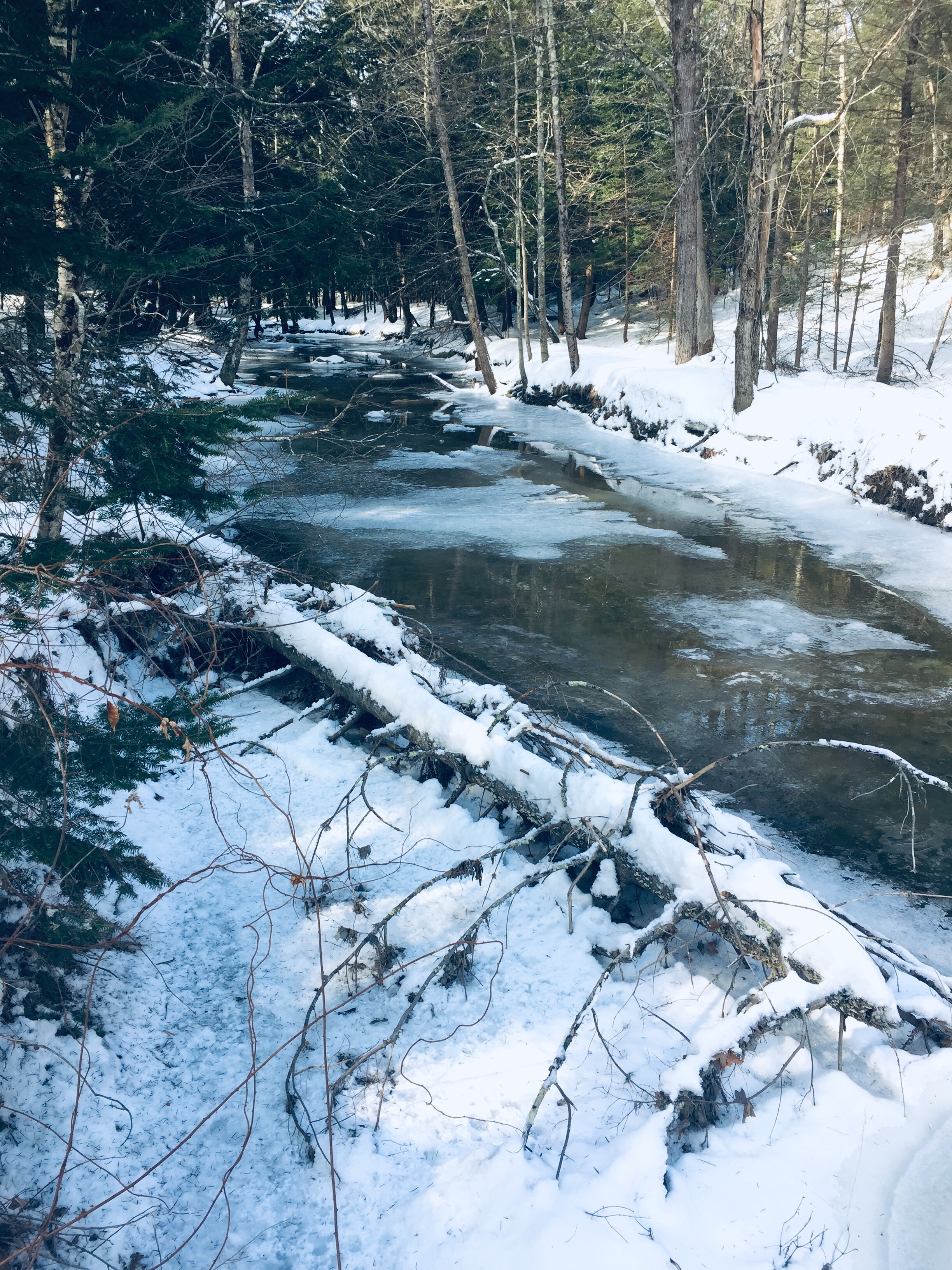
Mill Brook in winter, Mill Brook Preserve South, Westbrook, Maine
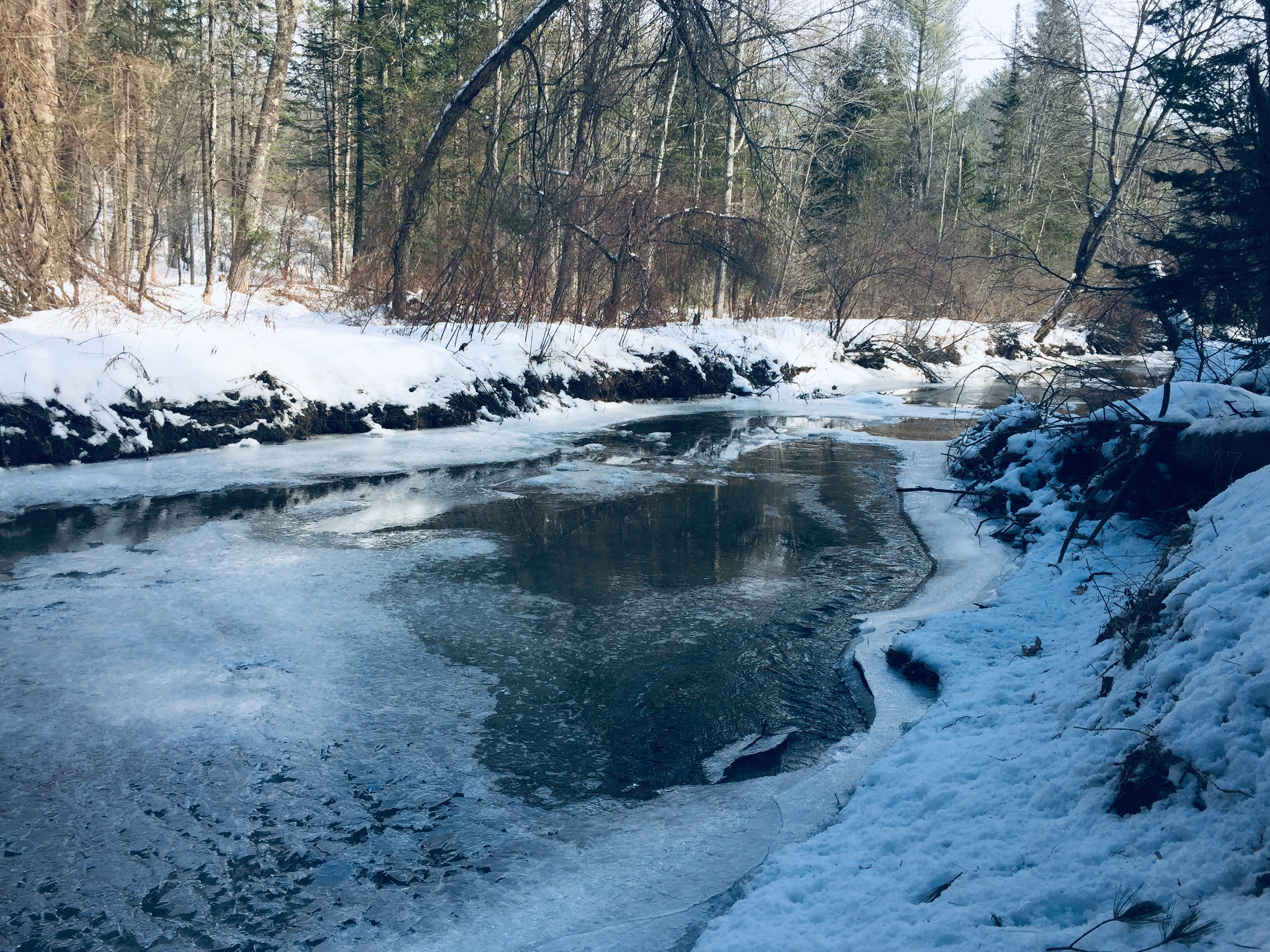
The spur trail midway through the loop leads downhill to Mill Brook, and on this winter visit, the flow was mostly under a sheet of ice, with an open area close to the near bank. In early summer, this area can be a great spot to watch the alewives run (and a midway picnic stop with smaller kids).
Mill Brook in winter, Mill Brook Preserve South, Westbrook, Maine
As in its northern sister preserve, navigation along the trails is forgiving and self-correcting, with maps posted at critical intersections throughout the Preserve.
Back in 2018, we ranked our top ten hiking and outdoors podcasts of 2018. In 2019, we changed the format, listing our five favorite hiking and outdoors individual podcast episodes of 2019. We consume a lot of podcasts, and those focused on being outdoors seem to have proliferated exponentially since we started listening. That’s why, in 2020, we are trying something new. This year, we will attempt to pick out the five best hiking and outdoors podcast episodes each month (or at least our favorites).
The best podcasts we heard in February focused on mindfulness – bringing wildlife to the forefront through art, to living purposefully, without technological input, to mental training and using the outdoor spaces we have. Below are the five best hiking and outdoors podcast episodes we listened to in February 2020, with a brief description of each podcast.
A warning – playing podcasts or music on external speakers while hiking is basically a capital offense. Playing podcasts or music through headphones/earbuds while hiking is somewhere in the spectrum of inadvisable to mortally dangerous. Just from a common sense standpoint, why would you want to have your hearing and attention somewhere else if you want to maximize the benefits of being immersed in the outdoors (or, more basically, fail to hear the bear you just startled)? All that being said, hike your own hike.
Driving by Californa billboards, artist Jane Kim was inspired to begin creating large-scale public murals of animals along the migration routes they share with humans. This idea, beginning with Sierra Nevada Bighorn Sheep along California highway 395, has recently culminated in a painting that includes a 50-foot-tall monarch butterfly, on a 13-story building in San Francisco’s Tenderloin district.
This public art helps the viewer realize what is possible, places the animal in the conscious mind, and draws attention to the potential shared environment for these creatures in urban green spaces (37 minutes).
The title of this episode is drawn from a Milton quote favored by conservationist and author Guy Waterman: “Accuse not Nature, she hath done her part; do thou but thine.” Guy suffered from depression, and died of exposure on Franconia Ridge in 2000. Guy’s widow, Laura Waterman, tells her story in this episode. Both Guy and Laura escaped office jobs, turning to the mountains of Vermont and a subsistence life in the woods.
At their home, they meticulously documented and recorded everything, from rainfall to temperature, to maple syrup, to the top-producing blueberry bushes, an accounting of nature’s minutiae that led to a heightened awareness. The books Guy and Laura wrote, including Backwoods Ethics, explored timely issues like the capacity of natural places for human use, and Laura explains the progression of these ideas over time.
In 2015, Australian journalist Sarah Allely suffered a mild traumatic brain injury after being hit by a car while riding her bike, and struggled to regain her former brain function. Allely documented her recovery in a documentary podcast series called Brain on Nature. Allely began to notice the recuperative effect of nature, starting by spending time in her garden.
Allely interviewed experts, and found the results made sense – mindful time in nature is the opposite of looking at screens, and can be stimulating to the brain, but also restful and restorative. The overload on the prefrontal cortex can sometimes be alleviated by something as simple as a walk in nature (42 mins).
This concise weekly podcast by Australian trainer Rowan Smith focuses on practical tips to train for hiking and mountaineering. In this February episode, Smith relays specific advice for preparing to tackle hikes over uneven and rough terrain. According to Smith, the best preparation is (obviously) hiking, followed by strength training. Smith recommends single-leg strength and proprioreception training to promote stability and injury prevention.
Following this strength advice, Smith pivots to belly breathing and a focus technique as an inoculation against stress. The physical and mental strategies outlined in this short episode can be used to prepare your body for jumping over actual rocks and roots, or the more metaphorical uneven path we all traverse (15 minutes).
In this episode, Shelby Stanger checks in with Shanti Hodges, who created Hike It Baby, which has become a nationwide network of parents and children hiking together and creating support groups through a shared activity. Hodges, a new mother in Portland, Oregon, grew frustrated with the limited activities for mothers and babies, and built her own community from the ground up.
Hodges discusses the challenges of parenthood, and the benefits (and limits) of the outdoors. Hodges then details her pivot from being consumed by Hike It Baby to her now spending more time with her son, and guiding and running womens’ retreats, while keeping involved with Hike It Baby. Stanger and Hodges then close with a helpful discussion of the best tips and gear for hiking with very small children (39 minutes).



 1.
1.  2.
2. 
 4.
4. 






 1.
1.  2.
2. 
 4.
4. 




 1.
1.  2.
2. 
 5.
5.  Hiking in Maine