Schiller Coastal Studies Center Trails (Harpswell)

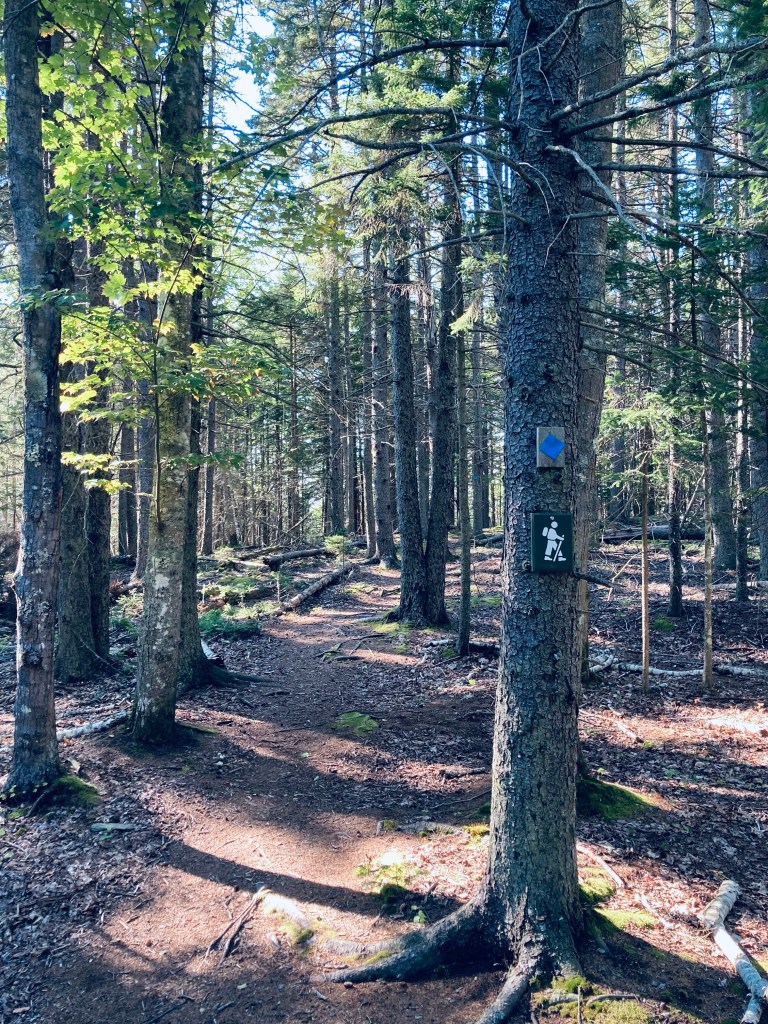
Spruce Fir-Forest Trail, Bowdoin’s Schiller Coastal Studies Center, Harpswell, ME

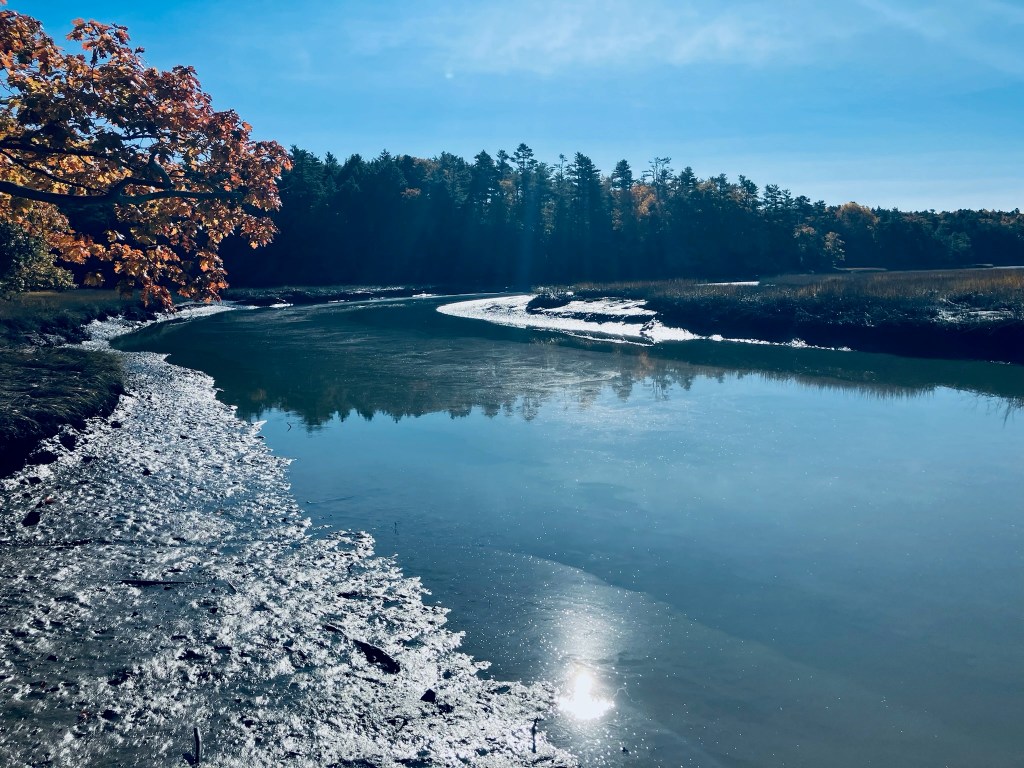
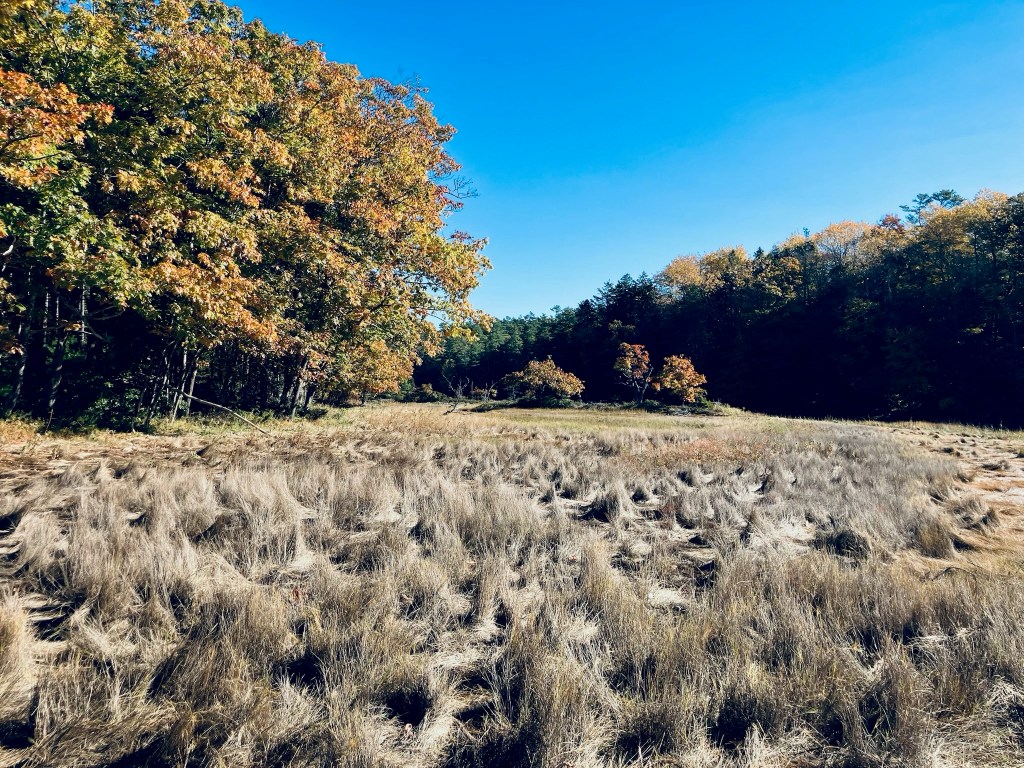
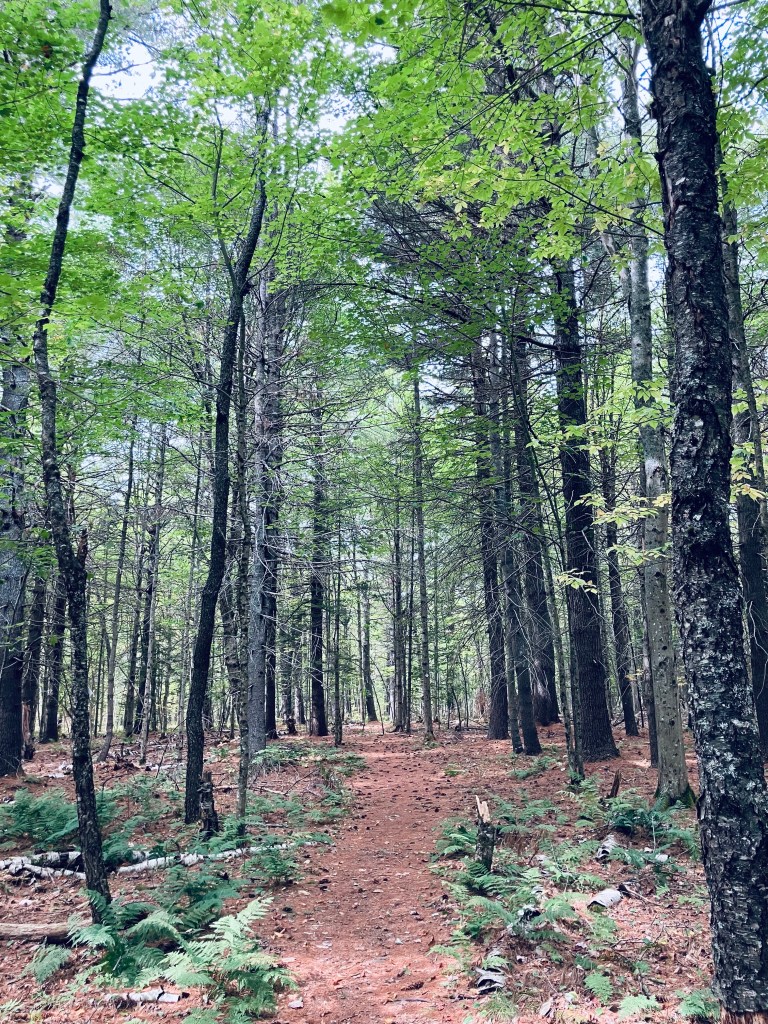
Schiller Coastal Studies Center, a 118 acre preserve on Harpswell’s Orrs Island, is owned by Bowdoin College, with trails made open to the public (foot traffic only, dogs on leash) from dawn to dusk. We discovered this special place using Maine Trailfinder, and have done several hikes since, in early September, in October, and in May, a loop hike of just under 3 miles, seeing most of the peninsula in under an hour-and-a-half through a long loop using the Spruce Fir-Forest Trail, Dipper Cove Path, Pine Needle Path, Brewer Cove Trail, Long Cove Loop, and Stone Wall Walk. We planned and hiked this loop using the excellent printable map available on the Schiller Coastal Studies website, as well as at an information kiosk at the small parking area off Bayview Road (it’s hard to see, due to the map’s colors, but the Long Cove Loop does connect to the Stone Wall Walk to complete the circle).

Harpswell Sound by Dipper Path, Bowdoin’s Schiller Coastal Studies Center, Harpswell, ME

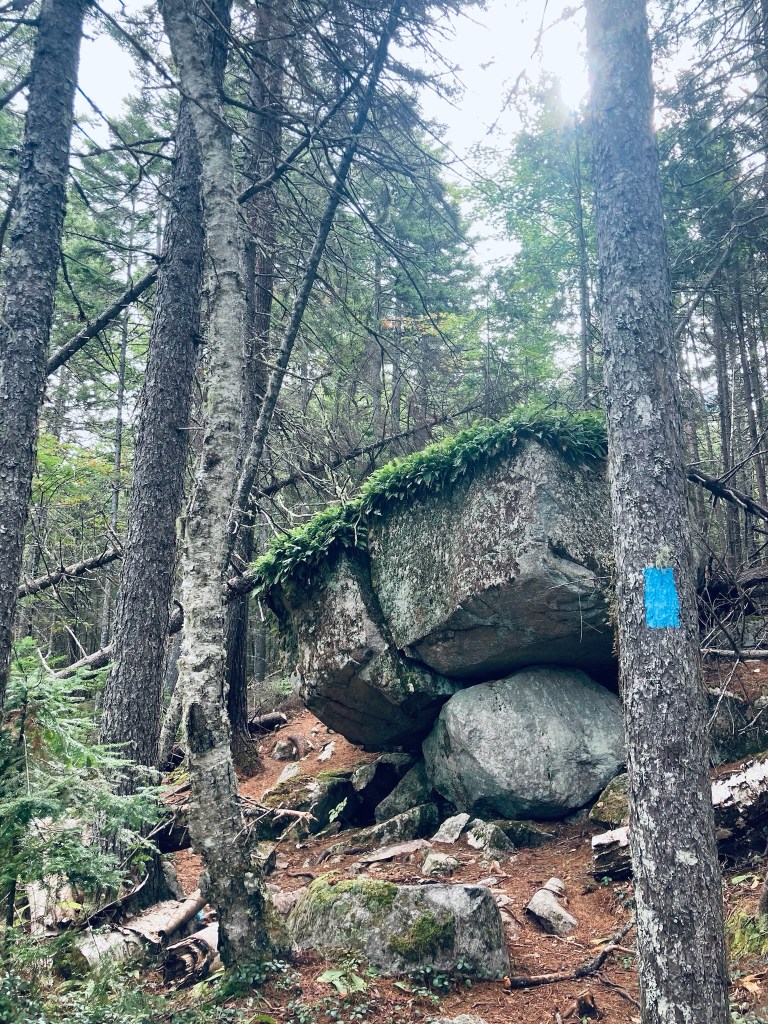
We started by walking south on Bayview Road, turning right (west) onto the blue-blazed Spruce Fir-Forest Trail. This trail descended quickly through its namesake forest to Dipper Cove on Harpswell Sound, meeting the Dipper Cove Path (green blazes) to head north along the shoreline, with glimpses of the water peeking through the sunlit trees. We enjoyed broader high tide views from the rocky shore of the emerald water and Wyer Island. According to Schiller Coastal Studies’ trail guide, the footpath to access Wyer Island is open at low tide only. The descent to the shore and the return climb along the Dipper Cove Path are the only real elevation along this loop.
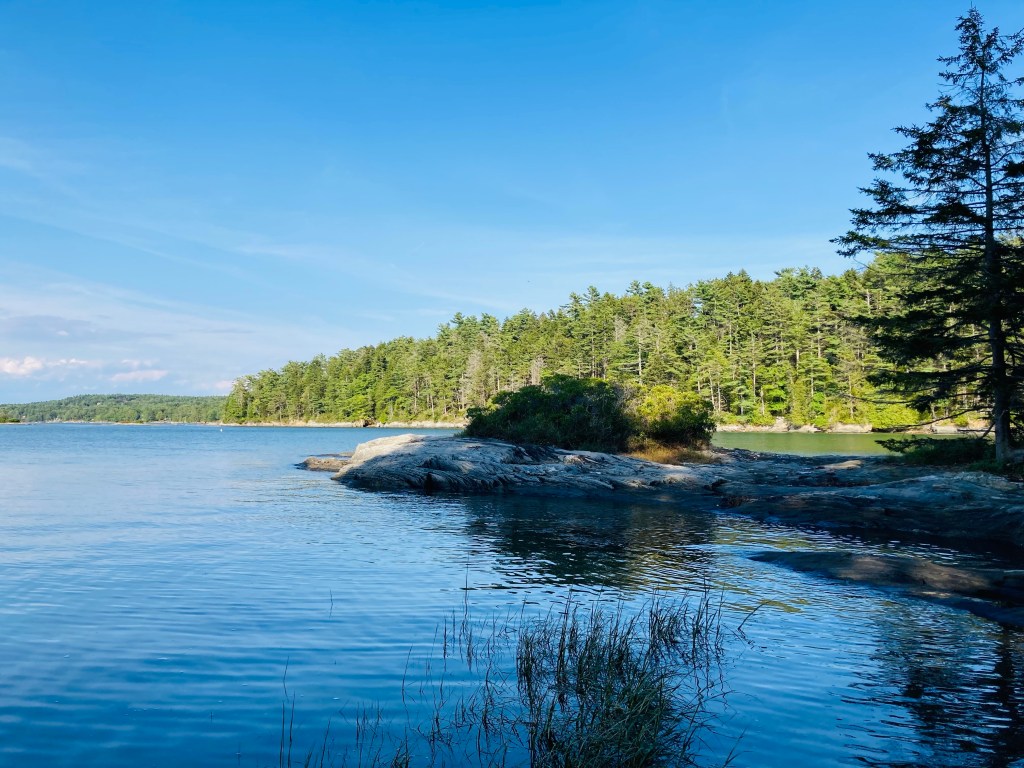
Terminus of Pine Needle Path, Bowdoin’s Schiller Coastal Studies Center, Harpswell, ME

We moved through the sunny campus along the road to rejoin the Pine Needle Path to the point of the peninsula, where a rocky promontory guarded the entrance to Brewer Cove. Several students can often be seen moving around the quiet campus. This amazing coastal property was deeded to Bowdoin College in 1981 by William (a Bowdoin graduate) and Irma Thalheimer, who continued to reside in the farmhouse there until their respective deaths in 1986 and 1994. The Center is named for Philip Schiller and Kim Gassett-Schiller, who more recently donated $10 million for laboratory and facility construction.

Late afternoon light, Brewer Cove Trail, Bowdoin’s Schiller Coastal Studies Center, Harpswell, ME

A chair tucked into a large bush gripping the rocks appeared to be a quiet, secret study spot, seen only by mergansers gliding by across the flat surface of Brewer Cove. We returned south, briefly retracing our steps to get onto the Brewer Cove Trail (blue blazes), which skirted the bottom of the cove, then headed north at a stone wall. The Brewer Cove Trail hugged tight to the small ridge along the way to Dog’s Head, with views down to the sheltered waters of Brewer Cove throughout, past twisted cedar trees.

Dog’s Head views, Long Cove Loop, Bowdoin’s Schiller Coastal Studies Center, Harpswell, ME

At the point of this peninsula, where the Brewer Cove Trail gives way to the Long Cove Loop (yellow blazes), a bench looks out over Dog’s Head and Harpswell Sound, where gulls, cormorants, and mergansers competed for territory. Here, we saw a small group of hikers heading back to the trailhead in the late-afternoon light. We paused briefly to enjoy the ocean views. The walk south along Long Cove seemed familiar, and looking at the map, it became apparent why – the Schiller Coastal Studies trails lie immediately across the Cove from the Devil’s Back Area Trails, which I explored previously on an unseasonably warm winter’s day. At a rocky open area in the trees, we heard, then saw, a pair of osprey wheeling overhead.

Spring wildflower – milkworts at Schiller Coastal Studies Center, Harpswell, Maine

In May, we saw a bright pink-colored fringed polygala, a species of milkwort flower, in the center of the path almost to the Stone Wall Walk. We headed uphill through evergreens and brightly colored changing ferns to pick up the Stone Wall Walk, the last leg of our loop. This trail passed a large section of blowdown trees and then moved through open fields.

Bright yellow and green ferns, Bowdoin’s Schiller Coastal Studies Center, Harpswell, ME

As we moved into the forest on the home stretch, I caught sight of a porcupine making its way out of the fields and across the trail. At our approach, it turned away from us, raising its tail toward us to telegraph its willingness to protect itself. The porcupine then lumbered through the pines, and made its way quickly up a tree, watching us from its perch as we walked back to the parking area. For food and drink after the hike, try Wild Oats Bakery and/or Flight Deck Brewing, which share a Brunswick Landing parking lot, on the way back to Route One.

Porcupine on Stone Wall Walk, Bowdoin’s Schiller Coastal Studies Center, Harpswell, ME

Stroudwater River Trail

Stroudwater River, Stroudwater River Trail, Portland, ME

Stroudwater River Trail, part of Portland Trails’ extensive network, is a 3.3 mile one-way (6.6 mile out-and-back) path beginning at Rivers’ Edge Drive, off outer Congress Street, that primarily follows the slow, muddy, meandering Stroudwater River where Portland meets Westbrook, crosses Spring Street, and ends at Smiling Hill Farm. This trail is popular with mountain bikers, trail runners and dog walkers. The full trail (see Portland Trails’ page) is unavailable from November 1 to April 1, as the area west from Portland’s Blueberry Road to Westbrook’s Cardinal Street is closed in the winter as a deeryard to provide a winter habitat for these animals.

Stroudwater River Trail, Portland, ME

Stroudwater Trail is an island of green in a fairly developed area of Maine, and the sounds and smells of industry and transit permeate much of the walk. The trail crosses underneath noisy I-95, and is flown over by thundering Jetport air traffic, but still maintains intervals of peace and quiet. On one late June day, we saw a U.S. Marine Corps Osprey vertical takeoff/landing plane doing test flights overhead.

USMC Osprey flying over Stroudwater Trail, Portland, ME

The Rivers’ Edge Drive lot is very small, and parking in the surrounding neighborhood is unauthorized. Parking abounds on Hutchins Drive (up to concrete barriers), but so do shifty characters waiting in idling cars in this remote, dead-end Portland spot, likely harmless to other hikers and walkers.

Pig in the varied greens of early spring on Stroudwater River Trail, Portland, ME

The trail itself is relatively easy and shaded, with switchbacks, stairs, and hills in spots, traveling through varied forest terrain, boardwalk bridges, and the grassy open areas created by power lines. A sign along the river marks the future location of a pedestrian bridge across the Stroudwater, which can be seen as of mid-April 2025, fully constructed and unused, sitting on the opposite bank.

Stroudwater River Trail, Portland, ME

Birds and seasonal wildflowers abound, particularly by the banks of the river. We saw robins, golden-crowned kinglets, and even a great blue heron. Unfortunately, insects also flourish in the late spring, so wear appropriate clothing or repellent. While the Stroudwater River Trail is not sufficiently remote to separate oneself from the bustle of modern life, for those working nearby or stranded at the Jetport, this easy trail presents a good way to get outside for a lunch break or a flight delay.

Stroudwater River Trail, Portland, ME

Pettengill Farm (Freeport, ME)

Stone wall in fall, Pettengill Farm, Freeport, ME

The Rodick Pettengill Farm in Freeport is a 140-acre property on the Harraseeket River owned and maintained by the Freeport Historical Society, and open to the public dawn to dusk, year-round. A self-guided tour and map, including trails, is available on the Freeport Historical Society website. In late October, we took a morning loop through the farm in the autumn foliage, using the Grant’s Point and Carter’s Creek Trails. Dogs are allowed (we were without Pig the dog for this hike, but saw several others with owners on the walk), a point we clarified with the Freeport Historical Society, as this policy has changed over the last several years.
Saltbox house, Pettengill Farm, Freeport, ME

Parking is available on Pettengill Road at the end of the farm’s driveway (as is a house-shaped box for donations) – just don’t park in front of the gate. Many historical placards dot the property, with vignettes from the farm’s up-and-down history, archeological findings, interactions with Native populations, and signs pointing out the sites of former buildings. The long driveway leads to the open fields around the farmhouse, built around the year 1800. We peeked in the windows (tours are available for groups of two or more with advance notice), then we walked downhill to the Harraseeket River, the site of a former shipping wharf for a brickyards.

Harraseeket River, Pettengill Farm, Freeport, ME

The sunlit October morning had a chill to it, but was invigorating, particularly since many hike reviews in warmer months listed mosquitoes and other biting insects as omnipresent. Across the field to the northeast of the house, we picked up the Grant’s Point Trail, mostly downhill through the mixed evergreen woods with a couple twists and the strong smell of pine, taking it all the way to its namesake promontory, with an excellent view of the river and beyond.

Pettengill Farm fields, Freeport, ME

There were some muddy areas, but none that were problematic or couldn’t be traversed. We took the Carter’s Creek Trail, winding in a forest full of birdsong, back up to the fields, skirting the edge until reaching the long driveway again. We bypassed the Ridge Trail and Marsh Trails, leaving them for another time.

Grant’s Point, Pettengill Farm, Freeport, ME

All told, the lollipop-type loop hike was about three miles in an easy hour and ten minutes, with time to read about history, stop in the sun, and birdwatch. While we did see other walkers and hikers, it was very quiet in the wooded portion of the trail. For those interested in more Freeport-area historical sites, the Freeport Historical Society has a Freeport Heritage Trail, with a map of sites and accompanying audio files.

Grant’s Point, Pettengill Farm, Freeport, ME

Blackstrap Hill Preserve

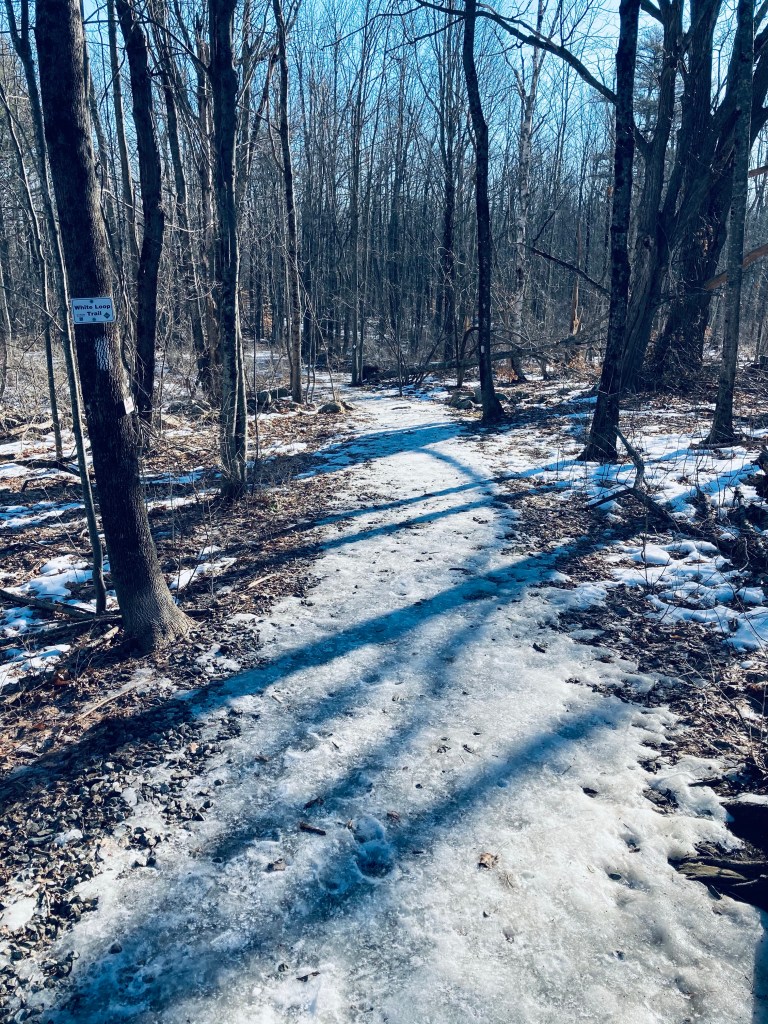
White Trail, Blackstrap Hill Preserve, Falmouth, Maine

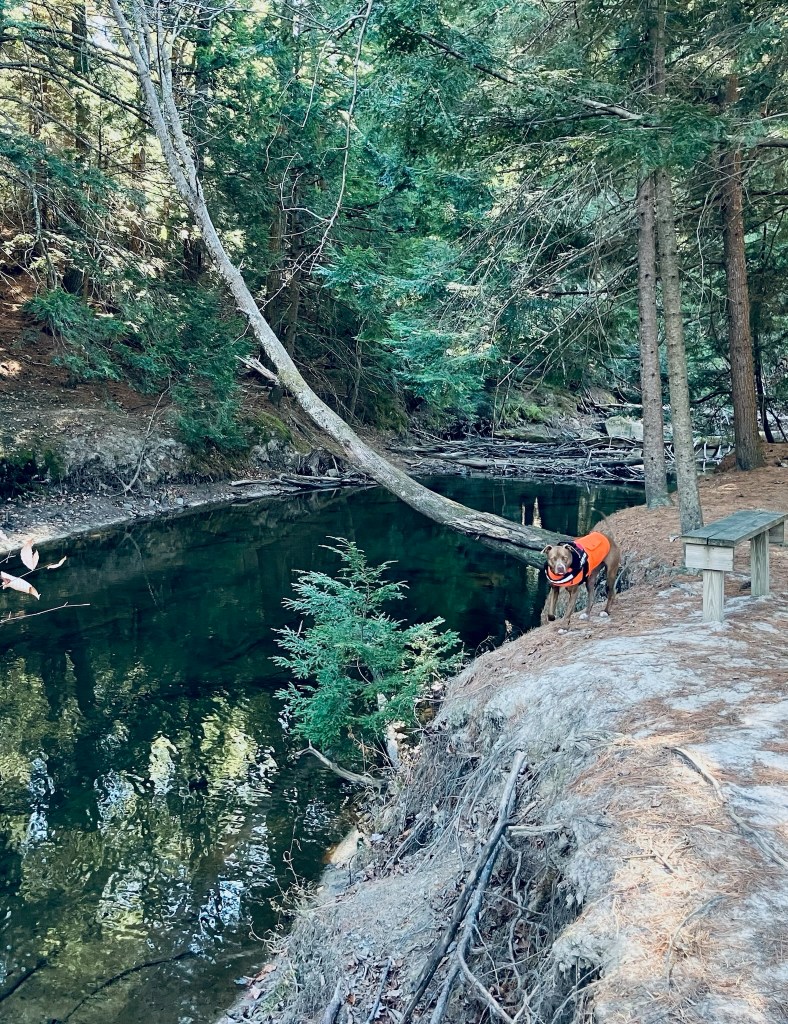
The Blackstrap Hill Preserve, along with the Blackstrap Community Forest, is comprised of two separate properties totaling almost 600 acres and 11 miles of trails, owned by the Falmouth Land Trust (FLT) and the Town of Falmouth, and divided by north and south. We have hiked this several times, and the photos are from a mid-March day and a mid-November day, several years apart. Dogs are allowed, and must be on-leash within 300 ft of trailheads. Hunting is permitted, so blaze orange is highly suggested in-season. Parking is available at the Blackstrap Community Forest parking lot on Blackstrap Road, where there is a small lot and map kiosk (see the FLT website for a map). From there, we have completed a loop of about 4.2 miles in a little under two hours (White Trail, Waterfall Trail, Red Trail, Greenline Trail, Saw Whet Trail, and Cross-Cut Trail).

Pig in blaze orange on the River Trail, Blackstrap Hill Preserve, Falmouth, ME

The Preserve is also accessible from a trailhead further up Blackstrap Road (same as for North Falmouth Community Forest), just north of Babbidge Road, where we did a 4.8 mile hike in about 2 hours (River Trail, Hayfield Trail, River Trail, Updraft Trail, Bobcat Trail, Rocky Ridge Trail, Happy Cats Trail), as well as another small parking lot off Hurricane Road. A connector to the east (from the River Trail) extends to the Hadlock Community Forest, as well.

Waterfall Trail, Blackstrap Hill Preserve, Falmouth, Maine

In March, after a short walk across the grassy field to the White Loop Trail, I put on micro spikes to deal with the icy footing. The White Loop Trail led to the Waterfall spur trail, marked with purple blazes, which added about .7 miles out and back, with the pleasant sound of the creek leading downhill. The waterfall was not so much one massive torrent, but a pleasing series of cascades, and would be a nice, easy hike for young children in warmer months.

Piscataqua River in late fall, River Trail, Blackstrap Hill Preserve

I returned to the White Loop Trail, continuing a counter-clockwise loop to the Red Trail, which was wide and sunken, making it a sort of frozen river in the winter melt. At the Red Trail intersection with the Yellow Trail (which I bypassed), you can begin to hear the highway again. The trail network is mostly self-correcting, with maps at major intersections.

Blackstrap Hill Preserve, Falmouth, Maine

I turned left by a lazy bend in the West Branch of the Piscataqua River to take the Greenline Trail toward the Saw Whet Trail. The Saw Whet climbs a ridge next to a marshy area, and is not particularly well-marked, but I eventually re-acquired some white blazes, eventually returning to the Red Trail and then the White Trail, which widened out for the loop back to the parking lot. For the longer loop from further up Blackstrap, we used AllTrails to navigate clockwise, dodging a few mountain bikers here and there (all of whom were courteous and respectful).

Blackstrap Hill Preserve, Falmouth, Maine

Great Back Lots and Valiant Trail Loop (Small-Burnham Conservation Area)

Great Back Lots and Valiant Loop Trail in Litchfield, Maine

The Great Back Lots and Valiant Trail Loop is part of the Small-Burnham Conservation Area in Litchfield, Maine, managed by the Kennebec Land Trust (KLT), who has a great website and map. The area itself is on a conservation easement by the landowners. I hiked this in late August 2024, navigating the 2.3 mile loop using AllTrails, easily completed in under an hour. The trails and parking area were very buggy, even on a dry sunny day. A small parking lot and kiosk are located off Pine Tree Road, with a sign-in station shortly down the trail.

Great Back Lots and Valiant Loop Trail in Litchfield, Maine

The Small-Burnham Conservation Area is open for hiking, nature observation, cross-country skiing, and snowshoeing. Contact the landowner for hunting permission, and snowmobiles are allowed on designated trails. Dogs are allowed on a leash or under voice command, as long as you clean up after them.

Great Back Lots and Valiant Loop Trail in Litchfield, Maine

The yellow-blazed Back Lots Trail follows the edge of a small ridge through deciduous trees overlooking a small, quiet stream. The slow flowage, bounded by ferns, looked fairly exotic by Maine standards in the late summer light. At a unique, twisted evergreen with five trunks, the trail turns hard left. At 1.4 miles I turned right on the main trail to do the loop counterclockwise.

Stone Bridge, Great Back Lots and Valiant Loop Trail in Litchfield, Maine

This trail was wide, open and shaded, a winding walk past a marsh and field of ferns. At a little over a mile, it opened up onto a wide meadow full of black-capped chickadee, cardinal and crows. On the opposite side of the loop, shortly before making the turn back towards the parking lot, I saw a large brown raptor by a low-lying marshy spot, but it flew away through the trees before I could identify it.

Great Back Lots and Valiant Loop Trail in Litchfield, Maine

Central Penjajawoc Preserve

White Pine Loop, Central Penjajawoc Preserve, Bangor, ME

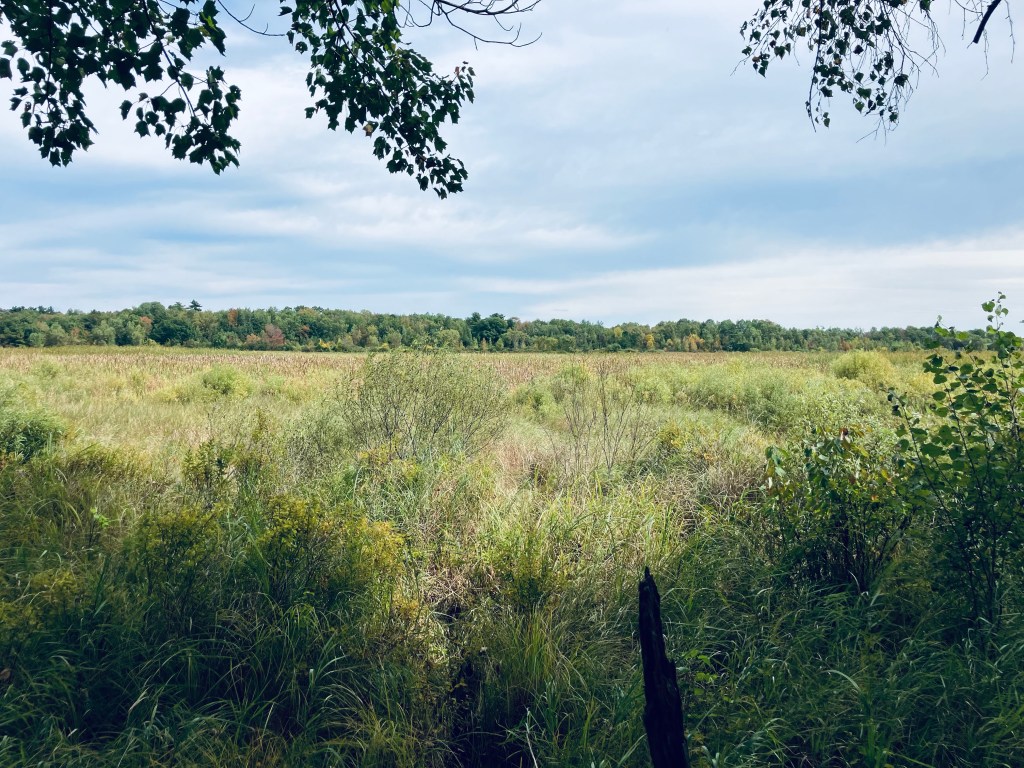
The Central Penjajawoc Preserve, a 182-acre trail network a short distance from downtown Bangor, is owned and maintained by the Bangor Land Trust, which has a helpful map and information on its website. No dogs or bicycles are allowed on the trails. The Preserve can be accessed from a small, signed parking lot on Essex Street, just south of the intersection with Burleigh Road. I hiked a loop in late September using the White Pine, Milkweed, and Penjajawoc Overlook Trails. The trail loop begins from a map kiosk as a narrow downhill path lined with ferns and wildflowers, and marked by diamond-shaped Bangor Land Trust placards on trees.

Tall White Pines, White Pine Loop, Central Penjajawoc Preserve, Bangor, ME

At the first trail junction (about a quarter-mile), I continued left on the White Pine Loop to go clockwise. The White Pine lives up to its namesake, and I enjoyed the sight and scent of the tall straight evergreens. As I moved further along the trail, there were low-lying marshy areas, mostly spanned with plank bridges, but in the early fall, it was dry enough that I had no issues with the mud. At about 2/3 of a mile, I hit the next trail intersection and continued left on the Milkweed Trail for the outer part of the loop.

Central Penjajawoc Preserve, Bangor, ME

I crossed a small stream lined with wildflowers and an open meadow, with the path now marked by flags. The footing was uneven, but the trail’s overall grade was flat and easy to follow. The trail dipped through a wooded area, back across a small stream, and then into another open meadow, with a similar density and variety of wildflowers. Just prior to the first (northernmost) Marsh Overlook, I encountered a massive tan toad with dark brown spots, who lumbered across the path, and then disappeared into the undergrowth.

Marsh Overlook on Milkweed Trail, Central Penjajawoc Preserve, Bangor, ME

I would describe the Overlook as more of a “through” look, a glimpse beyond the curtain of the trees to a large marsh, but no real elevation to look down from. I continued clockwise along the trail past the wildflowers and milkweed, following the flags, as the path is more of a game path here. Next turn was left, on the Penjajawoc Overlook Trail toward the second Marsh Overlook, which started through a small gap in a stonewall. I walked through another open meadow, this one higher and greener than the prior ones. This spur trail was a lot more overgrown, but still marked by flags and downtrodden vegetation, and fairly easy to follow. The field and its small islands of shrubs were full of chickadees, palm warblers, and eastern phoebe.

Overlook over Penjajawoc Marsh, Central Penjajawoc Preserve, Bangor, ME

I reached the second Marsh Overlook through a small stand of trees, and enjoyed the view, which was much more expansive than the first, hearing ducks in the distance. I paused and realized that I was covered in pollen from the waist down, following the walk through the meadow. The browns, gold, and yellow colors of early fall covered Penjajawoc Marsh and Penjajawoc Stream. On the return loop toward the parking area, I saw a small pile of bear scat on the pine-covered floor of the trail, as well as the signs of a small human encampment. The total loop was about 2.8 miles, taking only about an hour.

White Pine Loop, Central Penjajawoc Preserve, Bangor, ME

Kenduskeag Stream Parkway

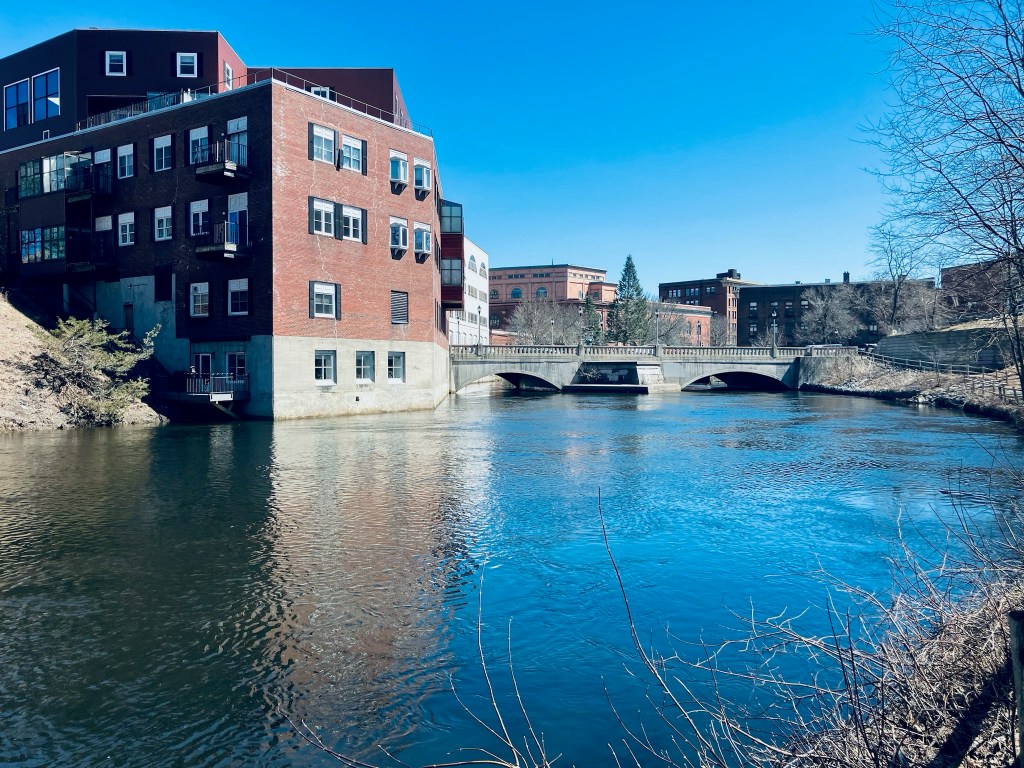
Kenduskeag Stream from Kenduskeag Stream Parkway, Bangor, ME

The Kenduskeag Stream Parkway traces its namesake waterway upstream from downtown Bangor, and is an easy out-and-back lunchtime hike totaling about two miles. You can start the hike from Coe Park (as recommended in AllTrails) or from various entries on Harlow or Franklin Streets, all of which give you about a mile to the trail’s end by the Maxfield Mill Dam. The path, maintained by the City of Bangor, is featured on their website, including a printable map.

Kenduskeag Stream from Kenduskeag Stream Parkway, Bangor, ME

I have completed this hike from Coe Park in spring and from downtown in the early fall, and each time it took about 40-45 minutes. From Coe Park, cross Court Street, passing the playground, and going downhill, veer left. In the winter time, with the foliage bare, you can see down from the hillside to the other side of the river.

Morse Bridge from Kenduskeag Stream Parkway, Bangor, ME

The trail winds down, doubling back to Morse Bridge across the Kenduskeag. This steel footbridge was installed in 1985 after a wooden version was burned by an arsonist. A word of warning – this trail is a bit dodgy, emblematic of the less-savory substance use and economic underbelly of Bangor. It’s more reminiscent of Stephen King‘s “Derry” than the Bangor tourism brochures would have you believe. A needle receptacle is typically not a point of interest on a hike. But no interactions made me nervous or feel unsafe. I have politely declined an offer from a man to buy my shirt, and exchanged pleasantries with a few people passing the time on benches.

Downtown Bangor from Kenduskeag Stream Parkway, Bangor, ME

Prior to Morse Bridge and to the right, the parkway will take you along the west bank back towards downtown Bangor, where the Kenduskeag eventually meets the Penobscot. I haven’t seen much wildlife here, but there are fish and ducks, and I heard the calls of song sparrow, American goldfinch, and chickadee. When heading upstream, be careful crossing Harlow Street, as the trail crosses a busy section of road where the crosswalk has been exfoliated by sand and grit, and cars coming down the hill from 95 or heading out of downtown will be unlikely to stop.

Kenduskeag Stream and dam remains from Kenduskeag Stream Parkway, Bangor, ME

At Gateway Park, there is a covered picnic area and an interpretive panel listing Gateway Park as the halfway point, and describing the history of the Kenduskeag. Uphill, trails lead down to the Kenduskeag rapids, for views and fishing. The remains of an old dam also rest on the banks, and in the watercourse. The trail ends at Maxfield Mill Dam, with signs across Valley Avenue indicating the area is closed.

Kenduskeag Stream in early fall from Kenduskeag Stream Parkway, Bangor, ME

Meduxnekeag River Trail

Meduxnekeag River Trail, Houlton, Maine

The Meduxnekeag River Trail, a lollipop loop in Houlton, is a stone’s throw from Maine’s border with Canada and starts from a variety of places. According to the brochure available at the trail kiosk, Meduxnekeag is Maliseet (one of the five tribes of the Wabanaki confederacy) for “rocky at its mouth.” On this first December day, I chose Riverfront Park, which has ample parking, and restroom facilities (May through October only) for a starting point. At about .6 miles on, the trail wound up the riverbank to the edge of an open field.

Meduxnekeag River Trail, Houlton, Maine

At this time of year, about four or five inches of snow covered the path, and I could read a mix of cross country ski tracks and footprints on the trail. In another week or two, I would need some traction devices or snowshoes, but for now, my body weight and good winter boots gave me the needed traction. I passed a double Adirondack chair, with views across the field, including a giraffe-like Irving sign on the horizon, which was less-than-scenic. The trail moved back into the woods about a mile in. This trail system has a couple loops built-in to make your own version of a hike, and even in December snow, I saw a couple people of various ages, including those with small kids, enjoying different levels of the trail.

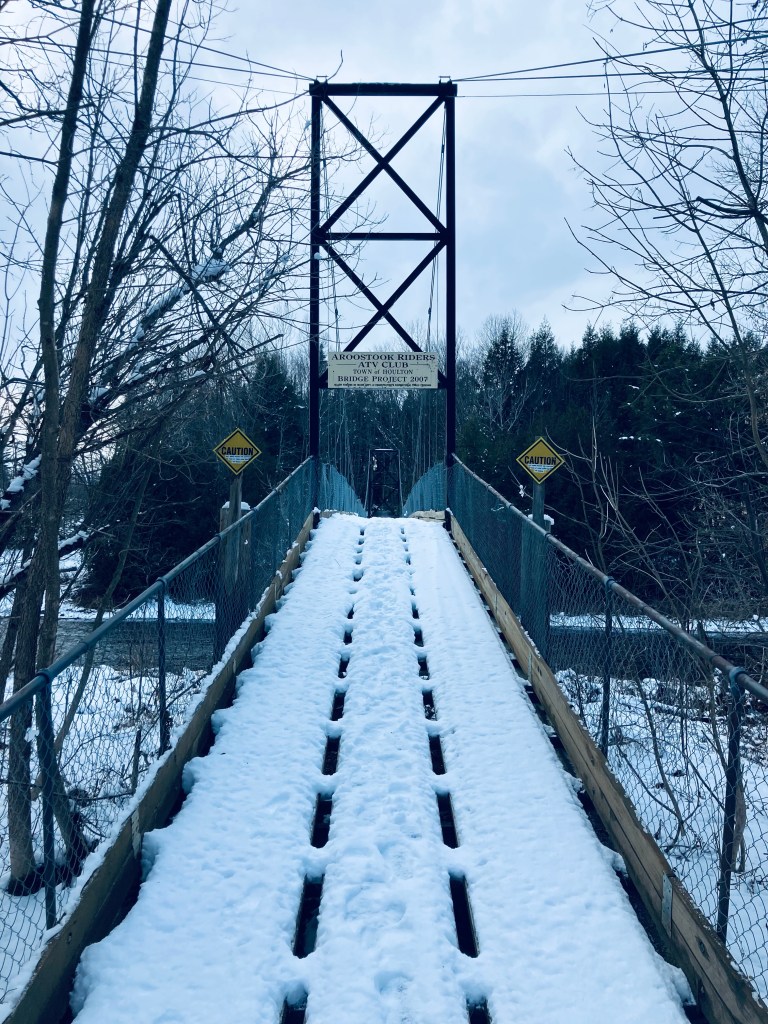
Footbridge/ATV bridge on Meduxnekeag River Trail, Houlton, Maine

1.5 miles, the trail had a marker splitting “Easy” to the left, and “Moderate” to the right. I stuck to Moderate and started heading downhill towards a series of bridges. The trail crossed under the separate I-95 bridges- northbound (about to end) and southbound (just beginning) and reached the footbridge across at about 1.75 miles, a bridge shared by ATVs and people. This bridge definitely swayed with footfalls, and I trod down the snow and enjoyed the slow movement of the river. Across, the trail follows the bank under the two I-95 bridges and then goes back uphill along Cook Brook, which feeds the river, before tracing the brook briefly above some pleasant cascades and waterfalls and crossing back over it on a small wooden footbridge.

Meduxnekeag River Trail, Houlton, Maine

It was a quiet rolling walk along the riverbank until two small foot bridges across the creek led to a series of squiggles on the map at about 2.75 miles, which turned out to be switchbacks leading uphill. At about 3 miles, I passed the John H. Millar Civic Center, where the Community Park entrance of the trail comes in. Close to 3.5 miles, I emerged from the treeline, and saw the Highland Avenue bridge. Crossing the bridge was a little challenging, as the snow was piled high, and felt like walking across a series of Bosu Balls, but there was a great view at mid-span back along the slow river and then I took the long staircase back down to the riverside path and the parking lot. All told, about 4 miles in an hour and twenty minutes.

Meduxnekeag River Trail, Houlton, Maine

River Pond Nature Trail

Katahdin across River Pond, River Pond Nature Trail, Millinocket, Maine

River Pond Nature Trail is the outside loop of a trail system, all with logging names, dotted with interpretive displays, off the Golden Road in Millinocket between its namesake River Pond and the West Branch of the Penobscot River, not far at all from Baxter State Park’s Togue Pond gate. I took this trail loop, owned by Katahdin Forest Management, in mid-September as the last Sunday hike on the way out of the park on a weekend trip.

River Pond Nature Trail, Millinocket, Maine

Looking at reviews, it was uniformly described as buggy, but I didn’t have any problems with flies or mosquitoes in the cooler temperatures of early fall. The narrow Tenderfoot Trail through the forest started at a small kiosk by the large parking area, where there were two other vehicles. I moved counterclockwise, and at about .4 miles, just shy of a large boulder, I got my first view of Katahdin through a side trail that led down to River Pond.

River Pond Nature Trail, Millinocket, Maine

As I continued, two people coming towards me told me there were moose in the second clearing. I saw many clearings, no moose, but it’s always exciting to know they are out there. I reached Moose Point and the Timber Cruisers Trail and enjoyed the views across the pond of Katahdin, still nestled in clouds. The south side of the trail is more forested, with an occasional view of the West Branch of the Penobscot River below in the distance.

Katahdin across River Pond, River Pond Nature Trail, Millinocket, Maine

I did not take the River Driver’s Trail, which was a detour of a spur trail that would likely have culminated in better views, as I did not have the energy. Nevertheless, the rolling hills and springy pine-needle paths of the Forester’s Trail were a pleasant change from the rocky terrain of Baxter State Park. All told, the loop was about 4 miles, taking about an hour and 24 minutes.

River Pond Nature Trail, Millinocket, Maine

Trout Mountain Preserve

Millinocket Lake from Observation Tower, Trout Mountain Preserve, T2 R9, Maine

Trout Mountain (1,409 ft) is the centerpiece of a 3,598 acre Preserve owned and managed by The Nature Conservancy (TNC), adjacent to the south side of Baxter State Park, and open from dusk to dawn (no overnight camping). Information and trail maps can be found on TNC’s Trout Mountain Preserve website. This hike is also fully described in The AMC Maine Mountain Guide. The relatively easy trail to the Trout Mountain summit, listed by TNC as 2.7 miles one-way, capped by an 80-foot observation tower, measured a total of 5.26 miles roundtrip by my AllTrails app, with only 827 feet elevation gain, the whole thing taking about an hour and 45 minutes.

Fern-covered boulders, Trout Mountain Preserve, T2 R9, Maine

The trail starts from a small kiosk accessible from the same turn as the large emergency helicopter landing area, just short of Baxter State Park’s Togue Pond Gate, where a bald eagle circled when I drove through. The trail is a well-maintained single track that is fairly rocky. After the Nature Conservancy sign welcoming you to The Trout Mountain Preserve, the trail winds through a widely spaced young forest with knee-high ferns.

Trout Mountain Preserve, T2 R9, Maine

After 2 miles, the incline increases quickly, but it’s through such a beautiful green, moss-covered forest with hobblebush and bright red berries that the strain likely won’t hit you for a little bit. I reached the tower in a little less than an hour’s time. It looked incongruent on this quiet mountain, but I was grateful for its elevation in order to see the surrounding countryside.

Observation Tower, Trout Mountain Preserve, T2 R9, Maine

The tower, which a stamp shows was erected in 2020, seemed absurdly tall while climbing it, and even taller once I was at the top. I could see the surrounding north Maine woods, Millinocket Lake, and Katahdin shrouded with clouds, looking like the cloud would move away soon. There is also an outhouse near the summit. I had the tower to myself, and enjoyed the meager remains of my trail snacks from a weekend at Baxter State Park. The hike back was almost uniformly downhill, and I passed another solo hiker, then a small family, each headed up to the top.

Katahdin from Observation Tower, Trout Mountain Preserve, T2 R9, Maine

(Disclaimer: This post contains affiliate links, and as an Amazon Associate Hiking in Maine blog earns from qualifying purchases.)