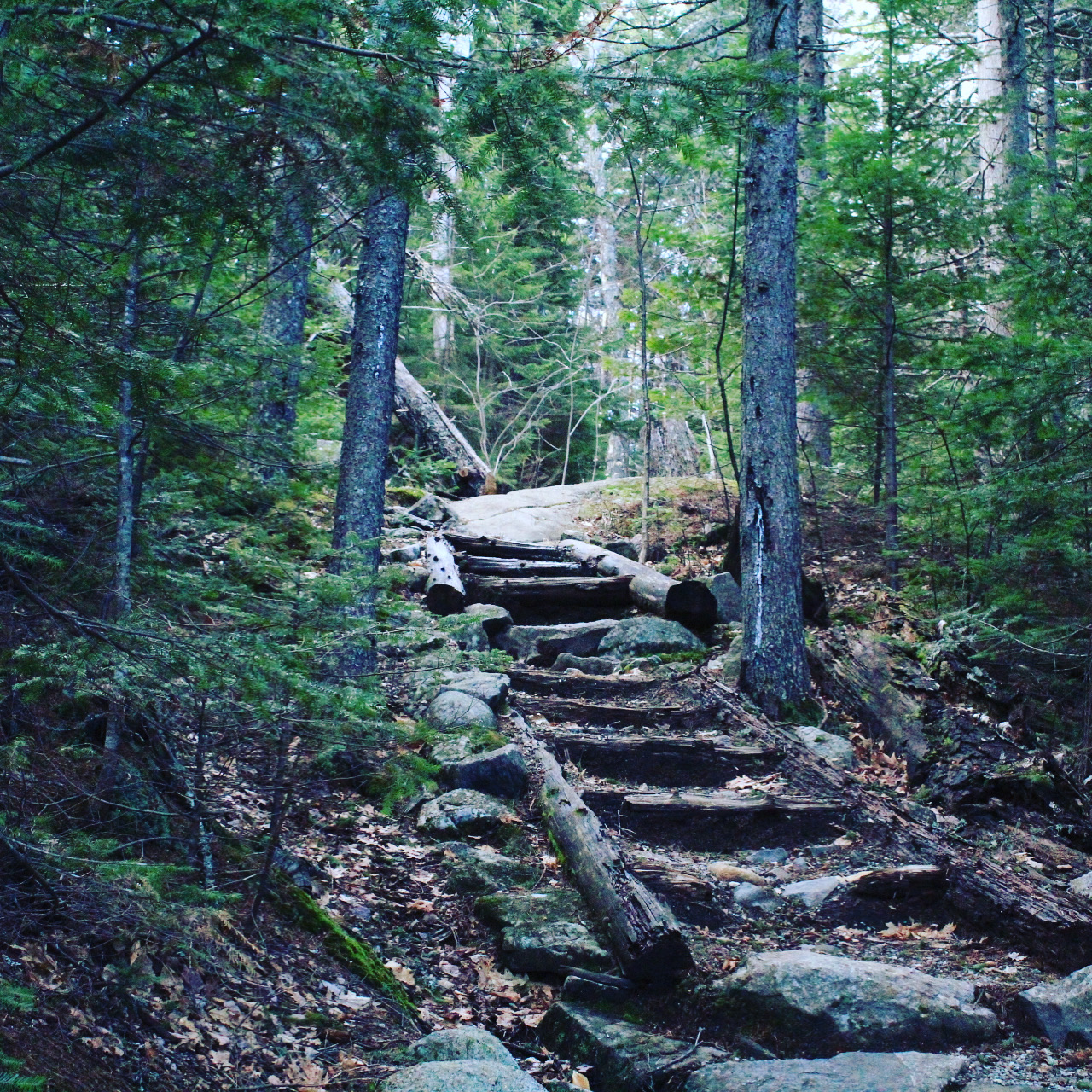
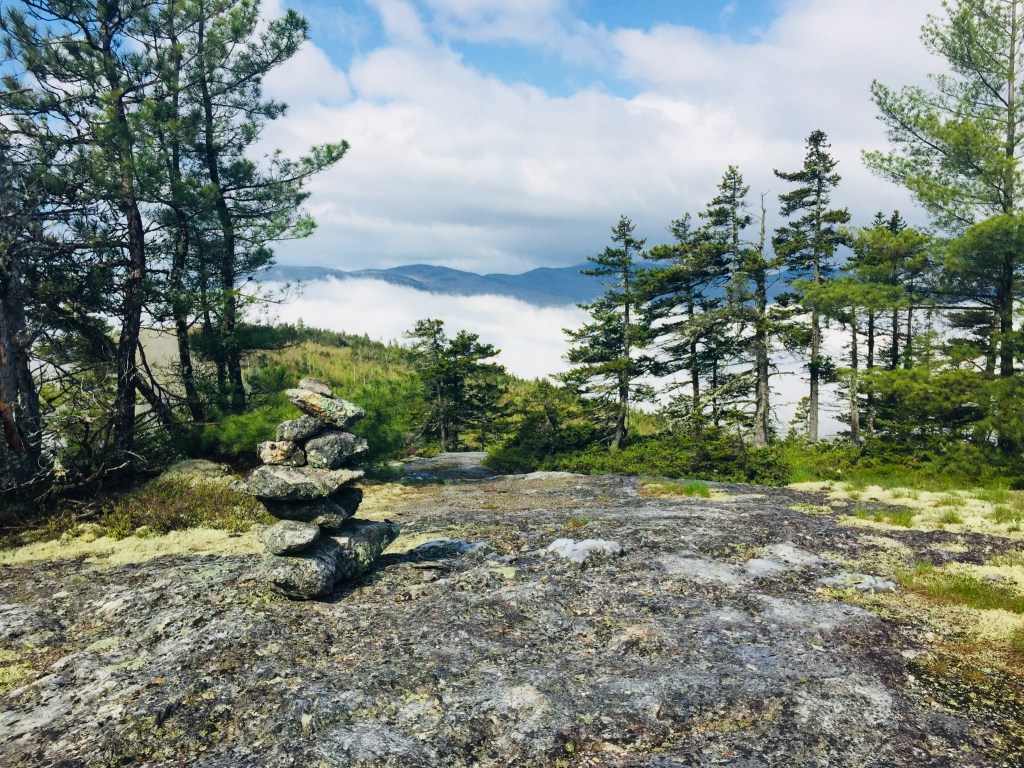
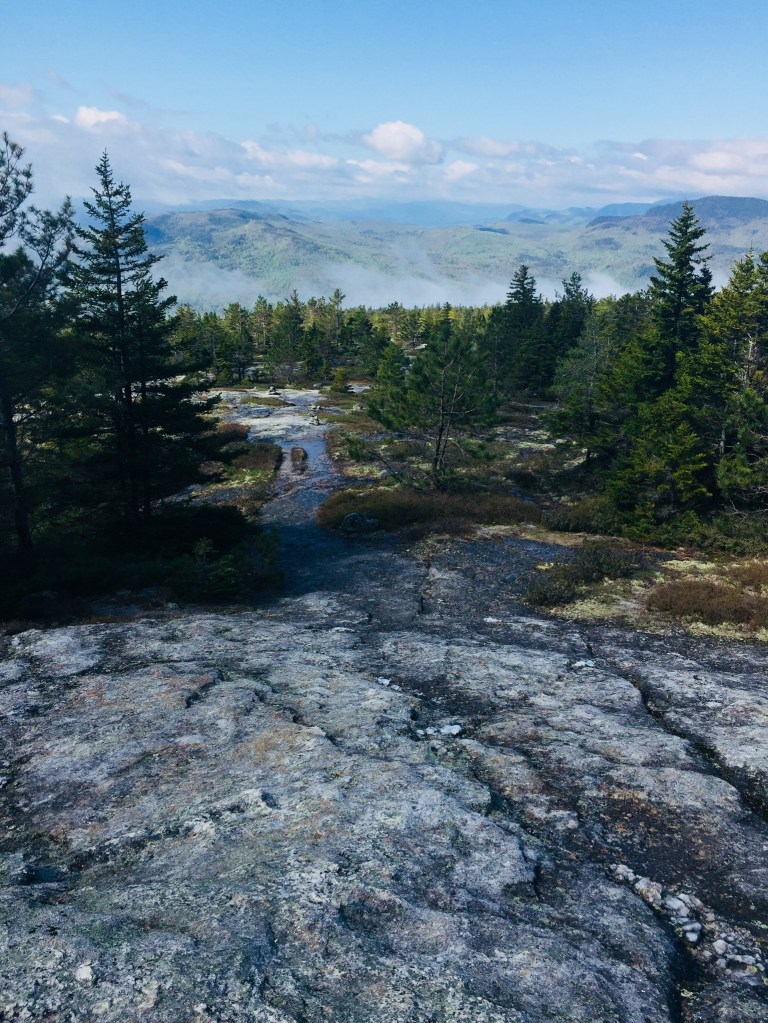
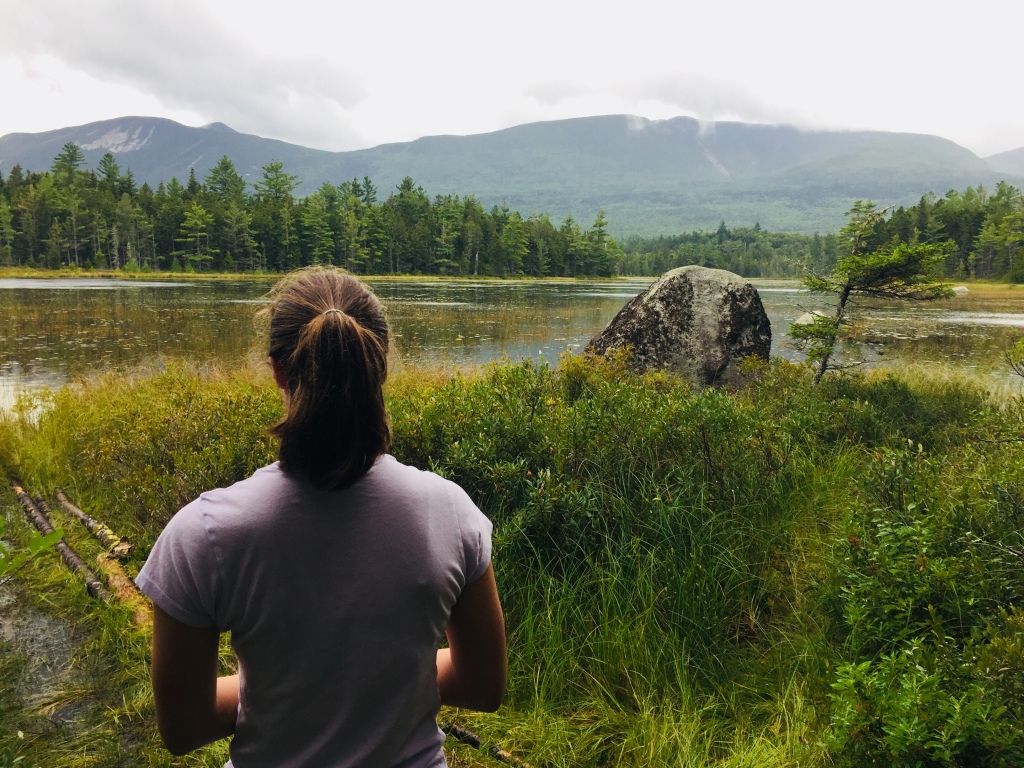
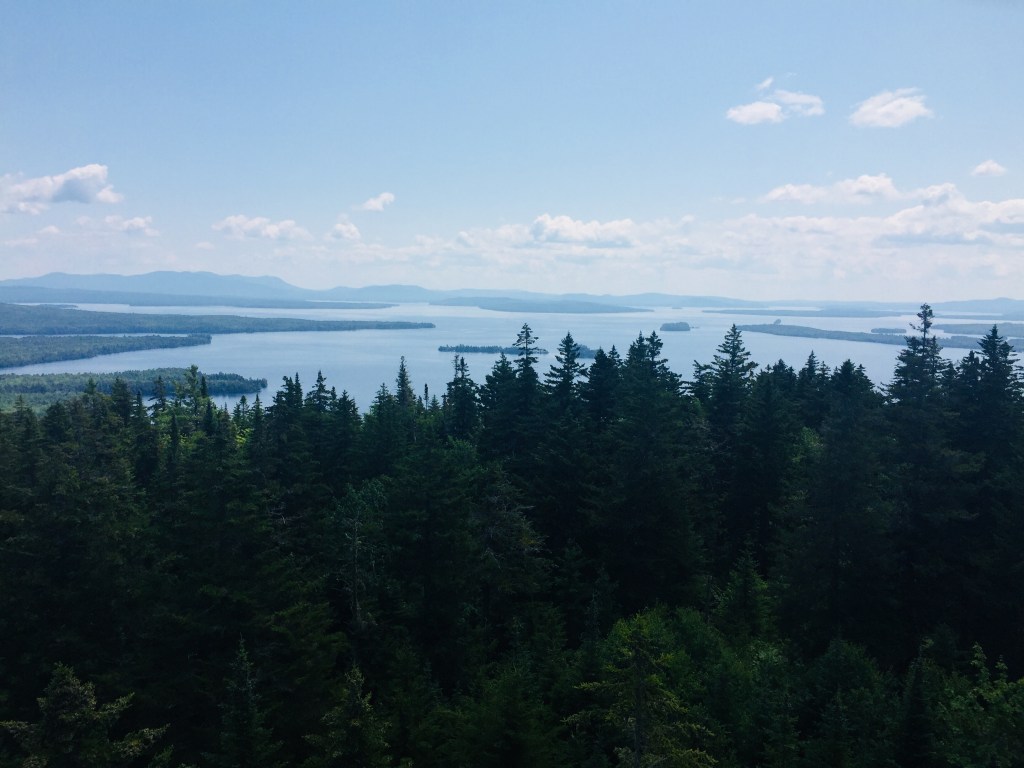
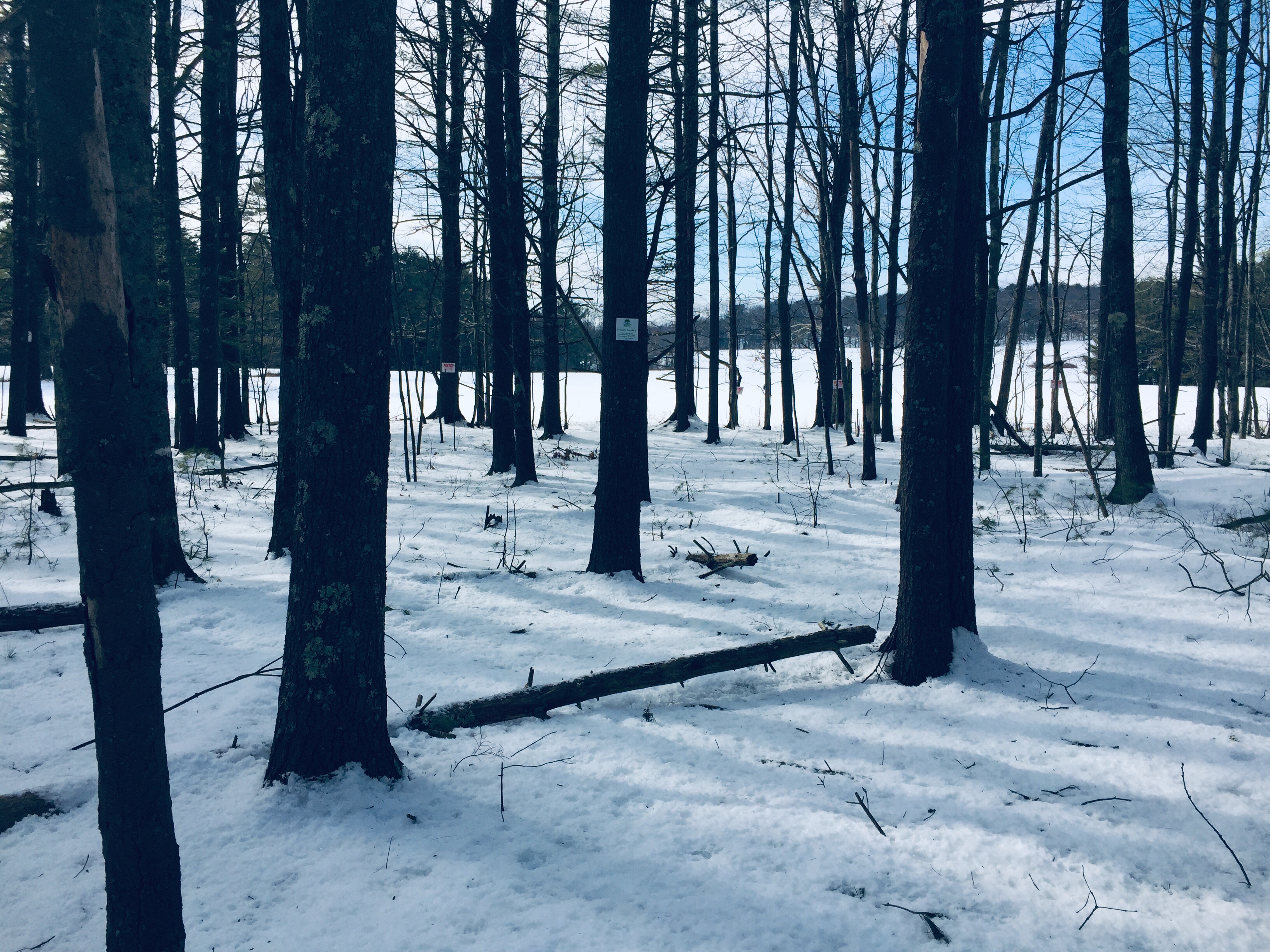
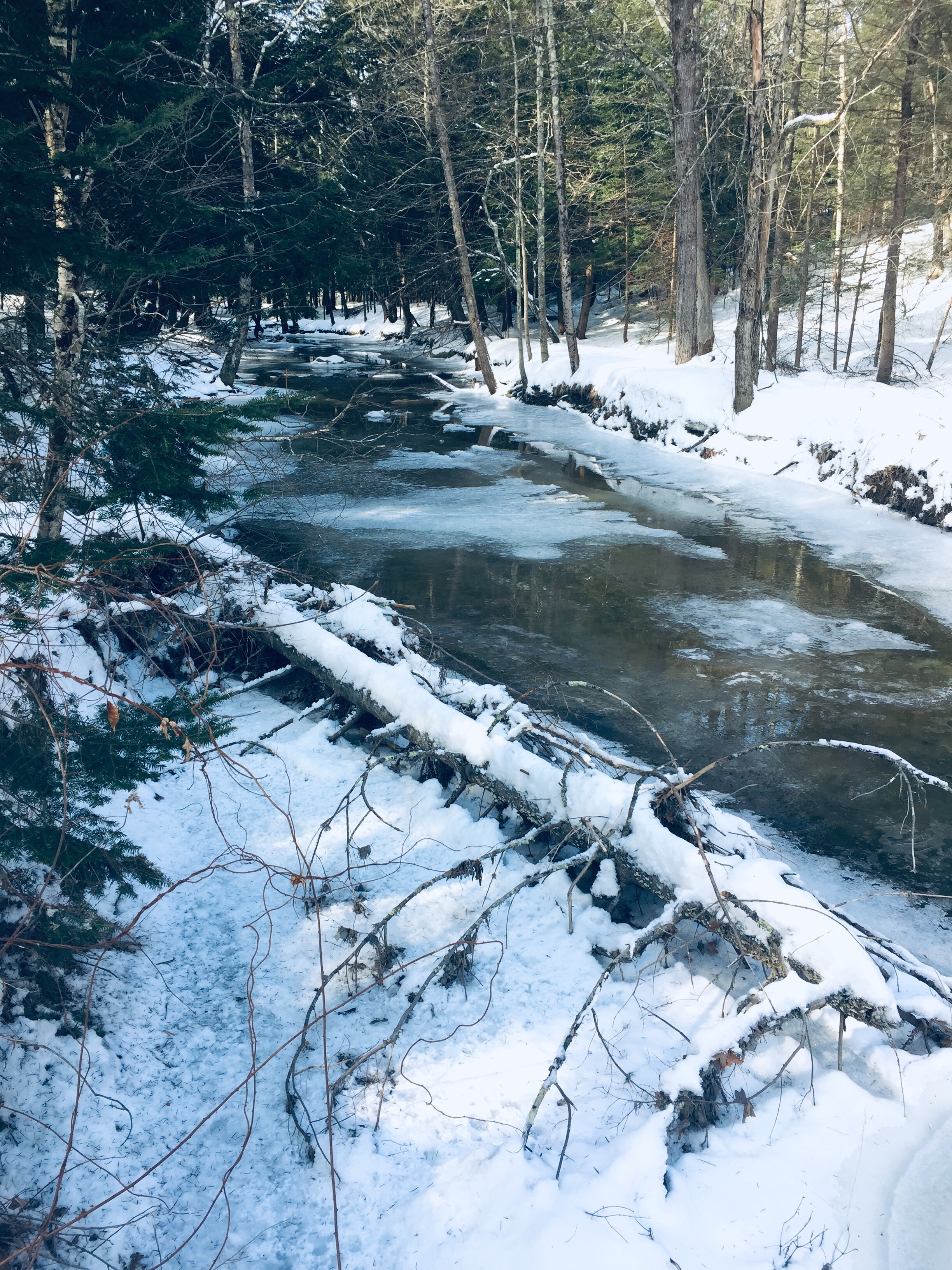
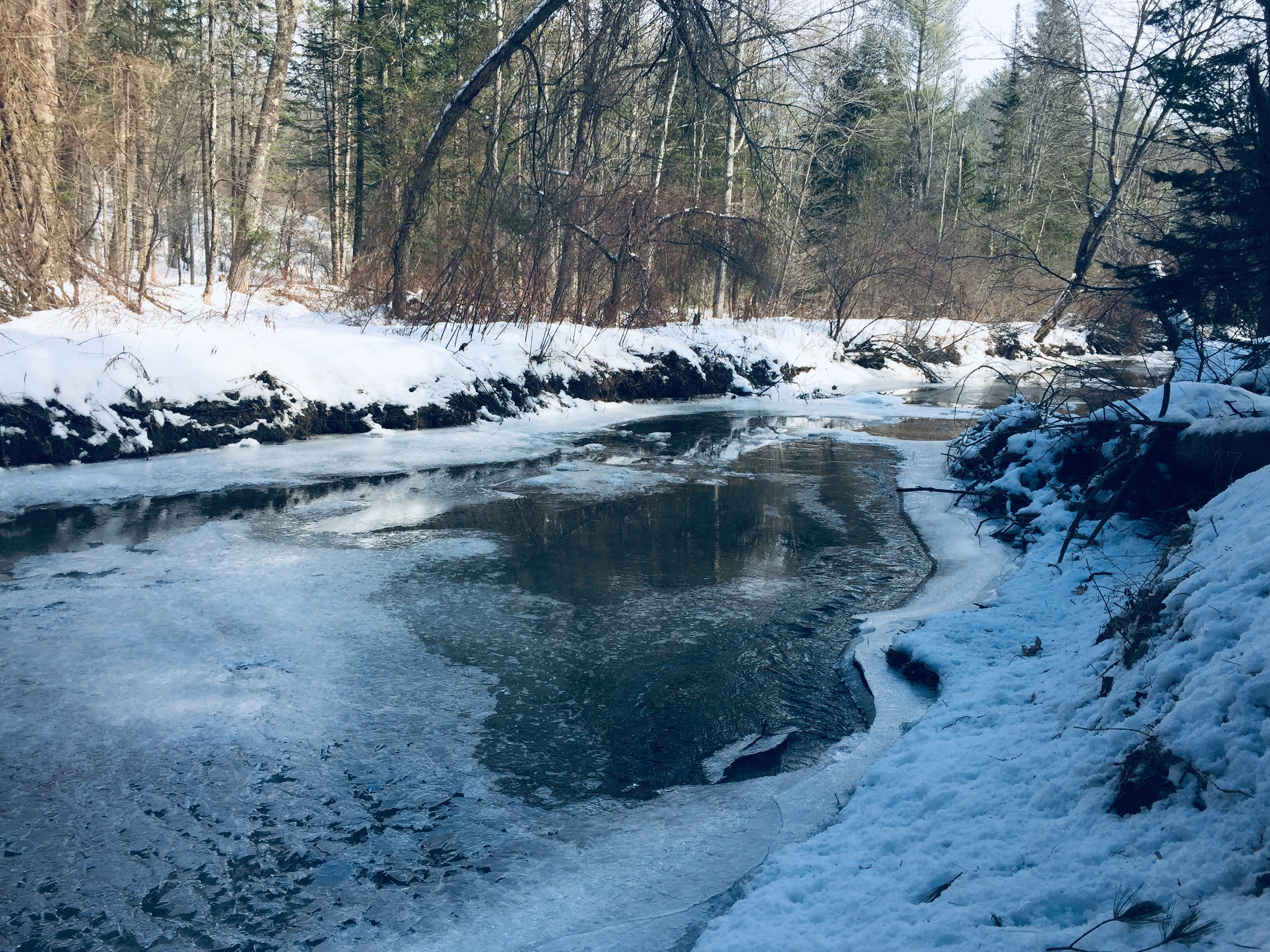
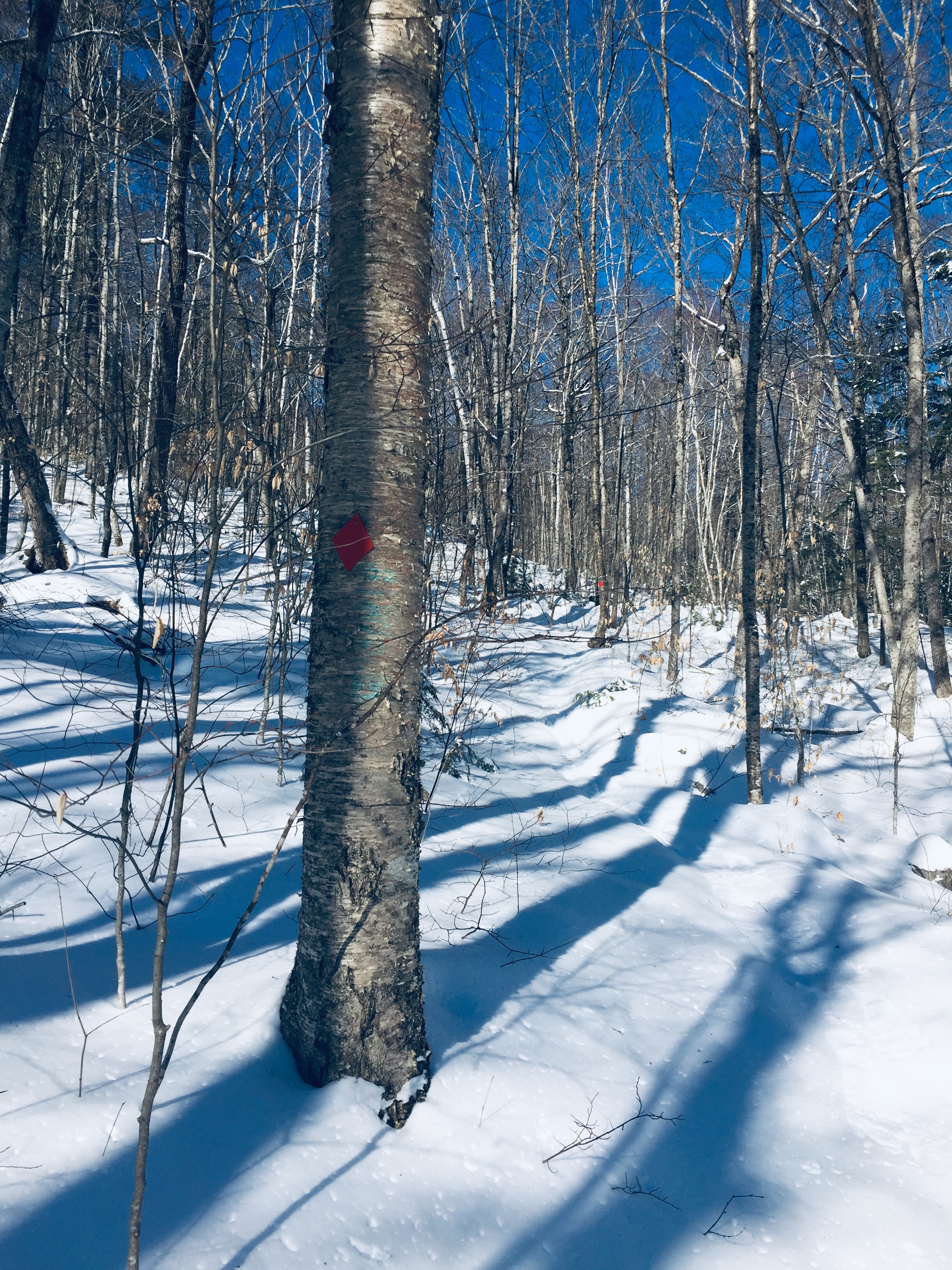
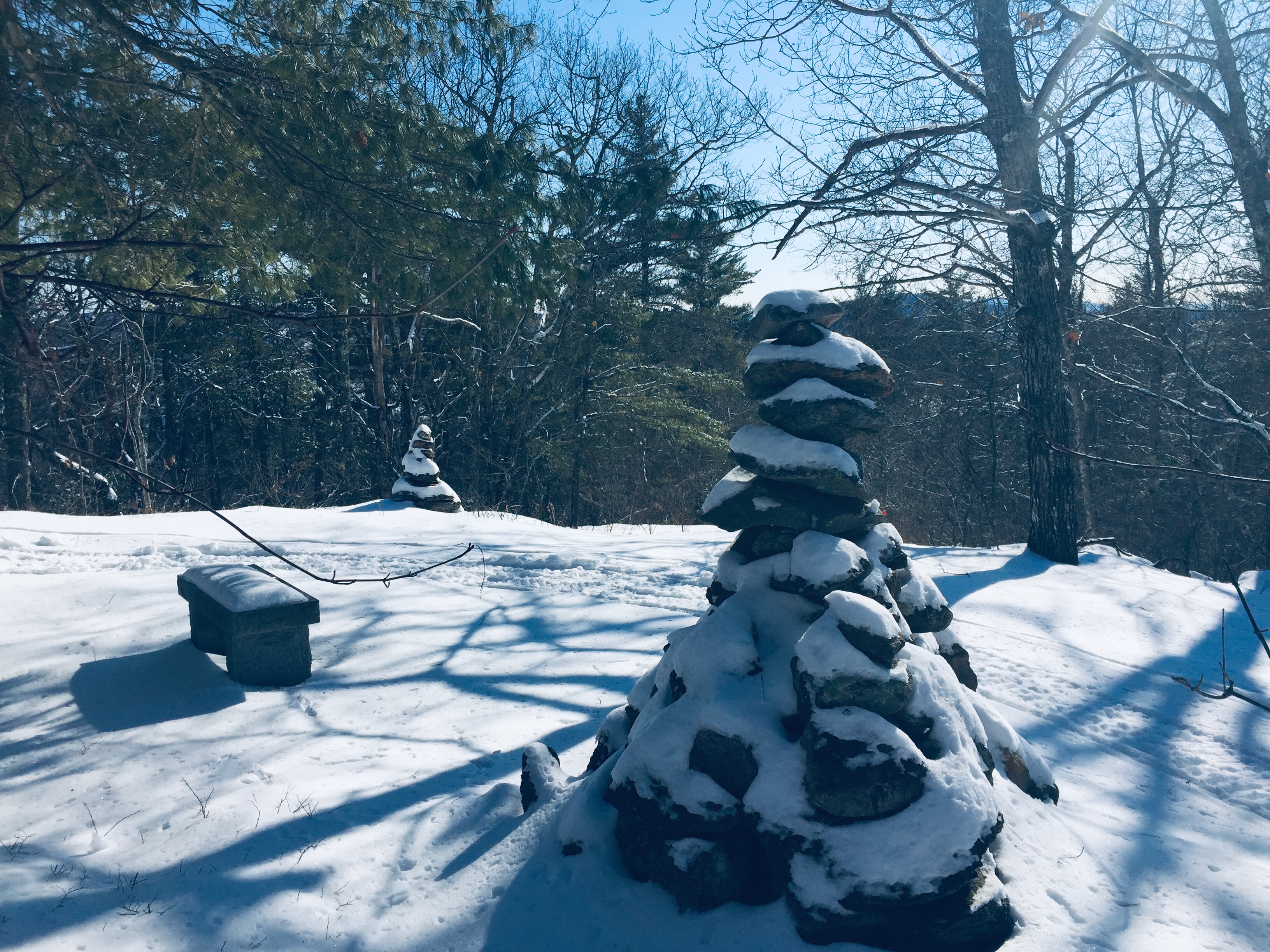
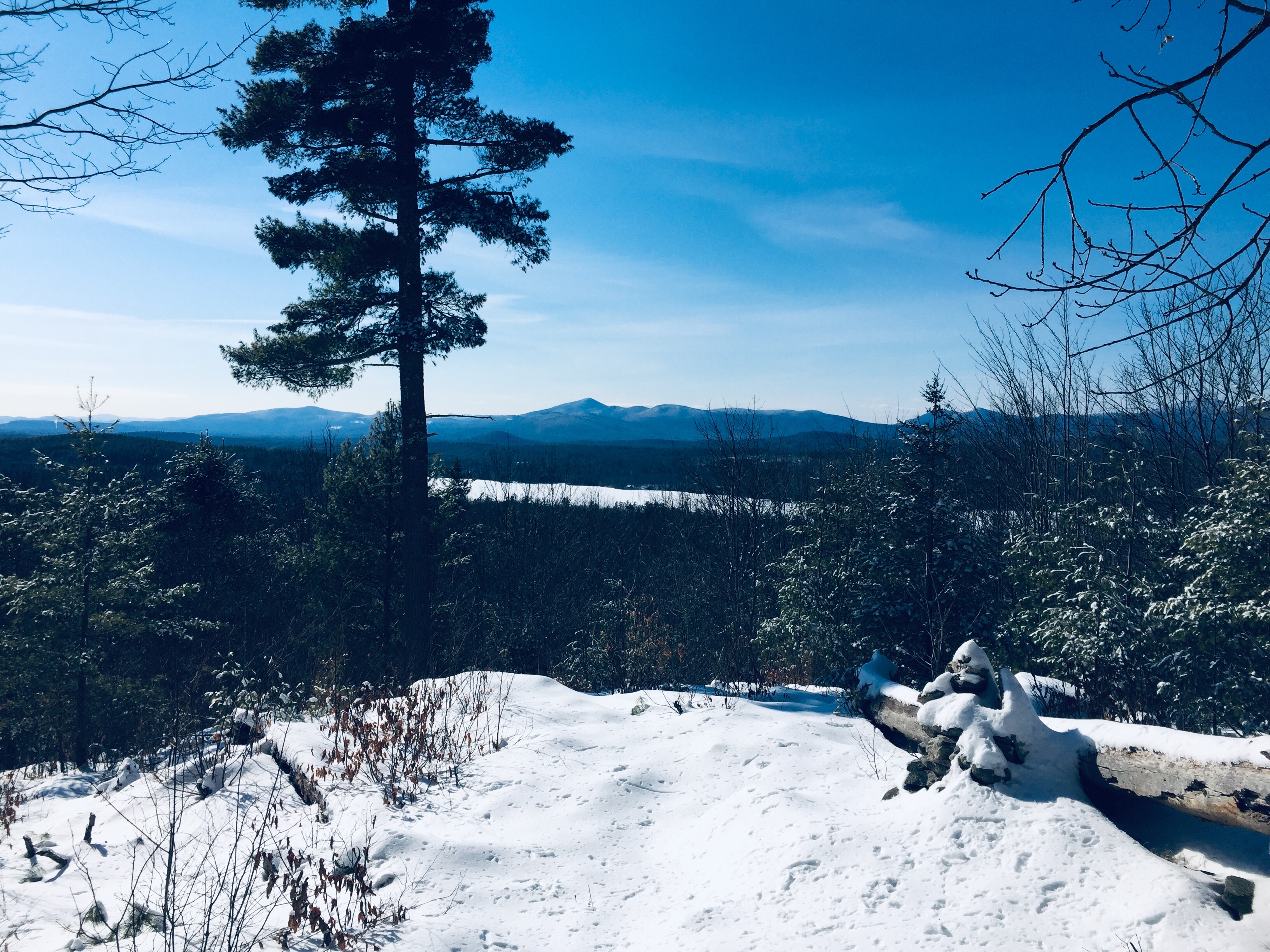
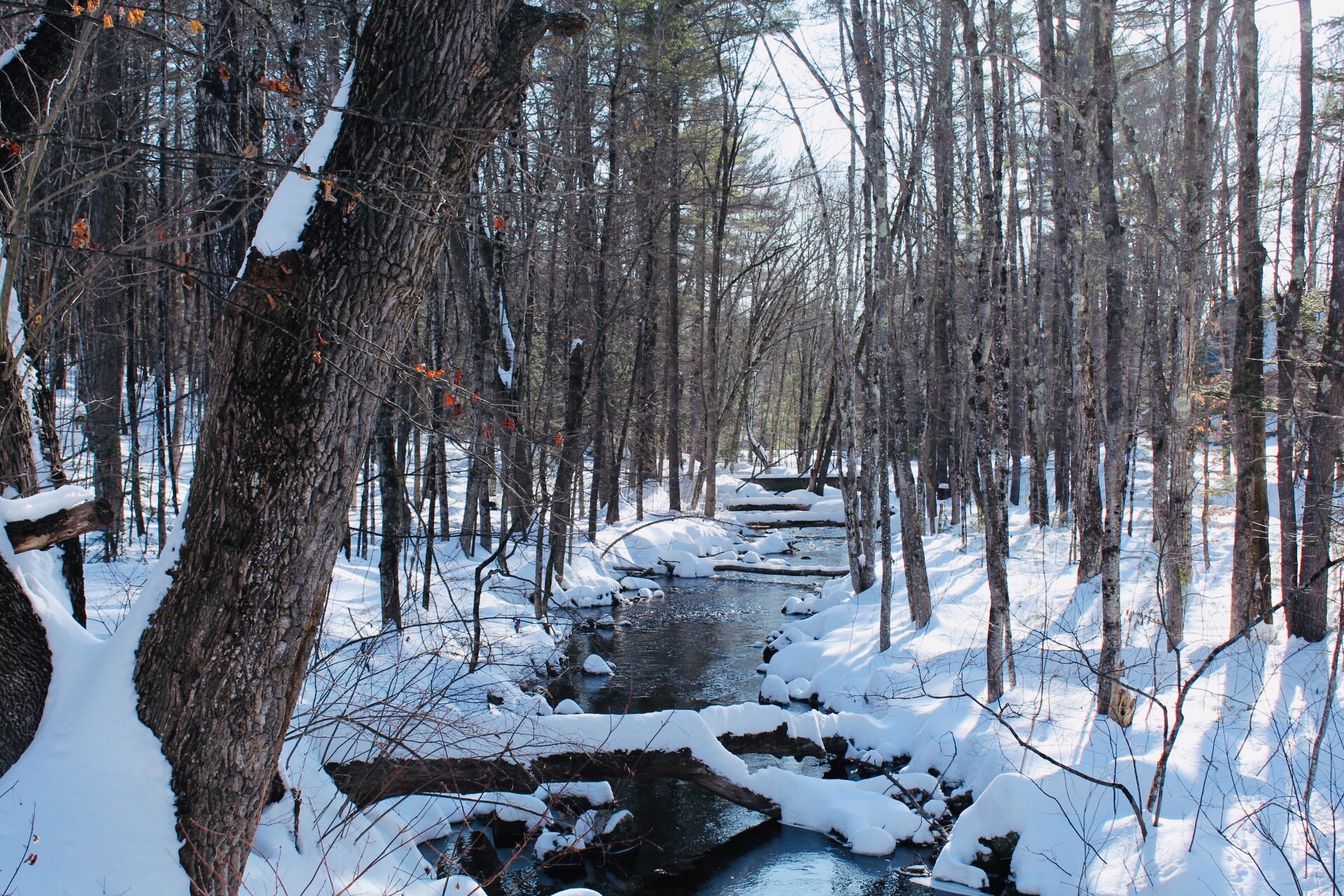
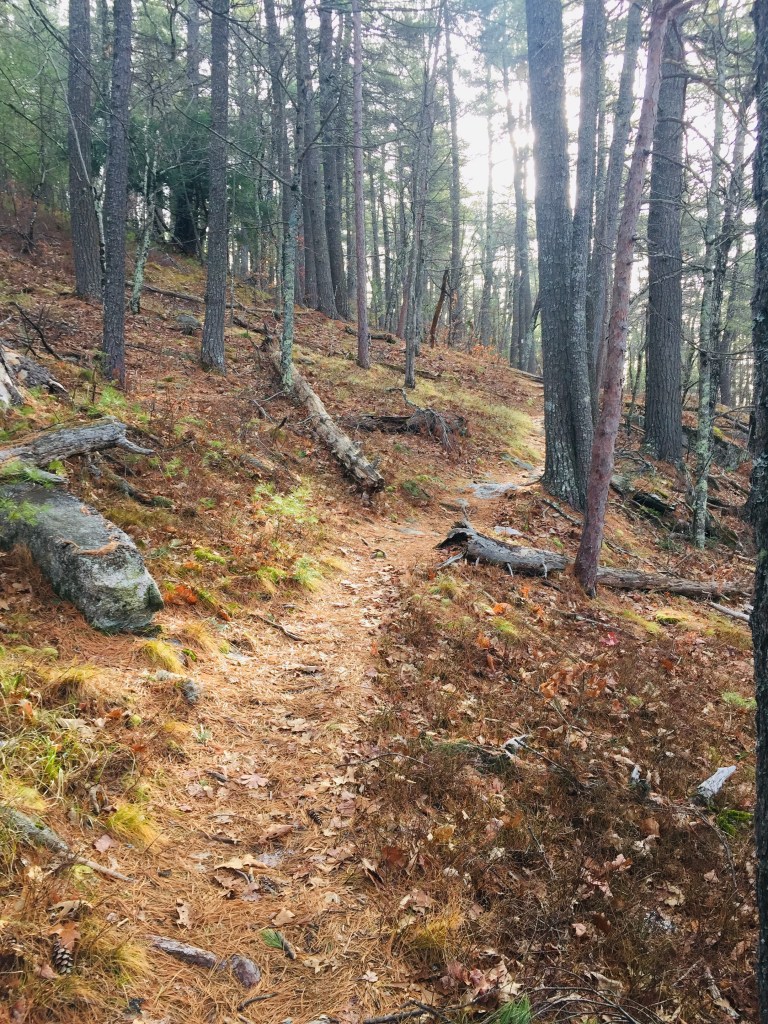
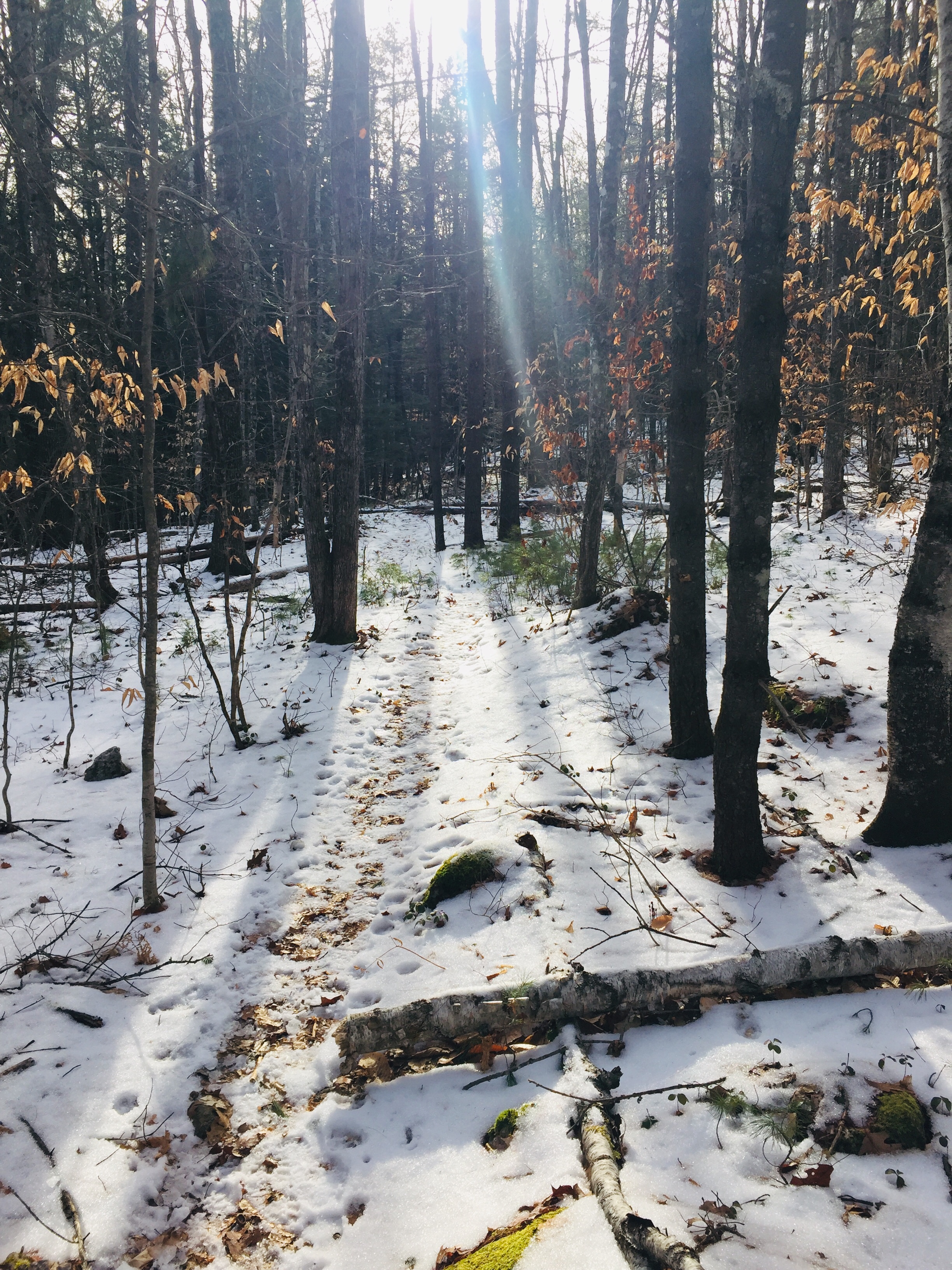
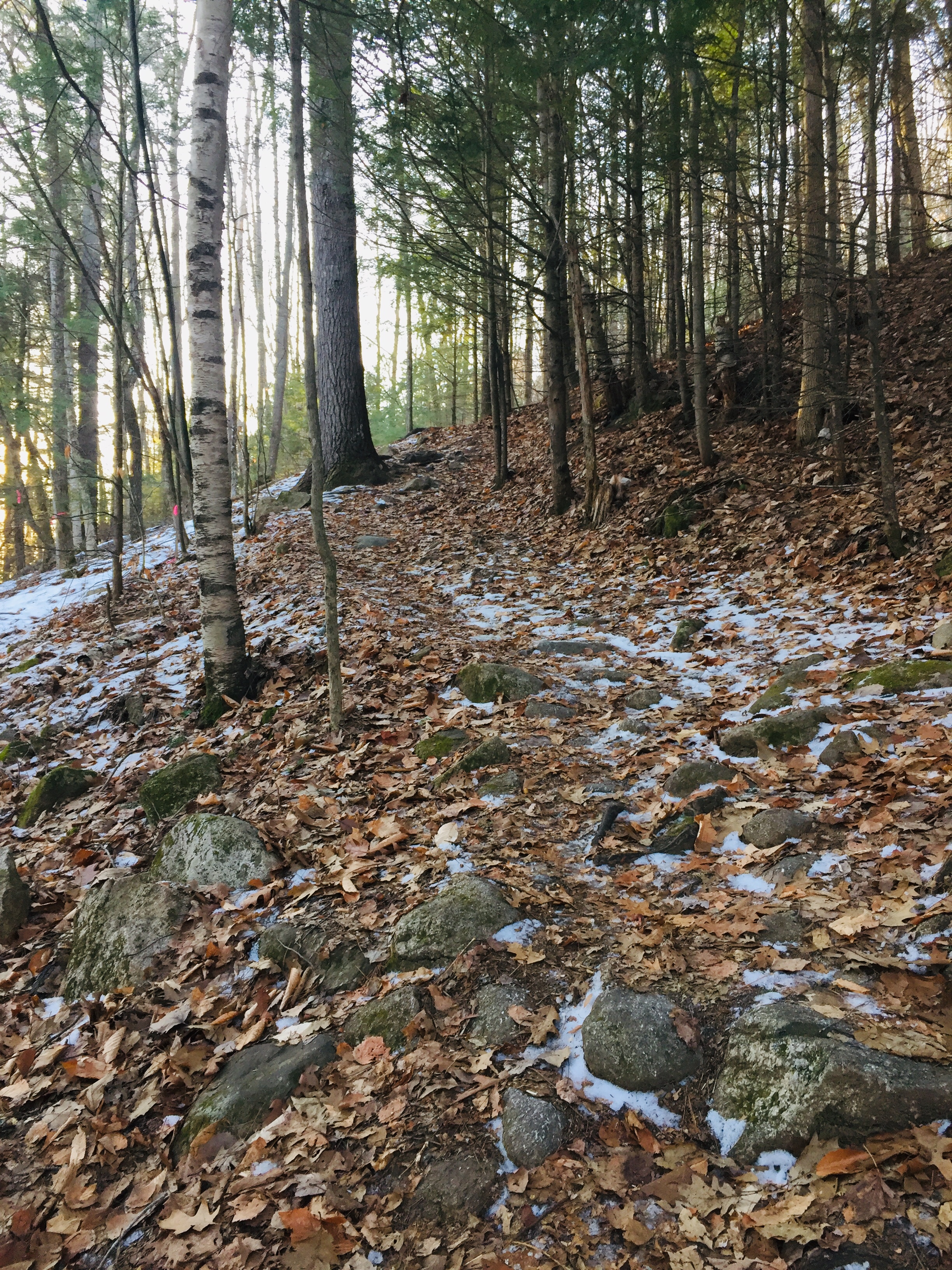
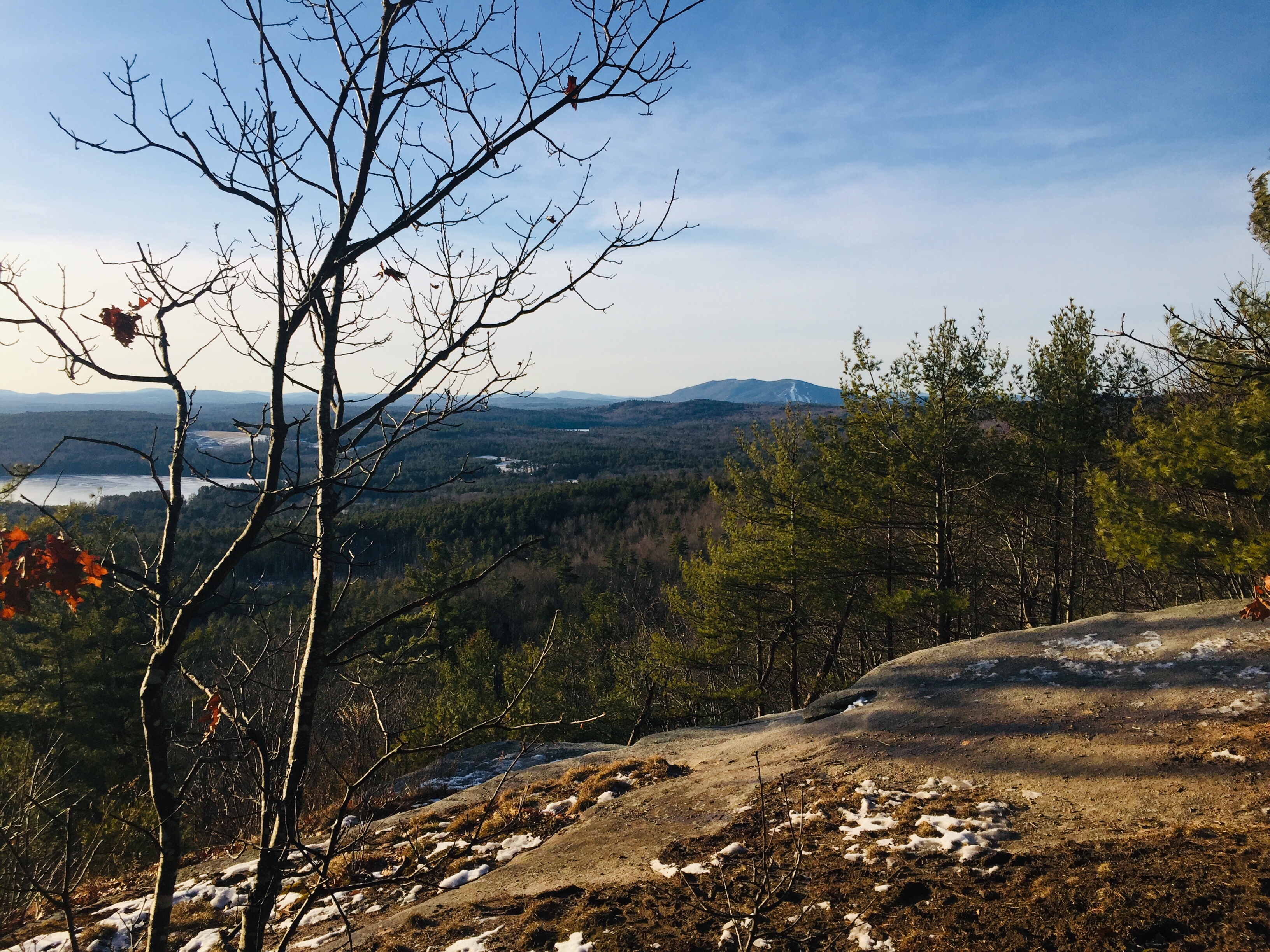
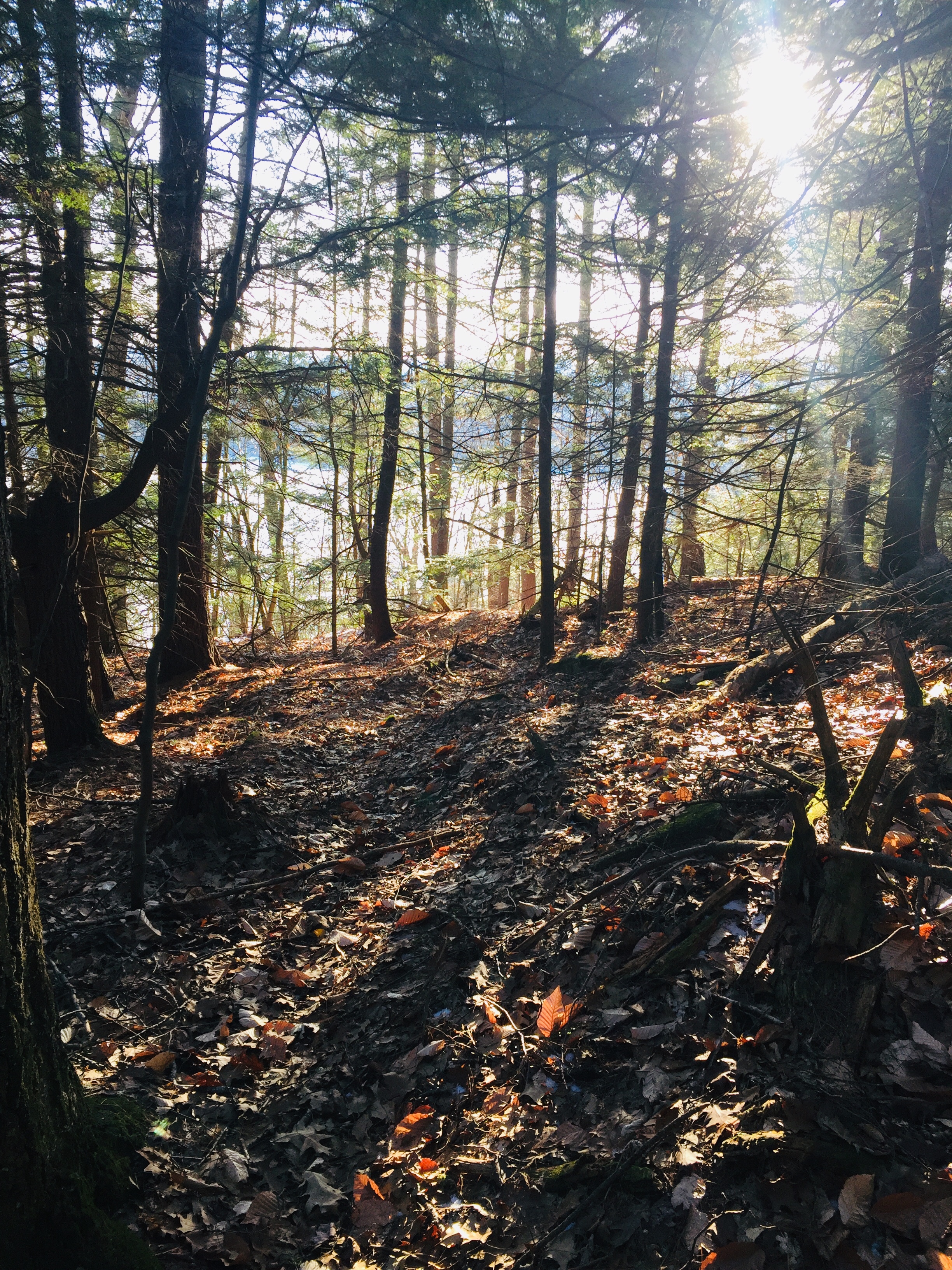
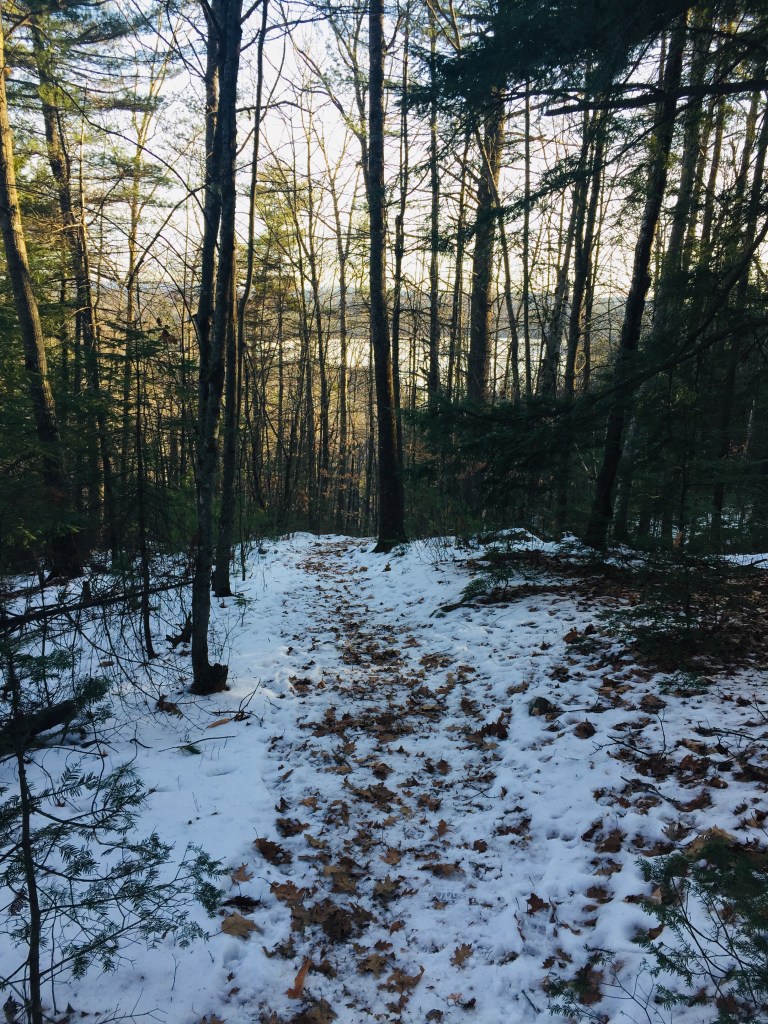
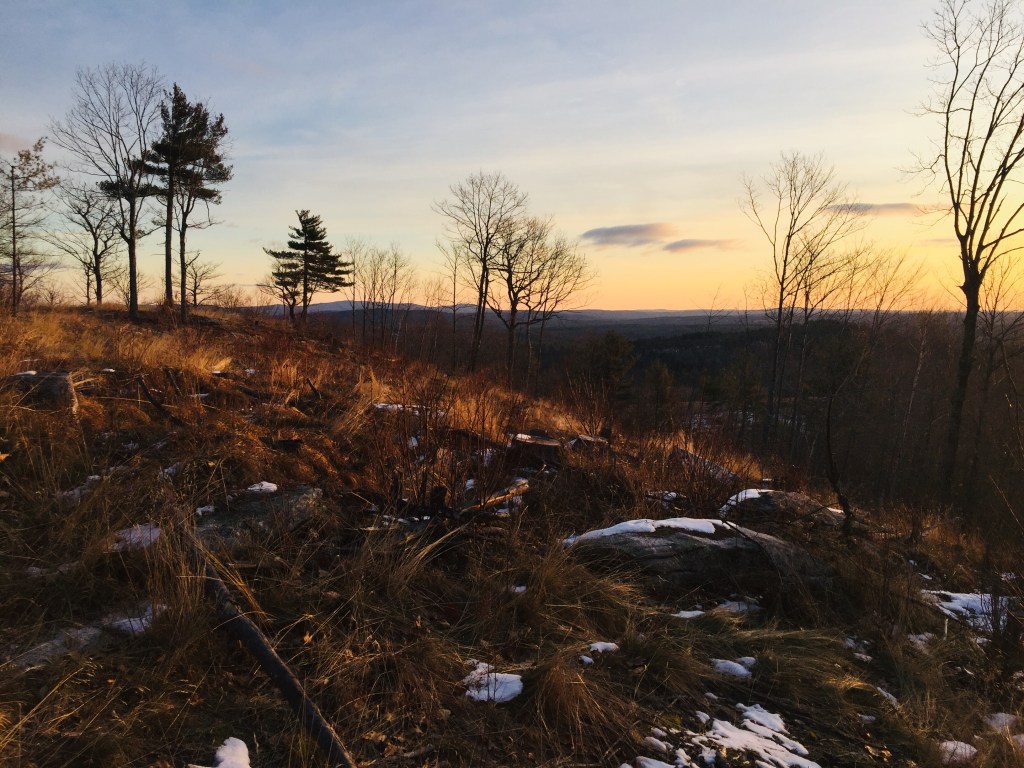
The Center Hill Nature Trail is a short (half-mile) loop located on Center Hill (1,658 ft), inside Mount Blue State Park, off Center Hill Road (unpaved) in Weld, Maine. This trail begins and ends at the parking area for the Center Hill picnic area, and includes excellent views of Mount Blue, Tumbledown Mountain, Webb Lake, and the surrounding lakes and mountains.
Center Hill Nature Trail, Mount Blue State Park, Weld, MaineThe steep, winding access road from Center Hill Road to the summit is paved, but not plowed in winter. There are snowshoe trails accessible to hikers from the base of the hill, or from the winter trailhead at park headquarters at 299 Center Hill Road, Weld, Maine. The best guide is Mount Blue State Park’s map and brochure.View of (right to left) West, Old Blue, Tumbledown, Little Jackson, and Jackson Mountains from Center Hill Nature Trail, Mount Blue State Park, Weld, Maine.We visited in May, before the summit road was open, and navigated the icy road to the summit on foot, then walked the Center Hill Nature Trail counter-clockwise, stopping at each viewpoint. The trail was wet, but easily navigable, and snow was only present in shaded areas.Viewpoint from Center Hill Nature Trail, Mount Blue State Park, Weld, MaineThis short trail is perfect for families, with picturesque spots to take photos and picnic tables with beautiful views, and brochures are available (in summer) for a self-guided natural history hike through numbered stations. In the summer, swimming is available a short drive away at Mount Blue State Park’s Webb Beach and Campground on the opposite side of Webb Lake.View of Mount Blue’s trademark conical summit from Center Hill Nature Trail, Mount Blue State Park, Weld, MaineFor those doing more challenging hikes in the area of Tumbledown, Mount Blue, or other peaks, this ring is a nice break, and the viewpoints and benches are an easy way to get the lay of the land of the Mount Blue area.View through the trees of Tumbledown, Little Jackson, and Jackson Mountains from Center Hill Nature Trail, Mount Blue State Park, Weld, Maine.
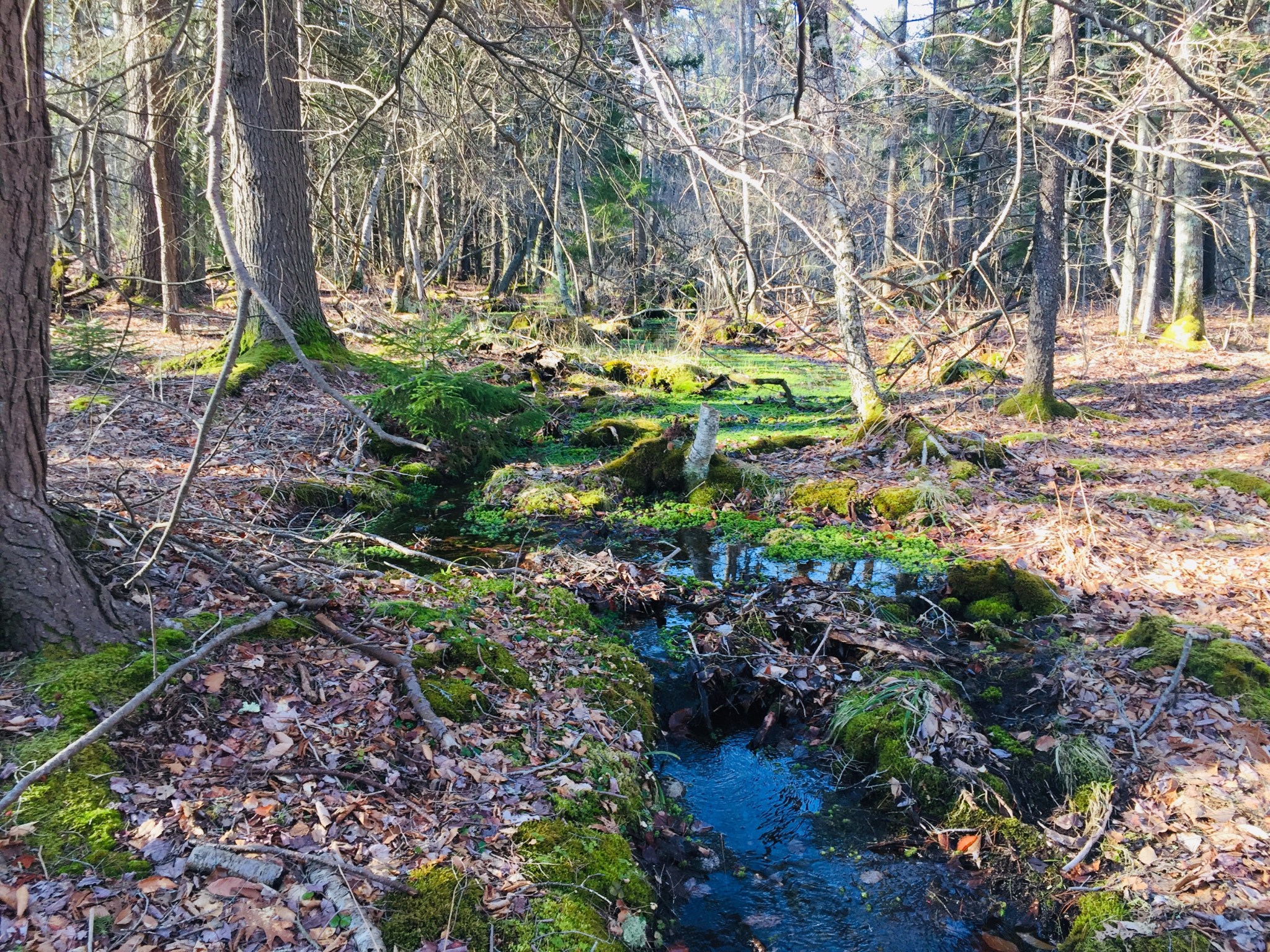
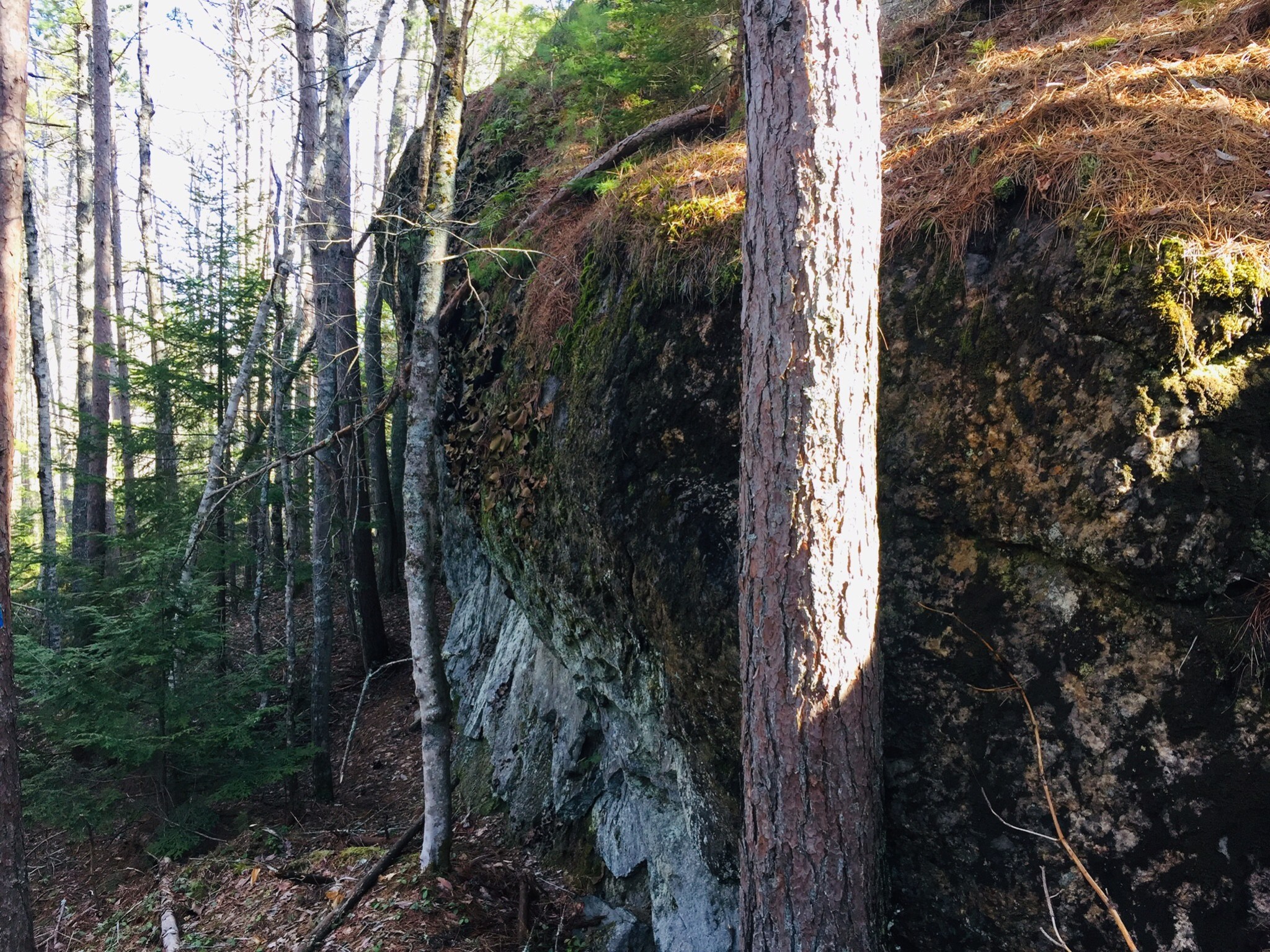
Seam of green moss surrounding stream, Basin Preserve, Phippsburg, METhe Sprague Pond Loop Trail through the Basin Preserve in Phippsburg, ME, is a quiet hike through diverse coastal woodland. The Basin Preserve consists of over 1800 acres in Phippsburg, Maine, from land donated anonymously to The Nature Conservancy (TNC) in 2006, and adjoins the Sprague Pond Preserve, maintained by the Phippsburg Land Trust. Trail maps of this rolling hike, featuring ridges, mixed hardwood, coastal pitch pine woodland, shrub marsh, and a 10-acre spring-fed pond, are available for download on the TNC website.Ridge covered in sunlight and blueberry plants, Basin Preserve, Phippsburg, MEOn a warm spring day, we took the Loop Trail, from the Burnt Ledge Loop trailhead on Basin Road and a portion of the Meditation Trail along Sprague Pond for a 5.8 mile loop (appx 2.5 hrs). Basin Road is closed for winter maintenance until April 15th, and trails (open sunrise to sunset) can also be accessed from the Sprague Pond Preserve trailhead on Route 209.Spring runoff in wooded stream, Basin Preserve, Phippsburg, METake time at the Basin Road trailhead to read the sign next to the fenced-in area opposite the trail, where TNC and the Maine Chapter of the American Chestnut Foundation maintain a seed orchard, where they are attempting to a produce a blight-resistant chestnut adapted to Maine’s climate. The Sprague Pond Loop Trail is a lollipop loop that divides at Burnt Ledge, and we chose the counter-clockwise loop, heading first down the western side of the trail.Rocky terrain and mixed vegetation, Basin Preserve, Phippsburg, METhis well-marked path, covered in pine needles, winds up and down small ridges, which are covered in blueberry plants. Despite the recent rains and swollen streams due to snow melt, the trails were dry and well-maintained. A few fallen trees made for brief scrambles/detours, but this was the exception, rather than the rule.Canada geese, south end of Sprague Pond, Phippsburg, MEWe saw and heard songbirds and squirrels throughout the hike, but the animal life peaked at Sprague Pond, where we saw mallard ducks, a great blue heron, Canada geese, a circling bird of prey (unidentified), and a garter snake enjoying the sunny Meditation Trail. Shortly after the pond, a beaver dam and lodge were visible, and a spring torrent fed a rocky waterfall next to the trail.Waterfall near Sprague Pond, Phippsburg, MEAfter the waterfall, the eastern side of the loop was primarily a mixed hardwood forest, open and light-filled, with desiccated beech leaves rattling in the wind, chattering squirrels and silent birches awaiting spring. This serene coastal woodland preserve offers a nearly six mile uninterrupted walk through pines, moss, blueberries, and birdsong.
Rumford Whitecap Mountain (2,214 ft) in Rumford is accessible through trails maintained by the Mahoosuc Land Trust (MLT), for a 5.4 mile out/back to the summit on the Orange Trail (or slightly longer using the Starr and Orange Trails), or a longer traverse over Black Mountain via the Black/White Trail (requires spotting a car). MLT’s website advertises Rumford Whitecap as a four-season destination for hiking, snowshoeing, and back country skiing, with blueberries in the summer.
Forest “gateway” descending the Orange Trail, Rumford Whitecap Mountain, Maine.
I have ascended via the Connector to the Starr Trail (marked with yellow blazes and flagging tape), and returned via the Orange Trail, and would suggest this route (or its reverse) for the views, rather than just the Orange Trail. I used the guidebooks Maine Mountain Guide and Maine Hikes Off the Beaten Path for detailed trail maps and descriptions. You can also find a map on the AllTrails app or Maine Trailfinder (link at the MLT website above).
Spring waterfalls on the Connector between the Starr and Red/Orange Trails, Rumford Whitecap
Both trails, divided by a pleasantly running brook in a valley between them, were muddy, but well-maintained. The Connector crossed the brook, with spring runoff created small waterfalls along the way. Rains can create a morning fog, but also spur the growth of a variety of May wildflowers from the trailhead to the summit.
Spring wildflowers, Rumford Whitecap, Rumford, Maine
The Starr Trail transitions from a grassy woods road to a winding climb, becoming more strenuous as the deciduous forest changes to a more sparse, rocky pine forest, and opens up on ledges with spectacular views of the Mahoosucs and White Mountains.
Descent out of the woods into the clouds on the Starr Trail, Rumford Whitecap
After the junction with the Orange Trail, the summit is only about another .5 miles, hopping over small cool rivulets of water running down the exposed rock face. Close to the summit last May, there was what appeared to be a large deposit of bear poop, but a quick look around didn’t disclose any prints. The summit itself is open in all directions, and a great spot for a picnic.
The long summit ridge of Rumford Whitecap
After a brief rest at the summit to enjoy the view and chew on some jerky, I headed back down the Orange Trail. The trail ran like a creek in places, with the spring rains, and remains diverted for a section. The hike can take about two to two and-a-half hours, with plenty of stops to listen to birdsong, inspect wildflowers, watch bumblebees at work, and pick up and inspect pieces of quartz.
(Disclaimer: This post contains affiliate links, and as an Amazon Associate Hiking in Maine blog earns from qualifying purchases.)
With the temporary closure of schools and businesses, the uncertainty in the air, and the moratorium on group activities in many places, the universal mood seems to be a somber one, at best. But, with care, resolve, and education (try this article on social distancing), a more sanguine view can prevail. What is a healthy thing to do that requires relative isolation – six feet of separation with non-family members, and no direct contact with surfaces that might contain lingering viruses?
Six feet of separation is easy to maintain on a trail.
Hiking, in its many forms, needs no more cheerleading for its holistic wellness benefits. But getting outside for mental health has never been more important. Here in Portland, Maine, schools will be closed until at least the end of April, a stay-at-home order has been issued, and non-essential businesses are temporarily closing. These actions, and others, can all have degenerative ripple effects on time, and on physical and mental health, if we let them.
Observation bench, Mariaville Falls Preserve, ME
First, breathe. We were fortunate to be born in a country with the infrastructure and prosperity to get through this. Here in Maine, we are less-densely populated than most other places, surrounded by an embarrassment of natural riches in the form of the coast, lakes, and mountains.
Remember- these are close, and popular, and may be crowded. The Portland Press Herald also just published a list of wild lands for exploration during this strange time.
Looking across Elbow Pond to Mt O-J-I and Barren Mountain, Baxter State Park
Again, check state and local guidelines on the trails or parks you are using. Some may be closed due to COVID-19, some may just be closed to protect trails during mud season. The best source of information is the maintainer of the trails, whether that be a government agency, a municipality, a land trust, or a non-profit.
The point is not some Instagram-worthy photo opportunity, it’s fresh air and time in nature, so don’t sweat the surroundings. Baxter Woods or Evergreen Cemetery are great places to walk. If you can’t make it way out onto remote trails, there are other outdoor options. Last weekend, dad and daughter took advantage of the sunny weather, using Portland Trails and the East Coast Greenway to safely walk ten-plus miles to Wainwright Fields in South Portland.
This is not meant to be a flippant article, but suggestions specific to getting outdoors in the Portland area. People are deeply affected by this pandemic. Post-hike, consider getting takeout or delivery from a local restaurant – Portland’s Old Port has an updated list of businesses where this is available, as does Portland Food Map. The best place to look for where to help is at your friends and neighbors, but donations of money or time to places like Preble Street or national charities like the Salvation Army or Meals on Wheels can help those less fortunate.
Mill Brook Preserve South, a 32-acre annex/extension of the Mill Brook Preserve, opened its trails in October 2019, and has a 1.5 mile easy lollipop loop for hiking, running, snowshoeing, and cross-country skiing, ending in a short spur trail with the opportunity to view the annual migration of the alewives in late May and June. As with the Mill Brook Preserve, the best information and trail map can be found at the website of the Presumpscot Regional Land Trust, which holds this land, and coordinates the 28-mile Sebago to the Sea Trail.
Kiosk at Mill Brook Preserve South trailhead, Millbrook Estates, Westbrook, Maine
The Mill Brook Preserve South trailhead is located next to well-marked parking spaces in the Millbrook Estates (300 E. Bridge St, Westbrook). We hiked the loop and the spur a couple times in February 2020, an easy hike of about forty minutes. The trail was packed snow, with softer snow on the margins, and I would suggest traction devices (Yaktrax or microspikes) to avoid slipping and sliding.
Edge of forest at southwest end of Mill Brook Preserve South adjoining cattle farm, Westbrook, Maine
We saw woodpeckers and red squirrels, as well as the tracks of deer. Dogs are allowed on the trail, but must be leashed, especially in the portion next to the working cattle farm (you will see signs). The beginning of the trail is next to a horse farm, so children may enjoy seeing these domesticated animals, if you strike out with woodland creatures.
Mill Brook in winter, Mill Brook Preserve South, Westbrook, Maine
The spur trail midway through the loop leads downhill to Mill Brook, and on this winter visit, the flow was mostly under a sheet of ice, with an open area close to the near bank. In early summer, this area can be a great spot to watch the alewives run (and a midway picnic stop with smaller kids).
Mill Brook in winter, Mill Brook Preserve South, Westbrook, Maine
As in its northern sister preserve, navigation along the trails is forgiving and self-correcting, with maps posted at critical intersections throughout the Preserve.
The Heald and Bradley Ponds Reserve consists of over 800 acres in Lovell, Maine, preserved and maintained for public use by the Greater Lovell Land Trust (GLLT) – see GLLT map here. A detailed description of trails is also available in the AMC Maine Mountain Guide. While snowmobiles are allowed in winter on marked trails, I didn’t see any on the sunny February Sunday I visited. I followed an easy to moderate (double, triple?) lollipop loop for about 4.6 miles (appx 2 hours, 886 feet of elevation gain), summiting Amos Mountain (955 ft) and Whiting Hill (801 ft) via the Blue, Orange, Yellow and Red trails.
Icy mill dam outlet of Heald Pond, Lovell, ME
From the (well-plowed) parking lot on Slab City Road, it is a short downhill walk to the Blue Trail, past the southern outlet of Heald Pond. Informational kiosks are at the parking area and at the beginning of the Blue Trail, additionally, small placards at trail intersections, each with a laminated trail map, make navigation self-correcting (“You Are Here” is difficult to screw up).
I wore snowshoes the entire route, and once off the snowmobile trail, was breaking trail through the deep, crusty snow. While the snowshoes made for enhanced mobility, the rasp and stomp of my steps eliminated my chances of seeing much wildlife. I was lucky enough to see a large pileated woodpecker, and the signs in the snow of others – the soft tread of foxes, the larger, circling tread of coyotes, the bouncing tread of deer, and the deeper, larger crescents left by moose.
Mt Washington wreathed in clouds from Amos Mountain viewpoint, Lovell, ME
I bypassed Whiting Hill on the way out, sticking to the west shore of Heald Pond on the Red Dot Trail, and clambering down the Otter Rocks Spur briefly to look at the frozen lake, and the sole visible ice fishing shack. As I was solo, wearing snowshoes, and shoreline ice is often the most treacherous, I didn’t venture out on the frozen pond. Continuing gradually uphill, I reached the intersection with the Chestnut Trail (blue blazes), and turned left, towards the Heritage Loop Trail (orange blazes), and a broad circle of the summit of Amos Mountain.
Summit cairns and bench, Amos Mountain, Lovell, ME
To the west of the summit is a viewpoint, just short of the Rogers Family Trail (blue blazes), with views of the Whites, with Mt. Washington as a centerpiece. The wooded summit of Amos Mountain contains rock cairns and a bench, with views to the southwest.
Kezar Lake and the Whites from Whiting Hill summit, Lovell, ME
I descended Amos Mountain to the Hemlock Loop Trail, and a small picnic area, then headed towards Whiting Hill and its loop back to the start of the trail and the parking area. Whiting Hall has a more open summit, with views to the West of Kezar Lake and the White Mountains beyond, and an easy downhill walk ended at Slab City Road.
This would also be a beautiful fall hike, but I enjoyed having the place mostly to myself in the snow. Parking areas on Route 5 and Heald Pond Road can also be used to shorten the hike for children or the less mobile – see the GLLT map for locations. This Reserve is not far from Sabattus Mountain, and the post-hike stops available in Lovell are the same – the Center Lovell Market, for picnic supplies and a restaurant, and (after checking seasonal hours) Ebenezer’s Pub for food and Belgian beer.
In January 2020, I hiked Mount Tom (1,073 ft) via the West Ridge Trail, an approximately 3.5 mile out-and-back from the parking lot for Mount Tom Preserve at Menotomy Road in Fryeburg, which took about an hour and fifteen minutes. Like Hawk Mountain and Mount Tire’m, which I did earlier the same day, this is a short but rewarding Oxford Hills hike. This can also be done as an approximately 4-mile loop hike by continuing after the summit to the Mount Tom Trail, then returning south on Menotomy Road, which is usually relatively quiet, to the start point.
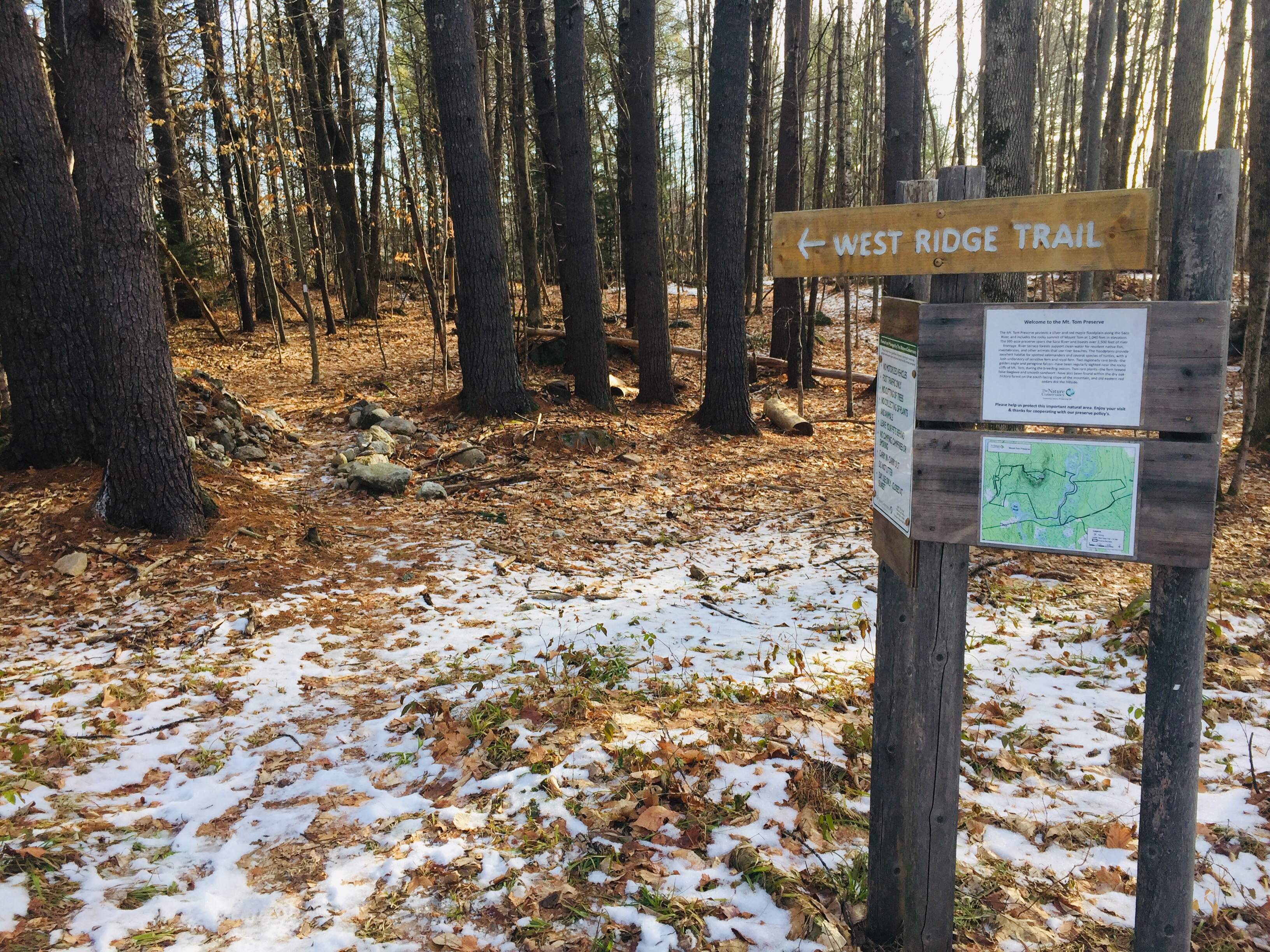
Kiosk and start of West Ridge Trail from Nature Conservancy parking lot, Mount Tom Preserve, Fryeburg, Maine.
This parking lot, and the Preserve, which includes the summit, are maintained by The Nature Conservancy (TNC). TNC’s excellent description of the Preserve follows:
Mt. Tom Preserve protects a silver and red maple floodplain along the Saco River, and includes the rocky summit of Mount Tom at 1,040 feet in elevation. The 995-acre preserve spans the Saco River and boasts over 3,500 feet of river frontage. Several day-use hiking trails provide recreational opportunities, as does as a 1.14 mile seasonal snowmobile trail that is part of a larger network maintained by the Interstate Sno-goers. Visitors can summit Mt. Tom, canoe along the Saco River, or just walk through the beautiful forests!
River terrace forests support clean water for resident native fish, invertebrates, and other animals that use river beaches. The floodplains provide excellent habitat for spotted salamanders and several species of turtles, with a lush understory of sensitive fern and royal fern. Two regionally rare birds–the golden eagle and peregrine falcon–have been regularly sighted near the rocky cliffs of Mt. Tom, during the breeding season. Two rare plants–the fern-leaved false foxglove and smooth sandwort–have also been found within the dry oak-hickory forest on the south facing slope of the mountain, and old eastern red cedars dot the hillside.
View south from West Ridge Trail, Mount Tom, Fryeburg, Maine.
The West Ridge Trail, marked by white blazes and small TNC emblems, rolls across that floodplain, crossing small brooks, passing ghostly birches and large rock formations, until becoming steep about a mile in.
West Ridge Trail, Mount Tom Preserve, Fryeburg, Maine.
The trail ascends the ridge, with frequent views through clearings in the trees, to meet the Mount Tom Trail, at which point, it turns right, and shortly thereafter, reaches the summit and its rocky ledges and views.
Mount Tom summit, Fryeburg, Maine.
The descent in winter was easy, with microspikes, and I saw several other groups, all with dogs, ascending the trail on my way back. An added benefit in winter was the lack of bugs, which would be omnipresent in the late spring and early summer in the first portion of the trail. This hike may be challenging for very young or out-of-condition hikers, but presents an easy to moderate walk in the woods, with views to the south of the Saco River Valley.
West Ridge Trail in winter, Mount Tom Preserve, Fryeburg, Maine.
Mount Tire’m (1,104 ft) is a short (1.3 miles, appx. 35 minutes) out-and-back hike via the Daniel Brown Trail, right in the village of Waterford. I hiked it recently in the winter, but this is an all-season hike, presenting a brief, but moderately steep climb. A story, too convenient to be anything but apocryphal, has the name coming from the Pequawket tribe near Fryeburg saying the climb would “tire um out.”
Daniel Brown Trail, Mount Tire’m, Waterford, Maine
The trailhead is located just uphill from the Waterford Congregational Church on Plummer Hill Road, with parking on the shoulder. While there wasn’t much snow, the grade of the climb and the ice had me pulling on micro-spikes fairly early.
Views from Mount Tire’m, Waterford, Maine, including Pleasant Mountain and Shawnee Peak.
The summit area includes some rock formations and a “cave,” a glacial erratic, which is popular with children, as well as summer blueberries. The sparse winter vegetation and abundant sun allowed for more light through the trees, and views throughout of nearby Keoka Lake, to the east.
View of Keoka Lake through the trees, Daniel Brown Trail, Mount Tire’m, Waterford, Maine
This well-packed and frequently used trail was relatively empty on this winter weekend morning, with only two other hikers, a fit older couple with a dog. In this quiet, I could hear the wind rattling and rustling through the winter forest’s dried leaves, the distinctive squawking of crows and intermittent chickadee songs.
Snowy Daniel Brown Trail, Mount Tire’m, Waterford, Maine
Hawk Mountain (1047 ft to 1070 ft, depending on who you trust) is a small mountain in Waterford, Maine, with sweeping views of the Lakes Region and Oxford Hills. Maps and information are available at the Western Foothills Land Trust website. Trails at the Hatch Preserve at Hawk Mountain are open year-round for hiking, cross-country skiing, and snowshoeing, and we hiked it on a cold late December day, and again recently on a sunny day in March.
View north at sunrise, looking back from the ascent of Hawk Mountain, Waterford, ME
The trails are not well-marked (the website delicately described the preserve as a little “wounded”), but I summited and enjoyed the views via an ungainly, but very easy, 1.9 mile loop using what I believed to be the Europe and Cyrus trails, taking about 45 minutes. The fastest way to the top is an approximately 1.4 mile out and back.
Winter sunrise on Hawk Mountain, Waterford, ME
The parking area on Hawk Mountain Road is well-maintained, and a kiosk contains a small map, walking sticks to borrow, and reminders to carry out what you have carried in. Past the main parking area/kiosk, there is a small parking area with a few spots next to an ATV trail intersection, with a town of Waterford parks sign. Beware during spring mud season of the short drive on Hawk Mountain Road between the parking areas, which is extraordinarily muddy, and requires four-wheel drive.
Forest on Hawk Mountain, Waterford, ME
In January, there were sled tracks and footprints on the trails, but the paths were empty and climbed gradually up, opening out on views to the east. In March, with the “social distancing” pushing people outside, the trails were more full.
Mount Washington and the Whites in March from Hawk Mountain
A short walk back west across the ridge leads to the scenic vista on town land overlooking the Oxford foothills, with views across to Pleasant Mountain. I didn’t need snowshoes or trekking poles for this simple hike, but some micro-spikes would have been helpful for traction on the packed, icy descent (an alternative would have been a piece of cardboard and a crash helmet, to slide down).
Pleasant Mountain, Shawnee Peak, and the Oxford Hills from Hawk Mountain, Waterford, ME
This is not a very challenging hike, but might be just the size and grade for young children, making it a perfect all-season hike for families in the Lakes Region, with a great picnic spot on top, and big views.
We received this video submission from a reader through the Contact Us link, and were happy to repost, as Acadia National Park shared with friends to good music (with a nod to Friends of Acadia) checks a lot of boxes for us. The producer was Patrick J. Lynch, and the music by Doctor Turtle, Often Outmumbled, Never Outpunned. As snow falls here in Maine, nice to re-visit the possibilities of early summer.